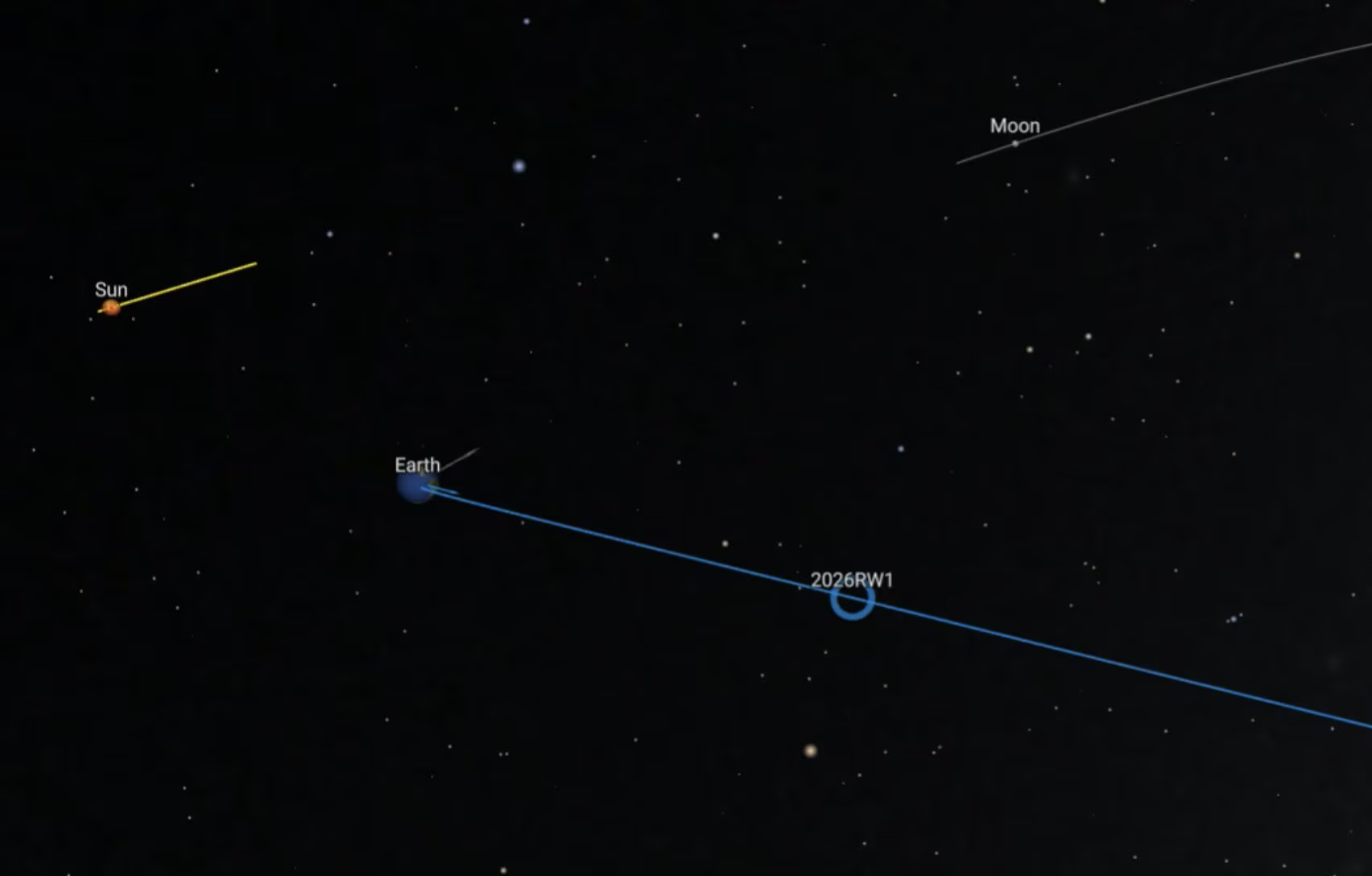
A small asteroid entered the Earth’s atmosphere and disintegrated over the Indian Oceanoff the northwestern coast of Australia: the space object, named 2026 RW1fell last September 6th around 18:07 Italianburning completely after entering the atmosphere and disintegrating without causing damage or impact craters.
So far, it doesn’t seem like anything exceptional: small space objects enter the atmosphere all the time. In reality, the news is important because it concerns the 13th asteroid which is discovered well in advance of impact. Over the course of human history, therefore, experts have managed to detect an asteroid before it entered our atmosphere only 12 more times.
In more detail, 2026 RW1 has been identified with approx 6 hours early: this is a considerable time if we consider that ESA estimated the asteroid to have a diameter of just 0.6–1.3 meters.
The characteristics of asteroid 2026 RW1
According to estimates from ESA’s NEO (Near-Earth Objects) program, the dimensions obtained from the absolute magnitude of the asteroid (equal to 33.4) and from an albedo between 0.05 and 0.25 indicate a diameter between 0.6 and 1.3 metres. The Minor Planet Center, however, reported a average diameter of approximately 0.8 metres: in short, in terms of size the asteroid could be compared to a hold suitcase.
ESA scientists have classified 2026 RW1 as belonging to the family of Aten asteroids which have an orbit that is on average more internal to that of the Earth: from an astronomical point of view, they have a semi-major axis less than 1 Astronomical Unit, i.e. the unit of measurement that represents the average distance between the Sun and the Earth (about 150 million km).
However, their aphelion (i.e. their maximum distance from the Sun) is large enough to lead them to intersect the Earth’s orbit: this is precisely what makes the impact with our Planet possible.
The impact of 2026 RW1 with the atmosphere occurred around 16:07 UTC (18:07 in Italy) last September 6: the asteroid completely disintegrated upon entry into our atmosphere above the Indian Ocean.
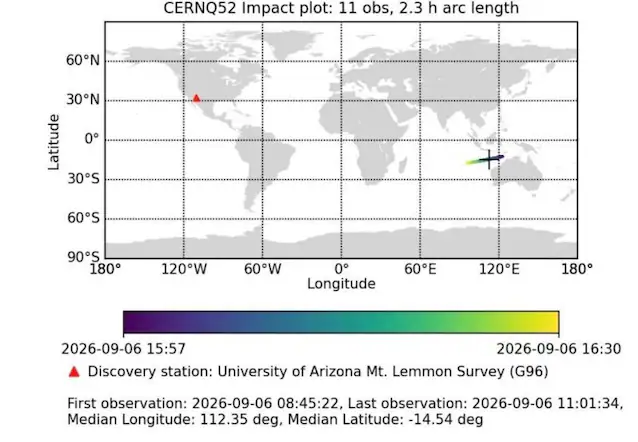
How they detected it early: MLO telescopes
Here the most interesting part of the story comes into play: on Sunday 6 September 2026, the automatic telescopes of Mount Lemmon Observatoryin Arizona, they intercepted a faint object crossing the sky. Initially the asteroid had received a provisional acronym, CERNQ52later replaced by the official name 2026 RW1.
Subsequent observations were then also confirmed by NASA’s Center for Near-Earth Object Studies, which then calculated the impact point in the middle of the Indian Ocean, far from inhabited coasts.
From when it was discovered to when 2026 RW1 burned up in the atmosphere have passed about six hours: it’s there thirteenth time in history that an asteroid is coming discovered before impact and doing so with an object measuring just 80 centimeters is noteworthy.
But how did they spot such a small space object? The technique consists of compare images of the same portion of the sky taken at different times, to spot fast-moving objects against the fixed background of stars.
This is not a new method: it was used by astronomers in the past Clyde Tombaugh, who discovered the existence of Pluto in 1930. At the time, however, the work had to be done manually, with photographic plates and an instrument called a “blink comparator”.
Today, however, i automatic telescopes they often leverage machine learning and artificial intelligence to make search faster. Once 2026 RW1 was identified, the ESA’s Meerkat systemanother automatic warning system, which in turn calculated the trajectory and predicted the time of impact.
The first Aten family asteroid detected before impact
Small asteroids enter Earth’s atmosphere all the time, but detecting them before they do remains a challenge rare eventas it is extremely complex. That’s why every discovery of this kind is considered a test case for i our surveillance systemswith the aim of improving the detection of space objects potentially dangerous for the Earth.
However, there is a detail that could make this case special compared to the previous ones: 2026 RW1 should be the first Aten-type asteroid never detected in space before an impact. The name Aten comes from the first asteroid of this category, 2062 Athens discovered in 1976, named in honor of the Egyptian solar deity.
To date, all asteroids detected in space before impact belonged to the family of the Apollos, which are on average at a greater distance from the Sun than from the Earth.
The first ever case of an asteroid detected before impact was in 2008, when asteroid 2008 TC3 was discovered about 20 hours before it fell into a desert in Sudan. So far, overall, no asteroid has been discovered more than 24 hours before impact.
