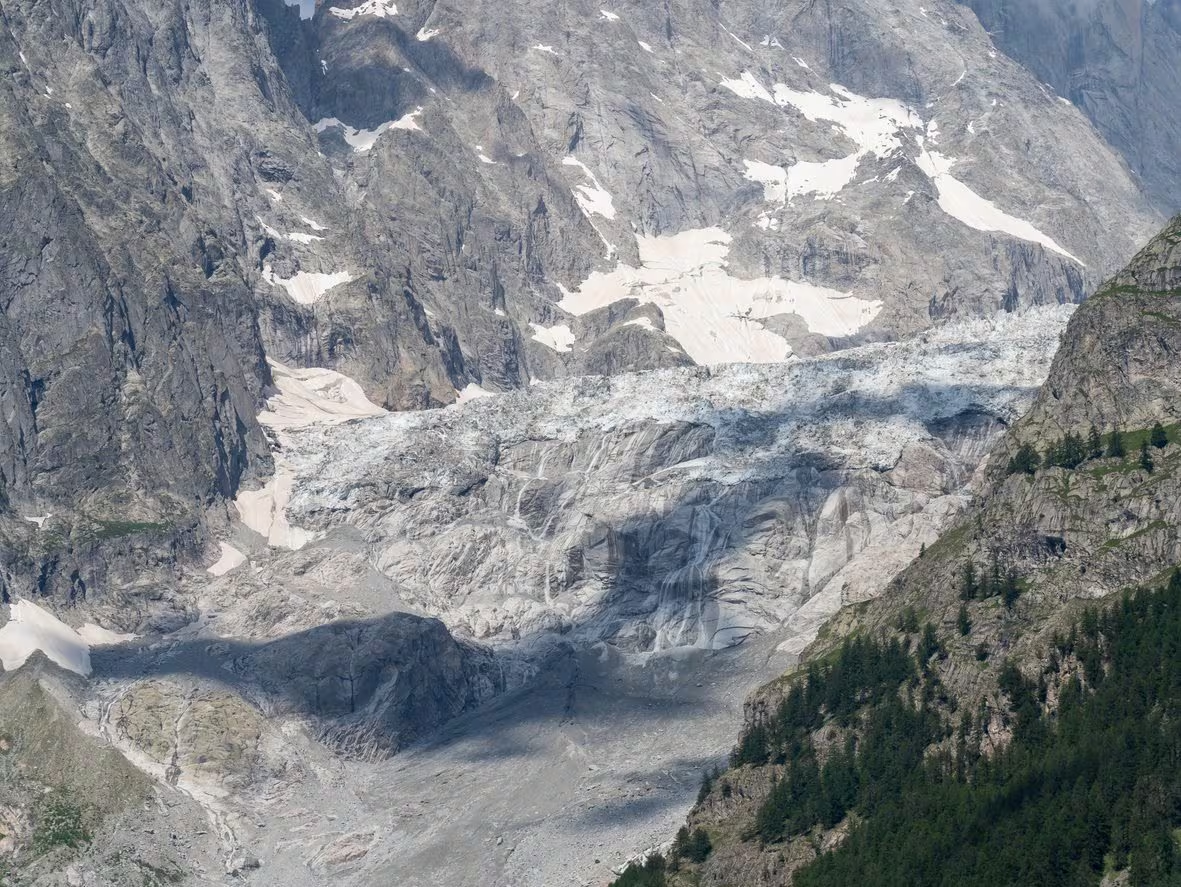
With the increasingly rapid melting of our Alpine glaciers due to global warming, countless numbers have emerged in recent years artifacts from the First World Warfor example shacks, weapons, clothes and even human remains. Added to these are findings dating back to more recent times, such as the one made in August 2026 on Mont Blancwhere volunteers recovered a lot of plastic and glass waste from the 1980s. Find these items again it doesn’t mean that the melting of the ice above them simply brought the glacier back to the conditions that characterized it at the time to which the finds date back and that therefore the current thickness of the glaciers has returned to being the same as a century ago. This is because, once an object falls to the surface of the glacier, it does not remain there forever. Embedded in ice, it is dragged by the movement of the glacier towards lower altitudes, where temperatures are higher and fusion prevails, which makes it emerge. This natural process is accelerated by climate change, which makes melting much faster.
Glaciers act like conveyor belts
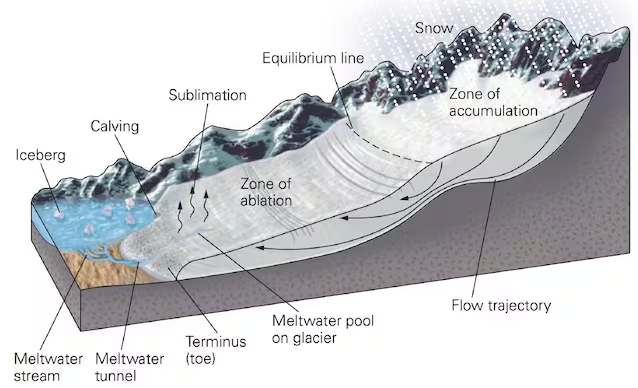
To understand why seeing ancient finds emerging from our glaciers today does not mean that their conditions have simply returned to what they once were, we must first understand the dynamics of these ice masses. Glaciers are formed thanks to the accumulation of snow at higher altitudes which turns into ice over ten or twenty years. Ice formation occurs in what is called feeding area of the glacier, where the quantity of snow that accumulates in winter exceeds that which melts in summer. The feeding area is located above a so-called line persistent snow limitwhich separates it from ablation zoneat lower altitudes, where there is a loss of ice due to melting or passage to the vapor state. If over the course of a year the amount of snow and ice lost in the lower part (ablation) exceeds that of snow that has been added to the upper part of the glacier (accumulation), the glacier is shrinking and it is said that the glacier mass balance is negative. This is what is increasingly happening to glaciers around the world due to global warming. Furthermore, as temperatures increase, the Persistent snow line is rising progressively in altitude, so even areas that were previously of accumulation become ablated. The presence of ice below this limit is due to the fact that glaciers are not static, but they move downstream due to the force of gravity as gigantic conveyor belts.
Because war relics buried in the Alpine ice re-emerge
In the past the objects that were lost or abandoned at high altitudes in our Alps, for example during the war, came quickly buried by heavy snowfall winter. The snow then progressively compacted under the weight of the layers above and underwent a series of processes that transformed it into ice, incorporating what it contained. Over the decades, glaciers have slid to lower altitudes, deforming and carrying the incorporated objects with youjust as they do with eroding rock fragments. Once they reached the ablation zone, the snow and ice covering them began to melt. The thickness of the layer under which they were hidden decreased to expose them again. However, these finds do not emerge at the point where they were abandoned, but further downstream. The trial today is accelerated by rapid fusion due to global warming, but sooner or later the glaciers would have abandoned what they were carrying anyway. In conclusion, the re-emergence of historical finds does not indicate that in the past the extent and thickness of the glaciers, and therefore the climatic conditions, were those of today. Instead it is the consequence of glacial dynamicsaccelerated by ongoing climate change.
