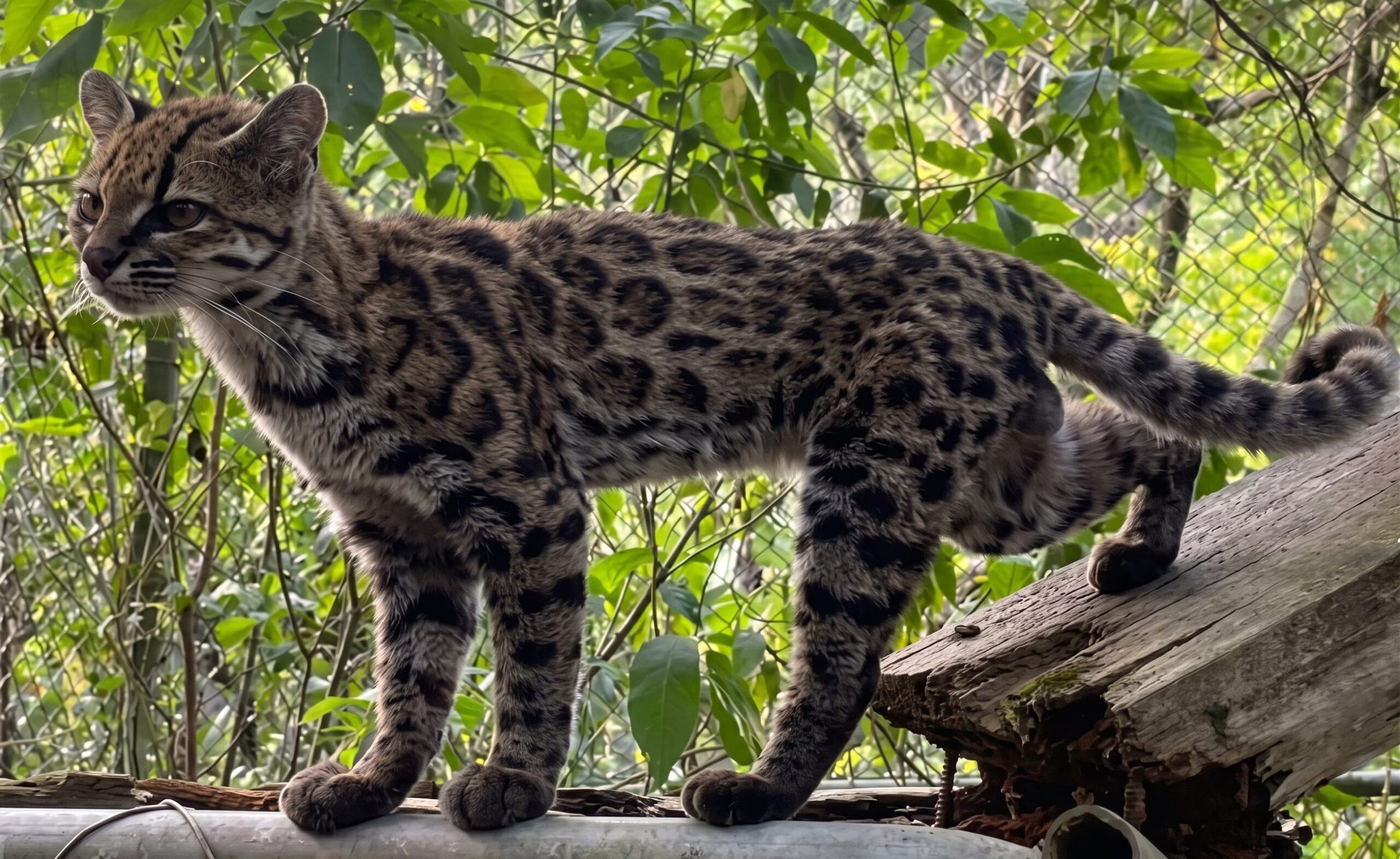
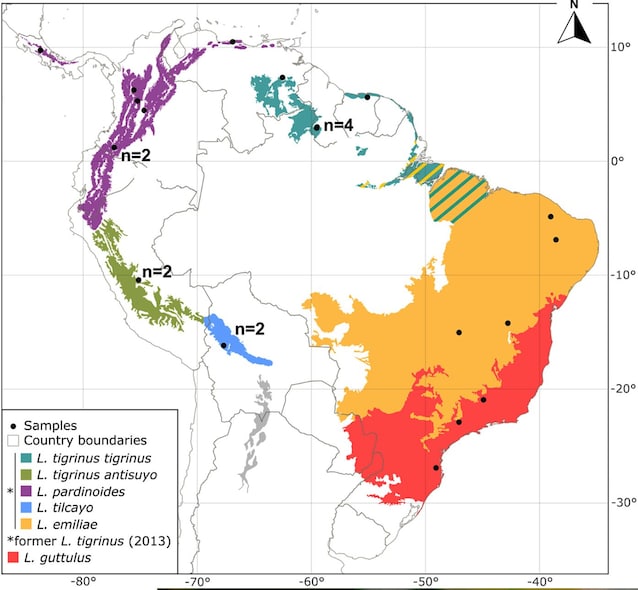
A group of researchers has discovered a new species of wild cat in Bolivia: is called Leopardus tilcayolives in the rainforests of the Andes and is the first “new” cat to science in over 100 years. The study, published on Current Biologyanalyzed the DNA of 38 specimens of the genus Leopardus and discovered that the group of so-called South American “tiger cats” actually includes five distinct speciesunlike the 2 that were thought (Leopardus tigrinus And Leopardus guttulus).
A historic scientific discovery: the first new tiger cat in a century
The last time a new species of feline was described dates back to the Pampas cat in 1923. Since then the taxonomy of felines has been updated several times, but always redefining already known animals.
The discovery began, by chance, in 2016 when a man found a baby feline along a Bolivian road and kept it at home for a year, convinced it was a domestic cat. Having become an adult and showing its wild side, the animal was entrusted to the Senda Verde recovery center, where the Bolivian researcher Paola Nogales-Ascarrunz examined it for the first time, noticing rosettes (the spots on the coat) larger and more irregular than those of the reference Brazilian tiger cats. A detail that alone was not enough to prove anything. It took years of genetic analyses, conducted together with Jonas Lescroart of the University of Antwerp and Eduardo Eizirik (PUCRS, Brazil), to arrive at confirmation.
What the tilcayo looks like, where it lives and how they recognized it
The tilcayo it is a small feline, smaller than a common domestic cat:
- Head-body length: 42-50 cm
- Tail length: 25 cm
- Weight: approximately 1.5 kg (the specimen recovered in Santa Verde weighed 1.4 kg)
The 10-year-old tilcayo observed by the researchers has a short muzzle, small and rounded ears and very long whiskers. The coat has a light brown background, darker on the back, sprinkled with dark and irregular rosettes (“open”, not closed as in the leopard).
This species lives in the rainforests of the Bolivian Yungas, on the eastern side of the Andes, between 1,500 and 2,000 meters above sea level. Recognizing this was not easy for researchers. Tiger cats are elusive animals, with populations that are difficult to distinguish even with camera traps. What was fundamental was thegenetic analysis. The authors of the study sequenced the DNA of 38 specimens of the genus Leopardus, reconstructing the phylogenetic tree. The team demonstrated that the Bolivian specimens form a branch of their own, separated from other tiger cats by approximately 1.4 million years of evolution.
Conservation status: is the new species already at risk?
Until now, the IUCN Red List recognized two species of tiger cat: Leopardus tigrinus to the north and Leopardus guttulus to the south, both classified as “Vulnerable“. If these large populations turn out to be in reality five different specieseach with a restricted range, the risk assessment changes: each will have to be considered separately, and some may be more threatened than previously thought.
For tilcayo, genomic data from the study shows a reduction in internal genetic diversity estimated at around 60% between the Pleistocene and today. The species, being very recent, has not yet been formally evaluated by the IUCN and some aspects of its biology (diet, reproduction, number of specimens) remain unknown. The authors themselves underline that protect the Yungas habitat Bolivian will be decisive for this “new cat”.
