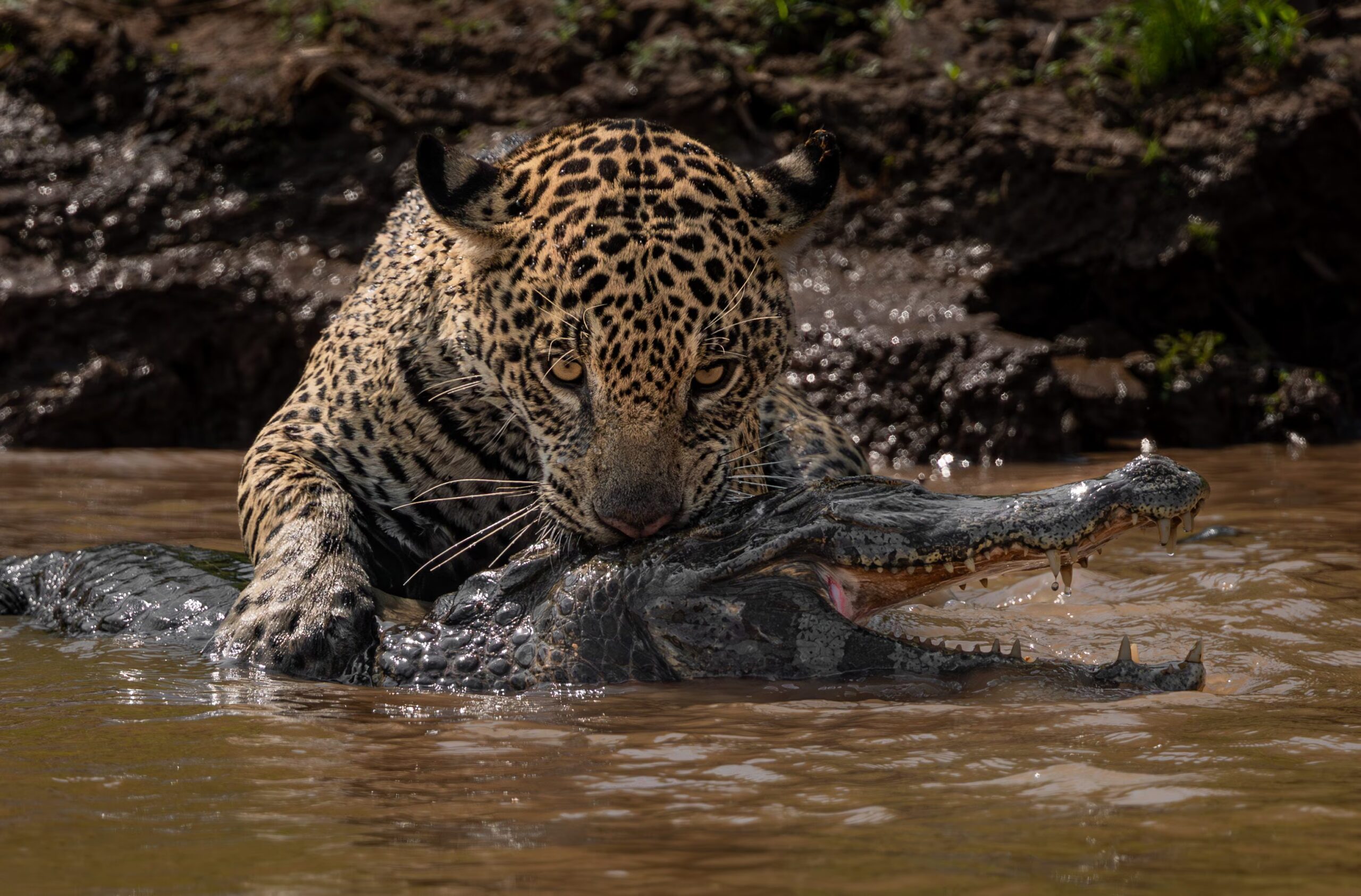
In the Pantanala tropical wetland in Brazil, it is not uncommon to witness one of the most spectacular predator battles in the animal kingdom: a jaguar (Panthera onca) who faces a caiman in a melee of a few seconds. As shown by the numerous videos that often circulate on social media, the feline approaches its prey from the shore, lowering itself from overhanging trees or moving directly into the water, and then swoops down on the reptile. The jaguar, in fact, is among the few felines in the world capable of regularly hunting and killing caimans, crocodiles and turtles thanks to a unique adaptation: a specialized hunting technique that ends with a lethal bite delivered to the skull (force between 945 and 1460 Newtons according to a study on The Anatomical Record).
The fight of the jaguar against the caiman
In the images of the Pantanal Official canal, the pattern is typical of an ambush: the jaguar identifies the caiman in the water, slowly approaches from the branches of a tree and then makes a quick leap onto the target. There is no pursuit, as the jaguar is an ambush predator for which the most important phase is the silent approach, just as happens for its close relative, the leopard (Panthera pardus). Once the caiman has been bitten in the water, the two begin to wriggle in a brief fight from which the feline emerges victorious, dragging the now helpless reptile out of the water.
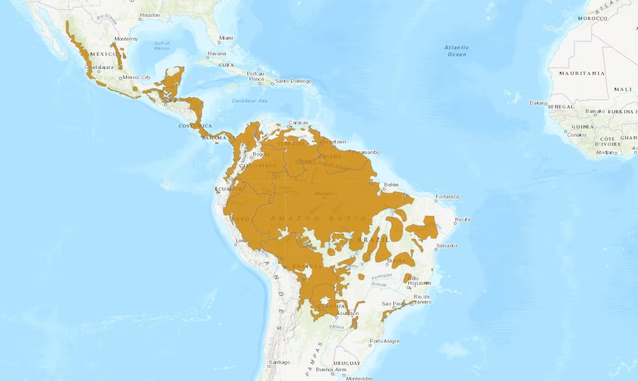
The Brazilian Pantenal is the ideal context to witness this clash: it hosts the highest density of jaguars in the world and it is rich in caimans (Caimans yacare). A GPS monitoring of 10 jaguars, explained in a study published on Journal of Mammalogy in 2010, in this area it documented that almost a quarter of the prey consumed (24.4%) were truly caimans. This shows that hunting these armored reptiles is a structural habit of its diet.
The hunting technique: the lethal bite to the skull
Other large cats such as lions, tigers or leopards kill large prey by biting them in the throat or neck. The problem is that the body of caimans is protected by bony plates (osteoderms) and the neck is short and armored, not offering the same weak points as a mammal. The jaguar, a skilled and effective swimmerhas therefore developed a different hunting technique: he aims straight at the neurocraniumthe box that contains the brain, and sinks his canines into it until the connection with the spinal cord is severed. As he explains Panthera.org (NGO for the conservation of big cats), the effect is one paralysis almost immediate which reduces the risk of a counter-attack.
For all this, you need a very powerful bite. Bought biomechanical studies on carnivores, such as “Bite club: comparative bite force in big biting mammals” published on Proceedings of the Royal Society B.they place the jaguar at the top among felids for bite force in relation to body masssurpassing lions, tigers and leopards. The BFQ values are shown in the ranking below (Bite force adjusted for body mass allometry – Bite force corrected for body mass) calculated in the study.
Its skull is structured to convey this force through the canines. An anatomical reconstruction, shown on The Anatomical Record to study the bite of the smilodon (an extinct saber-toothed tiger), he used the jaguar as a term of comparison among living felines, estimating its strength among 945 and 1460 Newtons.
To give another order of magnitude, A study published on SciELO Mexico he calculated a strength of the canines greater than 680 Newtons in the capture of unarmored prey such as the peccary, a pig-like mammal of the Taiassuidae family.
Second Panthera.orgthe jaguar would have strengthened this strategy after the extinction of the South American megafauna at the end of the last ice age when it had to find alternative food sources such as aquatic reptiles. The same adaptation that allows them to add to their diet crocodiles, turtles And tortoises.
Sources
Panthera.org Cavalcanti, SMC & Gese, EM (2010), Kill rates and predation patterns of jaguars (Panthera onca) in the southern Pantanal, Brazil, Journal of Mammalogy Wroe, S., McHenry, C. & Thomason, J. (2005), Bite club: comparative bite force in big biting mammals…, Proceedings of the Royal Society B Deutsch, AR, Berger, A., Martens, LL, Witt, BR, Smith, RLJ & Hartstone-Rose, A. (2025), Myological and osteological approaches to gape and bite force reconstruction in Smilodon fatalis, The Anatomical Record Bite force and jaw stress in the jaguar (Panthera onca) during predation of the peccaries, SciELO México Pantanal Brazil IUCN Red List – Panthera onca
