Around a beautifully laid table, there are those who can make everything disappear in two minutes and those who take half an hour to eat a single bite. Eat slowly and chewing well, as we were told as children, can influence the way food is digested, the speed with which the stomach empties and even the amount of food that we ingest. Chewing is in fact the first act of digestion because it reduces food particles, facilitating the work of the stomach. At the same time, chewing and the speed of the meal activate a series of nervous signals and hormonal involved in digestion and satiety. For example, by eating quickly the body would not have time to send these satiety signals to the brain. Even the consistency of foods and even the way we perceive visually how much food remains on the plate, as reported by an interesting study published in 2016 on PloS one they can unconsciously change our ingestion rhythm. Another interesting fact emerges from the studies: eating quickly would lead to ingesting larger portions and feeling less full, but a cause-effect relationship is not yet clear on our health and body weight in the long term.
The stomach works better and empties sooner with small pieces: studies
When we chew, our teeth act like little blenders: they crush and grind what we eat into small pieces. These are mixed with saliva, rich in amylase enzymes, which begin to break down carbohydrates, and then continue their journey towards the stomach. The smaller these pieces are, the greater the surface area that stomach enzymes can “attack” to digest food: in short, chewing well and facilitates the work of the stomach, and alerts the entire gastrointestinal system to prepare for the arrival of food.
In fact, chewing also stimulates nervous reflexes which stimulate the secretion of gastric and pancreatic juices and accelerate intestinal motility: a 2025 study published by Lettieri and colleagues on NutrientsIn fact, remember that often after surgery, patients are made to chew gum to “reactivate” intestinal transit.
A practical example? In 2002, Pera and his team compared the difference between 25 and 50 chews per bitedemonstrating that those who chew longer reduce food into fragments of less than a millimeter, causing the stomach to begin to empty yourself firstwithout the food remaining to “stagnate” in the gastric cavity. Same result on an experimental model of gastric digestion of rice in research published in early 2026 on Food Research International: smaller pieces produce a less dense chyme (that semi-liquid compound formed in the stomach by the digestion and mixing of food) and the food spends less time in the gastric cavity.
Different textures and quantities make us eat faster or slower
One of the factors that influences the speed with which we eat is certainly the consistency of food. We chew a toast or a cracker more times than a crème brûlée or a vegetable puree. Heuven and colleagues measured how much the texture of a dish can influence the speed with which we eat it (and also the amount of food we ingest). They prepared breakfasts and lunches that were perfectly identical in taste, but with modified and different consistencies, in order to make them harder, drier and less hydrating.
Those who ate the foods that were most difficult to eat not only ate 40% more slowly, but also ate 22% less foodwith no perceived difference in liking.
In addition to texture, there is a component visual and cognitive linked to the quantity of food still present on the plate. In a 2016 study published in PloS one, the researchers used a “trick” by adding or removing food from a bowl with a peristaltic pump, without the participants realizing it: one group saw 300 ml, but actually ate 500 ml; another saw 500 ml, but actually ate only 300 ml. This is how it was created an inconsistency between the volume of food they saw on their plate and the amount they actually ate. The observed result is that the Ingestion rate changed based on visual feedback: if the plate emptied faster than expected (second group), the participants instinctively slowed down, and vice versa, without realizing it. In practice, we predict how much there is left to eat and consequently adapt the speed at which we eat to how quickly the plate empties.
Chewing, hormones and satiety: studies on GLP-1 and peptide YY
As we mentioned, chewing alerts the entire system that food is arriving to be dismantled and nutrients to be absorbed. Satiety signals are also produced and released, such as peptide YY and glugacon-like-peptide 1 (GLP-1) which reach the brain signaling: “we’re good, we don’t need any more food”. By eating too quickly, the body doesn’t have time to secrete these signals, causing us to ingest more food than we need before the brain gets the stop signal.
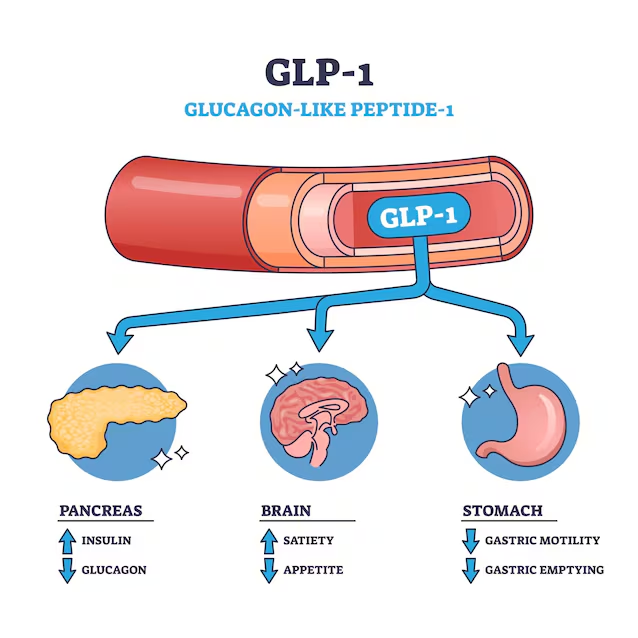
Confirmations come from several studies, such as that of Kokkinos and colleagues, who in 2010 compared the blood concentrations of these two hormones in people who had consumed 5- and 30-minute meals. Those who chewed more and ate more slowly had higher concentrations of these hormones and felt fuller than those who had eaten the meal in just 5 minutes.
The same trend was observed in a 2019 study published in Nutrientsin which Hawton and colleagues compared a meal eaten in 6 minutes with the same meal eaten in 24 minutes. In addition to higher concentrations of GLP-1 and peptite YY, slow eaters simultaneously showed a greater suppression of ghrelin (the so-called hunger hormone) and, in the following three hours, he consumed on average 25% less energy from a free snack.
Fast eating and BMI: meta-analysis of the International Journal of Obesity
By measuring the speed of ingestion in g/min or kcal/min, the studies converge on an interesting point: eating faster generally leads to ingest more food and to have a higher caloric intake in the same meal, compared to eating slowly. How much this is reflected in the long term is still a question conflicting data and results.
In general, though, the studies have observed an association among those who eat quickly and higher weight and BMI (Body Mass Index). Ohkuma and colleagues, in a 2015 meta-analysis onInternational Journal of Obesitythey found that those who eat quickly have on average a higher BMI and a greater risk of obesity than those who eat slowly.
But be careful, the key to this story lies precisely in the terms “observed” and “association”: many of the studies that show this link are of a observationalthat is, they observe what happens in the population without directly establishing whether one thing causes another. Indeed, association does not mean causation: the fact that two phenomena often occur together it is not sufficient to establish a cause-effect relationship. In this case, for example, we cannot say that eating quickly is the cause of a high weight, nor that we weigh less because we eat slowly. In practice, researchers point out that often these two things (speed of ingestion and body weight/BMI) travel together, setting the so-called “flea in the ear” that pushes us to want to know more. To understand if and how they are related, they are further, larger studies with more defined protocols are necessary. What we must keep in mind is that body weight is a parameter that depends on an infinite number of factors, much more complex than a simple indication of how fast we eat.
Sources:
Lettieri M, Rosa A, Spataro F, et al. Chewing Matters: Masticatory Function, Oral Microbiota, and Gut Health in the Nutritional Management of Aging. Nutrients. 2025 Pera P, Bucca C, Borro P, Bernocco C, De LA, Carossa S. Influence of mastication on gastric emptying. J Dent Res. 2002 Yu H, Tu J, Hou Y, Shi H, Han J, Liu W. Effect of mastication degree and eating rate on in vitro dynamic gastrointestinal digestion of rice. Food Res Int. 2026 Heuven LAJ, van Bruinessen M, Tang CS, Stieger M, Lasschuijt MP, Forde CG. Consistent effect of eating rate on food and energy intake across twenty-four ad libitum meals. British Journal of Nutrition. 2024 Wilkinson, L.L., Ferriday, D., Bosworth, M.L., Godinot, N., Martin, N., Rogers, P.J., & Brunstrom, J.M. (2016). Keeping Pace with Your Eating: Visual Feedback Affects Eating Rate in Humans. PloS one Argyrakopoulou G, Simati S, Dimitriadis G, Kokkinos A. How Important Is Eating Rate in the Physiological Response to Food Intake, Control of Body Weight, and Glycemia?. Nutrients. 2020 Hawton K, Ferriday D, Rogers P, Toner P, Brooks J, Holly J, Biernacka K, Hamilton-Shield J, Hinton E. Slow Down: Behavioral and Physiological Effects of Reducing Eating Rate. Nutrients. 2019 Ohkuma T, Hirakawa Y, Nakamura U, Kiyohara Y, Kitazono T, Ninomiya T. Association between eating rate and obesity: a systematic review and meta-analysis. Int J Obes (London). 2015
