
Has it ever happened to you, when sleeping for the first time in a new place, that you felt more “alert” than usual during sleep? Whether it is a hotel room or a guest room at a friend’s house, the fault – at least in part – is not the great heat of this sultry summer, but our brain: indeed, a hemisphere of our brain that remains more active to monitor the situation in this place unknown to us. In the animal kingdom, the phenomenon – known as unihemispheric sleep – this is nothing new. It is mainly migratory birds and cetaceans that resort to this strategy, thus managing to keep some functions active even during sleep. In birds, this mechanism allows first of all rest in flight without interrupting long migrations and, at the same time, maintaining a certain level of vigilance against possible predators. This last function, together with the need to periodically rise to the surface to breathe, is also particularly important for marine mammals. In humans, unihemispheric sleep is not developed so markedly, but studying how it works in other species can help us better understand some of our mechanisms.
Birds and unihemispheric sleep: why they sleep with one eye open
To fully understand unihemispheric sleep, one of the most interesting cases is that of birds, in which this ability seems to have a precise adaptive value. In 1999, a team of researchers demonstrated that, in mallards (Anas platyrhynchos), sleeping individuals on the edge of a grouptherefore more exposed to possible predators, resort more frequently to unihemispheric sleep compared to individuals positioned in the center. Additionally, they keep the opposite eye open (contralateral) to the more alert hemisphere and orient it towards the outside of the group. This is a mechanism also known in other animals, but which is particularly evident in birds because – as explained in an article by Drenhaus & Rager published in The Anatomical Record – have strongly crossed visual pathways: the information collected by each eye is processed mainly by the opposite hemisphere.
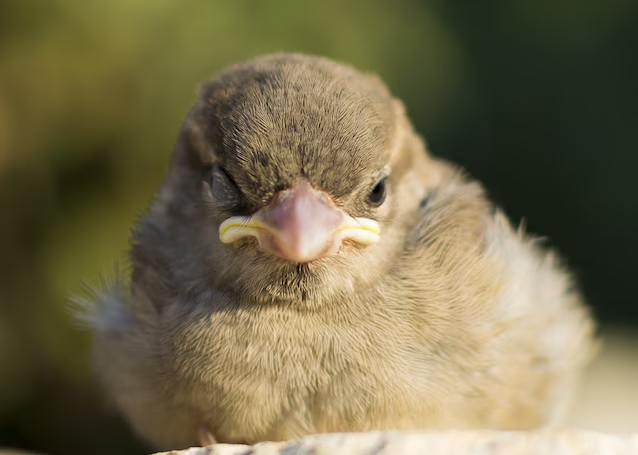
This allows the mallards on the edge of the group to keep the surrounding environment under control with the eye facing outward, while the other hemisphere rests. And precisely this ability to increase or reduce the use of unihemispheric sleep depending on the position in the group shows how flexible and modular this strategy is. This flexibility becomes even more evident in birds that undergo migrations or long periods of flight, during which sleep must adapt to needs of locomotion and navigation. In frigates (Frigate minor) this was demonstrated by Rattenborg and colleagues directly with EEG (electroencephalogram). The study, published on Nature communicationssuggests that, during oceanic flights, these birds can enter slow-wave sleep even with only one hemisphere, especially while they glide and they turn in the updrafts. From the need to keep a possible predator under control to the need to continue flying for long periods, birds show us how resting with half a brain can be a great advantage. But unihemispheric sleep is not their prerogative: in cetaceans this strategy has taken on an even more central role, becoming their main way of sleeping.
How dolphins and whales sleep without stopping breathing
Living in water while breathing air poses an inevitable problem: you have to return to the surface periodically. As long as you’re awake it’s simple, but when it comes time to sleep, shutting down completely can become dangerous. Maintaining a relatively alert hemisphere, therefore, allows dolphins and whales to maintain control of movements necessary for swimming and breathing without completely giving up sleep. Added to this are other possible advantages, such as the ability to monitor the environment and contribute to thermoregulation. A similar strategy is also used by fur seals and fur seals, especially when they sleep in the water. On land, however, these animals resort much more to bihemispheric slow-wave sleep, that is, the more “classic” mode in which both hemispheres sleep at the same time. Dolphins and whales, on the contrary, they rest primarily through unihemispheric sleep.

A 2008 article summarizes this particular reorganization of sleep in cetaceans: during rest, one hemisphere shows slow, high-amplitude waves typical of deep sleep, while the other presents more desynchronized activity, similar to that of wakefulness. The two sides of the brain they alternate in rest and, in the long run, they receive comparable amounts of sleep. As highlighted by Mascetti in 2016, in a single session it can happen that one hemisphere sleeps more than the other, but this asymmetry tends to compensate in subsequent sessions, until the sleep is distributed in a substantially balanced way between the two sides. The phenomenon also seems to be regulated in a way independent in the two hemispheres: if sleep is repeatedly disturbed on only one side, it is precisely that hemisphere that subsequently shows a compensatory increase in slow-wave sleep, as described by a 1992 study.
Falling asleep with half your brain at a time: what happens to humans
Precisely this relative independence between the two hemispheres makes the sleep of cetaceans, mammals like us, particularly interesting also for understanding human sleep. True unihemispheric sleep comparable to that of dolphins and whales has not been observed in humans, but some research shows that, under certain conditions, the two hemispheres of our brain can still reach different levels depth of sleep and alertness. One of the most studied examples is the so-called “first night effect”, well known to those involved in sleep research: when a person sleeps for the first time in an unfamiliar environmentlike a hotel room, rest tends to be more fragmented and less profound. A study published in Current Biology showed that, during this first night, brain activity is not perfectly symmetrical. During the experiment, the authors found that the left hemisphere – in particular the Default Mode Network (DMN) – remains in a lighter state of sleep than the right and seems to retain a greater ability to react to sounds coming from the environment. This asymmetry disappears or is reduced on subsequent nights, when the place becomes more familiar. The researchers interpreted the phenomenon as a sort of system of “night surveillance“: a very attenuated version of what allows cetaceans and birds to stay alert from predators while resting. However, it is not clear whether there is an alternation between the two hemispheres: further studies will be necessary to resolve this doubt.
A 2019 study coordinated by the Technical University of Berlin, however, analyzed the differences between the two hemispheres by applying mathematical models to real maps of human brain connections, also with regards to degree of synchronization of neural activity during sleep. In the sleeping brain, in fact, the activity of neurons tends to become more coordinated and regular (synchronized). Under some conditions, however, this synchronization may be slightly more pronounced in one hemisphere than in the other, suggesting that the two sides of the brain do not always sleep with the same intensity. The causes of this asymmetry are not yet clear and, according to the models developed by the researchers, they could also depend on the structural and connectivity differences between the two sides of the brain. Studying these phenomena can therefore help to understand whether the human brain retains, albeit in a much more limited form, part of the flexibility observed in animals capable of true unihemispheric sleep.
Sources
Drenhaus, U., & Rager, G. (1992). Organization of the optic chiasm in the hatched chick. The Anatomical Record, 234(4), 605-617. Lyamin, O. I., Manger, P. R., Ridgway, S. H., Mukhametov, L. M., & Siegel, J. M. (2008). Cetacean sleep: an unusual form of mammalian sleep. Neuroscience & Biobehavioral Reviews, 32(8), 1451-1484. Mascetti, G.G. (2016). Unihemispheric sleep and asymmetrical sleep: behavioral, neurophysiological, and functional perspectives. Nature and Science of Sleep, 221-238. Oleksenko, A. I., Mukhametov, L. M., Polyakova, I. G., Supin, A. Y., & Kovalzon, V. M. (1992). Unihemispheric sleep deprivation in bottlenose dolphins. Journal of Sleep Research, 1(1), 40-44. Ramlow, L., Sawicki, J., Zakharova, A., Hlinka, J., Claussen, J. C., & Schöll, E. (2019). Partial synchronization in empirical brain networks as a model for unihemispheric sleep. Europhysics Letters, 126(5), 50007. Rattenborg, N. C., Lima, S. L., & Amlaner, C. J. (1999). Facultative control of avian unihemispheric sleep under the risk of predation. Behavioral Brain Research, 105(2), 163-172. Rattenborg, N. C., Voirin, B., Cruz, S. M., Tisdale, R., Dell’Omo, G., Lipp, H. P., … & Vyssotski, A. L. (2016). Evidence that birds sleep in mid-flight. Nature communications, 7(1), 12468. Tamaki, M., Bang, J. W., Watanabe, T., & Sasaki, Y. (2016). Night watch in one brain hemisphere during sleep associated with the first-night effect in humans. Current biology, 26(9), 1190-1194.
