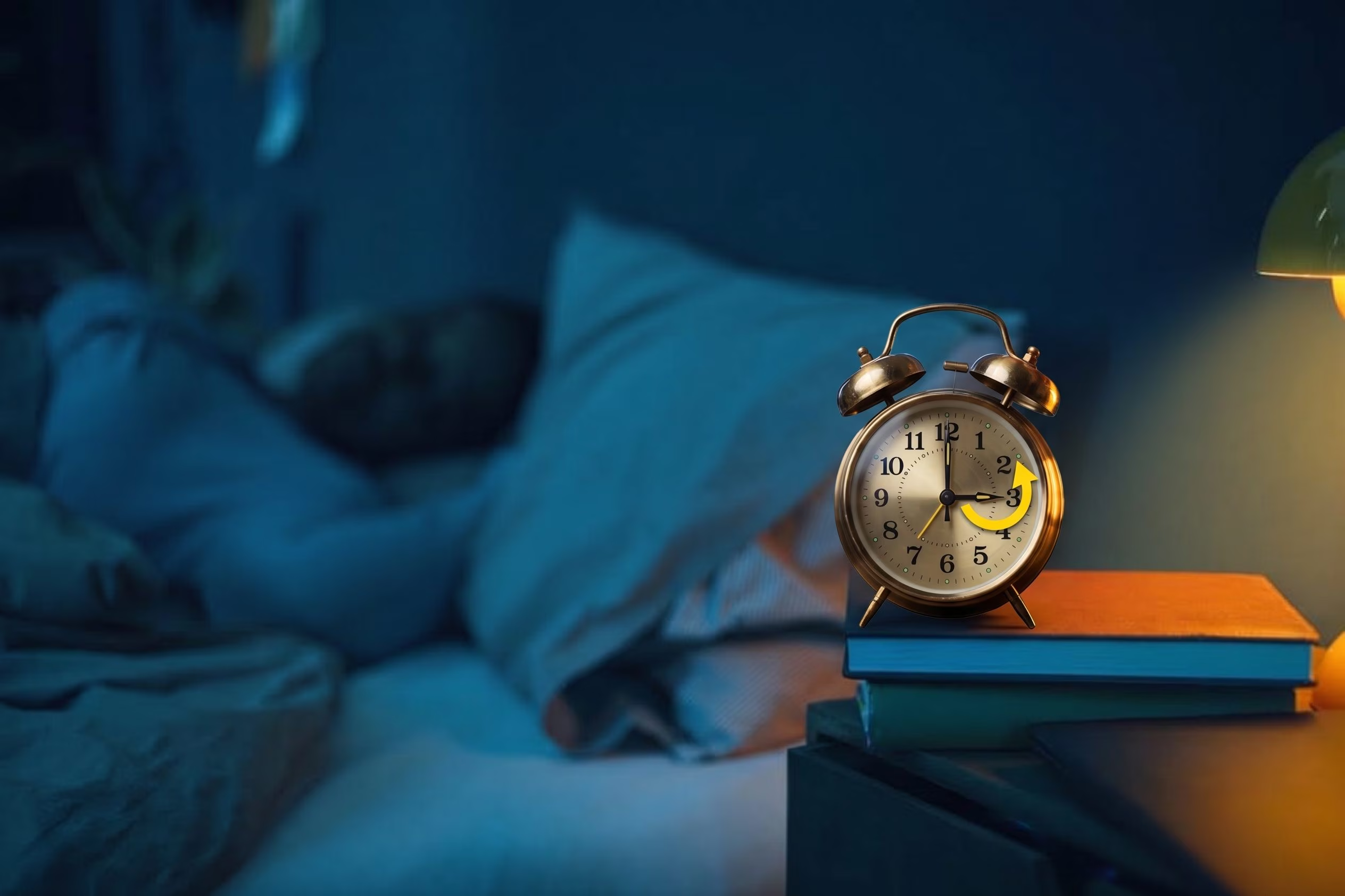
Now that autumn has officially begun, it’s natural to think about what’s imminent time change: on the night between Saturday October 24 and Sunday October 25, 2026 in fact, solar time will return and the hands will have to be set back an hour, with 03:00 becoming 02:00. This means the first night we will gain an extra hour of sleepbut we will lose an hour of light in the late afternoon.
The alternation between summer time (the “summer” time currently in progress) and solar time (the “winter” time, considered the “natural” time) is officially in force since 1966 And affects on ours rhythmi, sui electricity consumption and also on the organization of ours society: in the coming years, however, the time change twice a year could be abolished.
In March 2026, the Chamber of Deputies launched a fact-finding investigation to assess the possible impact of permanent daylight saving time on the national territory, with a focus on the possible effects and repercussions on the production sectors.
The timing is not coincidental: in 2025 a systematic review of the literature was carried out (analysing 149 studies conducted in 36 countries) from which it emerged that the change to summer time in spring is associated with an increase in the risk of heart attack of approximately 4% in the first week and an increase in fatal road accidents in the days immediately following the change.
The cause, however, would not be daylight saving time per se, but rather the sleep deprivation and the circadian misalignment due to the time change. Simply put: our “biological clock” takes several days to resynchronize and in the meantime we have to deal with lapses in attentionOf productivity and with majors mood swings.
In short, according to these studies, change time well twice the year is considered the worst option in terms of health. At this point, however, if we wanted to set a single timetable all year round, which one should we choose? Daylight saving time, therefore summer time, which allows you to gain an hour of light in the evening, or solar time, winter time, considered natural time (because it follows the apparent motion of the Sun, placing midday (i.e. 12) around the moment in which the Sun reaches the highest point in the sky)?
It is precisely for this reason that a fact-finding investigation was carried out within Parliament, which set the following objectives:
- The comparison between models which provide for seasonal changes in time or adoption of permanent summer time and evaluation of the socio-economic effects and the repercussions on the country’s productive fabric in terms of potential energy savings and increased productivity;
- Data analysis and the documentation currently available and the assessments provided by the subjects audited by the Commission;
- The evaluation of one experimental phase with extension of summer time;
- The evaluation of the preparation of the consequent acts functional to the application of one single reference standard.
The work should have been completed on 30 June 2026, but at the moment the Commission has not yet released a final document: at least for 2026, therefore, solar time will start as usual.
In any case, it is highly likely that the commission will opt for a period of experimentation, as has been done in other countries, so as to evaluate the actual energy savings and examine the potential impacts on the population and social habits. In fact, we must not forget that, in the event of permanent summer time being adopted only in Italy, it could create inconveniences with neighboring European countries, in the event that the time zone was no longer aligned and shared as it is today.
