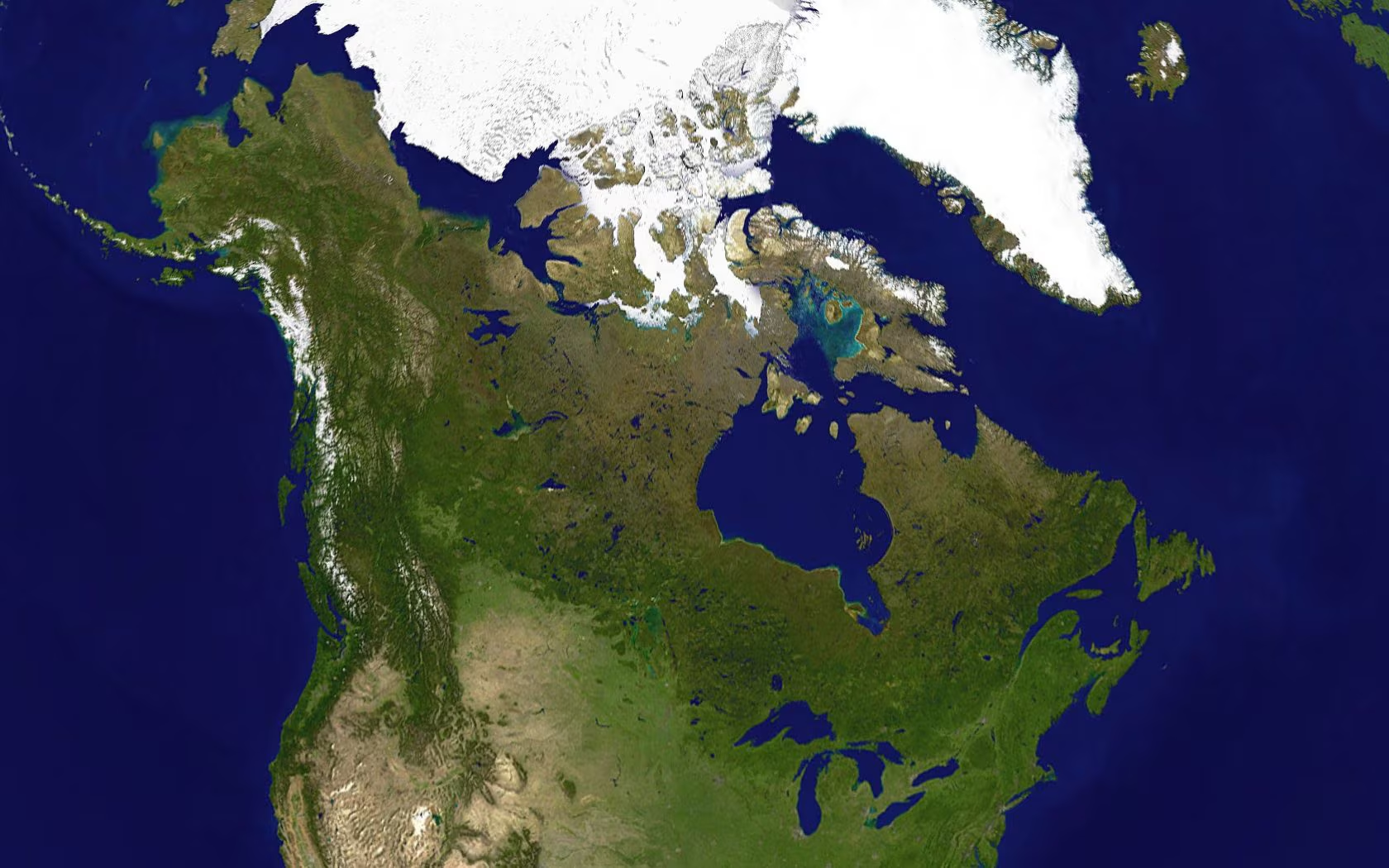
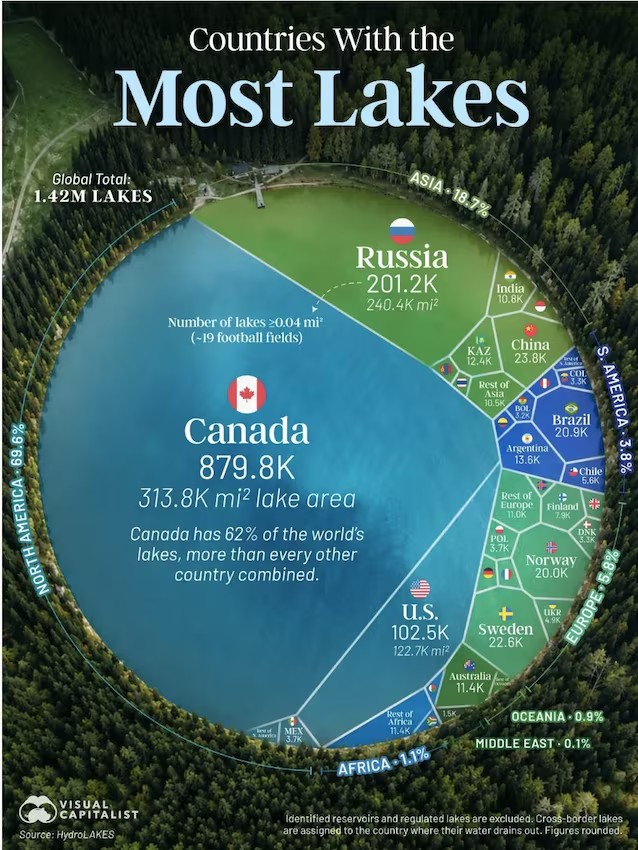
The Canadaalone, has more lakes than all the other countries on planet Earth combined. I am 879,763equal to approximately 62% of all lakes on Earth considered by HydroLAKES, that is, natural ones with a surface area of at least 0.1 km². Taking even smaller bodies of water into account, the Canadian lake count would go up to over 2 million!
The numbers come from a ranking drawn up starting from HydroLAKESthe global database developed by Mathis Messager, Bernhard Lehner and colleagues and published in 2016 on Nature Communications. The database collects approximately 1.43 million lakes and basins with a surface area of at least 0.1 km²; the ranking reported here considers natural lakes, excluding artificial basins and those regulated by man. Italy comes in 56th place. But why are there almost two thirds of the world’s lakes in Canada? The person responsible is the last ice age.
The ranking: the 25 countries with the most lakes in the world
HydroLAKESreference database created by researchers Mathis Messager and Bernhard Lehner (McGill University), map 1,420,891 lakes worldwide, counting only those with a surface area of at least 0.1 square kilometres (ten hectares, more or less fourteen football fields) and excluding artificial reservoirs and lakes regulated by man. Here are the top countries in the ranking.
There is an abyss between first and second place: Canada has more than four times as many lakes as Russiawhich is the largest country in the world, but on a surface level the distance is shorter, with approximately 812,700 km² for Canada and 622,600 km² for Russia (which also includes the Caspian Sea).
And the third place, the United Statesin turn has 50% of the lakes compared to Russia, for a total surface area of approximately 317,793 km², after which from fourth place down the number drops below 24,000, i.e. less than one fortieth of the Canadian total. The number of lakes, however, it is not certain that it reflects the classification by surface area: Kazakhstan, for example, has about half the lakes of Sweden, but the total surface area of its lakes is more than double, equal to about 57,760 km².
And theItaly? It turns out al 56th place in the ranking, with 596 bodies of water considered.
How to count water basins: the Finnish paradox in Europe
Census lakes is more complicated than it seemsbecause first of all the size of a body of water must be defined so that it can be defined as a lake: it is a problem that finds the perfect example in Finland, the European country with the most lakes.
Finland is known worldwide as “the land of a thousand lakes“, yet in this ranking it only comes in twelfth place, with just 7,898 lakes. The Finns, when they count their lakes, also include the smallest, even large, ponds 500 square meters: with this measurement they arrive at approximately 188,000 lakes. HydroLAKES, which instead only considers the bodies of water above 0.1 square kilometres, there are many fewer.
The same is true for Canada: by setting the threshold at even smaller bodies of water, the estimates would go up to over 2 million lakes. Each ranking must always be read remembering the rule with which it was constructed.
The merit of the last ice age and the melting of glaciers
THE first places are occupied by the countries of the Global North: Canada, Russia, United States (especially the northern ones), Sweden, Norway, Finland. They all have one thing in common: until about 12,000 years ago they were buried under kilometers of ice, under the great ice caps of the last glaciationwhich reached their maximum extension about 20,000 years ago. Here the advance and retreat of the ice left an extraordinary quantity of depressions which filled with water during the deglaciation.
Canada was covered by the Laurentide ice cap; Scandinavia and northwestern Russia from that fennoscandica. These ices did not stand still, but moved very slowly and unstoppably, working the underlying ground in two ways:
- The first is theexcavation (in jargon exhaustion): the moving ice, loaded with debris and boulders, scraped away the rock and dug thousands of basins and depressions, some deep, others barely visible.
- The second is the deposit: when the glacier retreated and melted, it left behind enormous quantities of debris called moraines (disordered accumulations of stones, gravel and clay transported by the ice), which formed natural barriers behind which the melt water stagnated.
The phenomenon is all the more evident in Canada because of the Canadian Shield (Canadian Shield), the immense nucleus of very ancient crystalline rocks (among the oldest on the planet) which occupies a large part of the country. Here glacial erosion has shaped the substrate, creating a surface full of depressions and basins. After the ice retreated, many of these depressions filled with water, contributing to Canada’s extraordinary lake density.
Additionally, some of the large lakes we see today are the miniature survivors of gigantic lakes that have now disappeared. Lakes Winnipeg, Winnipegosis and Manitoba, Canada are what remains of the Lake Agassiza basin formed about 14,500 years ago along the edge of the Laurentide ice sheet: it was larger than the sum of all the current North American Great Lakes. When, during the deglaciation, the dams and drainage routes changed, the lake began to drain through different paths and its progressive emptying left some of Manitoba’s large lakes as remnants.
Even Italian lakes were born this way: we are not in the top 25, because we have too few in proportion, but the large pre-Alpine lakes (Garda, Maggiore, Como and Iseo) were born from the excavation of glaciers during the glaciations. In our case we are talking about a few dozen large lakes, while in Canada hundreds of thousands of them have been created.
The exceptions of Brazil and Australia: coastal lagoons and ephemeral salt lakes
What are they doing with it Brazil (sixth) andAustralia (tenth) among the top ten names, given that these are hot countries and never covered by ice caps? Here a second family of lakes comes into play: those that are not born from ice, but from water and the shape of the territory itself. In Brazil they contribute to the presence of its over 20,000 different environments, in particular the coastal lagoons hey floodplain lakes, like the expanses of the Amazon and the Pantanal, where the great rivers, flooding every year, leave behind a myriad of stagnant bodies of water.
Australia, on the other hand, is the kingdom of ephemeral salt lakes, like Lake Eyre, which for most of the year is a dry salt flat and fills with water only after exceptional rainfall. And then there is a third way, that tectonics: long and very deep lakes that form where the earth’s crust cracks and sinks, such as the great lakes of the African Rift Valley or Baikal in Russia, the deepest in the world.
