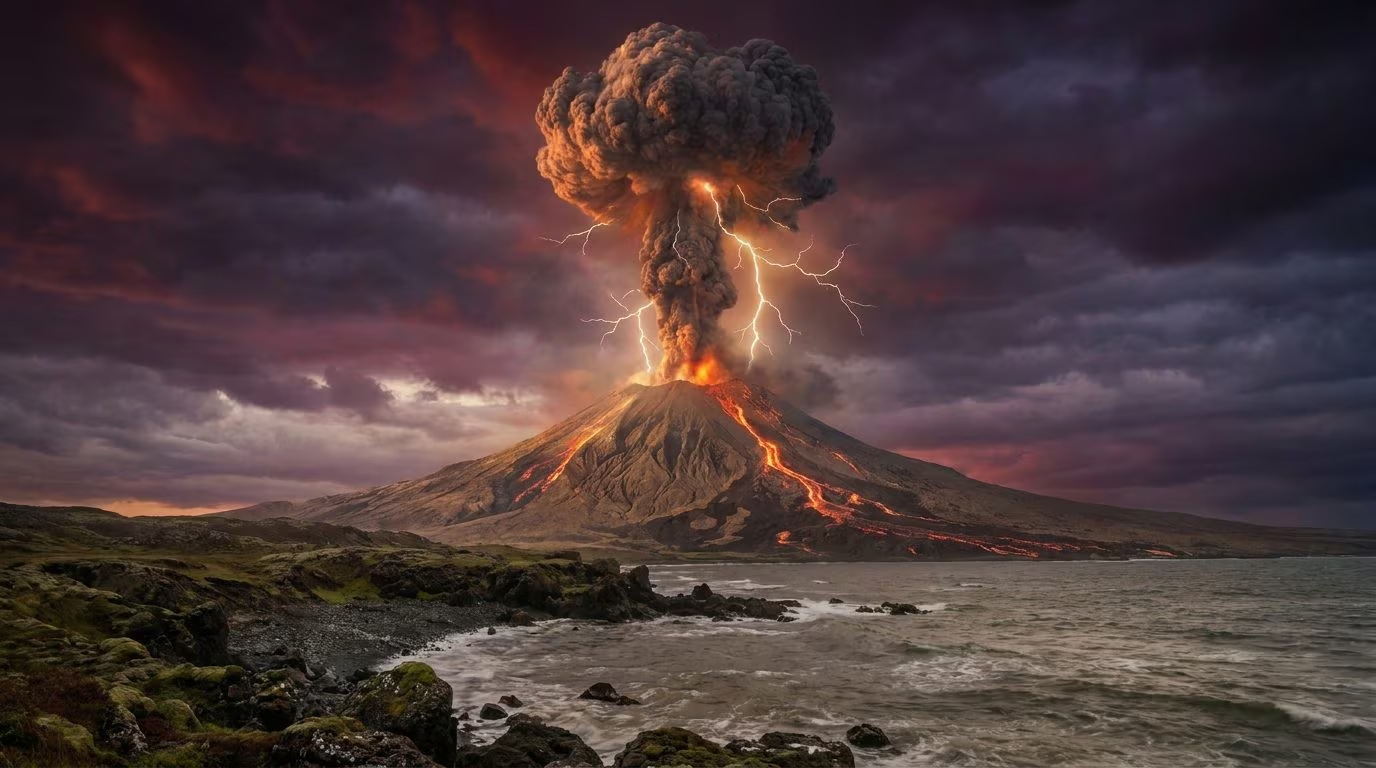
Research published in GeoScienceWorld identified an imposing fossil supervolcanohidden in the depths of the subsoil of theEastern England, in the area of The Wash. It is a monumental structure, today completely leveled by erosion and hidden under hundreds of meters of sediment, which in a distant geological past was the protagonist of one of the more violent eruptive events of earthly history. Its identification not only allows us to precisely reconstruct the tectonic structure of the planet inPaleozoic erabut it clarifies a major puzzle that remained unsolved for decades regarding the correlation of pyroclastic deposits in Northern Europe.
Zircons revealed the origin of supervolcano ash
For decades geologists have wondered about the origin of the so-called Kinnekulle tephra: a layer of petrified volcanic ash up to over one meter tall and spread over a huge area between Norway, Sweden, the Baltics, Belarus and Poland. The geographic extent suggested a monstrous eruption, but the cloud’s source remained unknown until the recent discovery of British Geological Survey (BGS) and fromUniversity of Oslo. Analyzing deep core samples between Lincolnshire and the Norfolkresearchers extracted microscopic crystals of zircon And apatite: minerals thinner than a human hair but which function like real ones atomic clocks. Zircons, in fact, form in magma and they trap traces of radioactive uraniumwhich over time transforms into lead. By measuring this decay, geologists dated the English samples to ca 454.4 million yearsan age comparable to that of Scandinavian ashwhile apatite confirmed its same chemical fingerprint.
The significance of the discovery was underlined Tim PharaohBGS geologist and first author of the study:
Over 454 million years ago, a supervolcano now hidden beneath one of England’s flattest landscapes produced some of the largest eruptions ever recorded in Earth’s history. Thanks to cutting-edge analysis, we believe we have been able to provide evidence that the origin of the ash layer in Scandinavia came from this supervolcano, redefining our understanding of England’s deep geological past.
The map of the planet 454 million years ago
To understand the dynamics of the event we must take a step back Ordovician period. At the time the layout of the continents was completely different from the current one: the microcontinent of Avalonia (of which England was part) and the continent of Baltica (the future Scandinavia) were separated by an ancient ocean basin known as Tornquist Sea. Eastern England was characterized by a highly active volcanic chain, with a geodynamic context similar to the present-day Pacific Ring of Fire or the island arcs of Indonesia. When The Wash supervolcano exploded in a type eruption super-Plinianhurled hundreds of cubic kilometers of incandescent material into the stratosphere with a force equivalent to thousands of atomic bombs. The air currents of the time then transported the gigantic ash cloud hundreds of kilometers beyond the Tornquist Sea, causing it to settle on the seabed of what is now Scandinavia.
Because today the ancient volcano in England is no longer visible
Geological data also show that, shortly after the main explosive phase, the magma chamber now emptied, it collapsed on itself, giving rise to an imposing structure caldera. A second eruptive event linked to the collapse of the structure has been dated to around 453.7 million years ago. In the millions of years since, i tectonic movements they led to closure of the Tornquist Sea and the constant action oferosion it leveled the volcanic edifice. Today, on the surface of eastern England, there is no visible sign of this giant of the past; However, information held deep within the Earth’s crust continues to reveal details of a dynamic and ever-changing planet.
