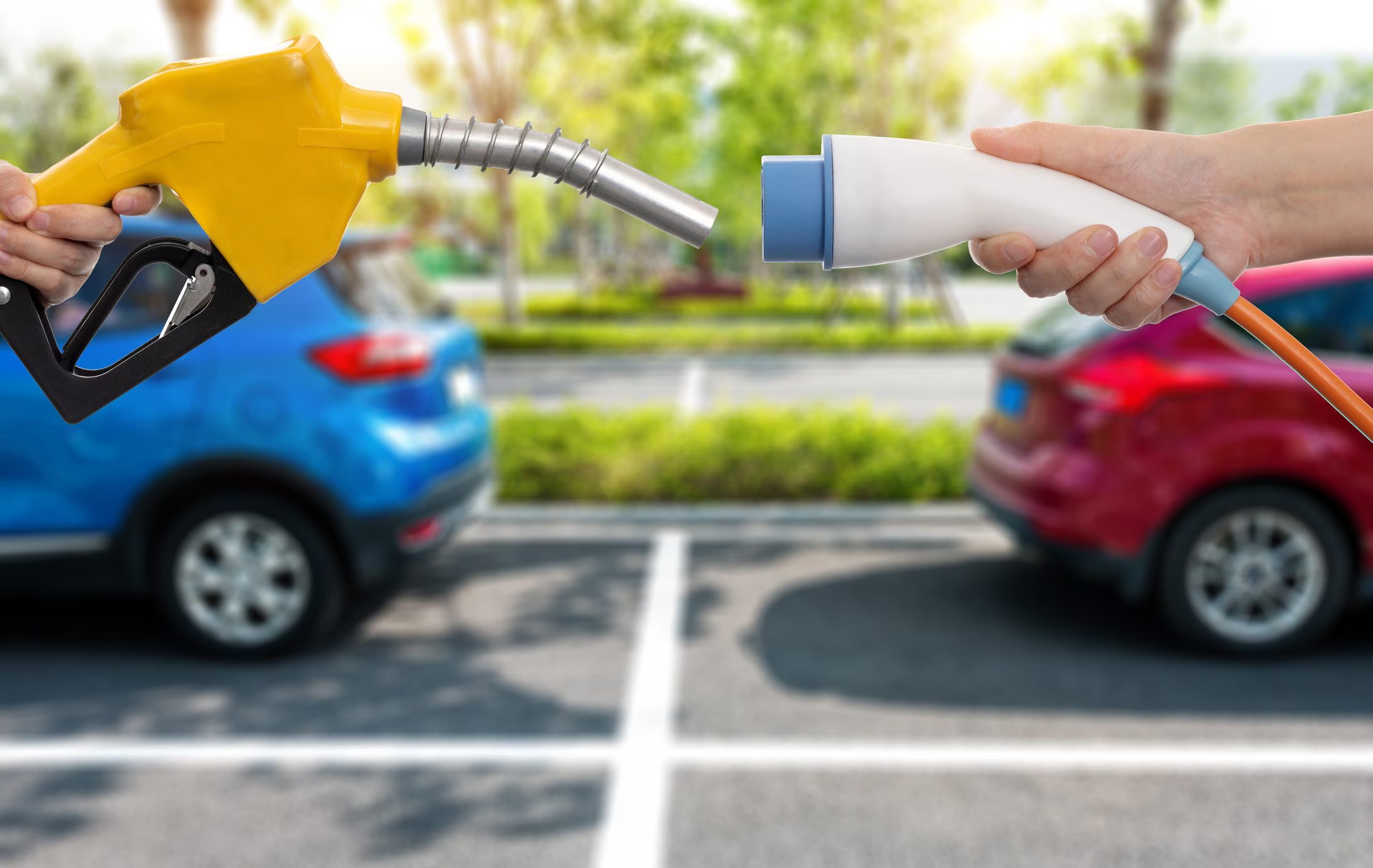
Electric cars are conquering one ever greater space on the roads and in public debate, alongside cars powered by traditional petrol and diesel engines. Interest in electric mobility is not only supported by issues related to environmental sustainabilitybut also those of economic nature.
But how much does it really cost? reload an electric car? And, above all, as much as possible save compared to a similar petrol or diesel car? In a context characterized by a strong variability in energy prices and gods fuelsin fact, the cost necessary to travel a certain number of kilometres represents an increasingly important element in the choice of car.
By comparing charging and fuel costs, the economic convenience of the electric car on consumption is real, but strictly linked to charging habits: it is clear with home charging, while it is drastically reduced if you depend on fast public charging stations. However, to evaluate the real savings in the long term, the cost of energy alone is not enough: it is fundamental consider the investment as a wholeincluding the purchase price, incentives and future operating expenses.
How much does electric charging cost in Italy
TO June 2026the Italian public charging network matters 84564 points installedwhile about the 54% of the motorway service areas has an infrastructure for charging electric vehicles. The availability of charging stations, however, does not translate into uniform rates, given that the cost of charging varies depending on both the technology used that of power of delivery. For the slow or medium charging in alternating current (AC) at public charging stations, the cost is on average between 0.45 And 0.60 €/kWh. With the fast charging in direct current (DC) the price rises to 0.73 €/kWhwhile for ultra-fast infrastructure it can exceed 0.76 €/kWh.
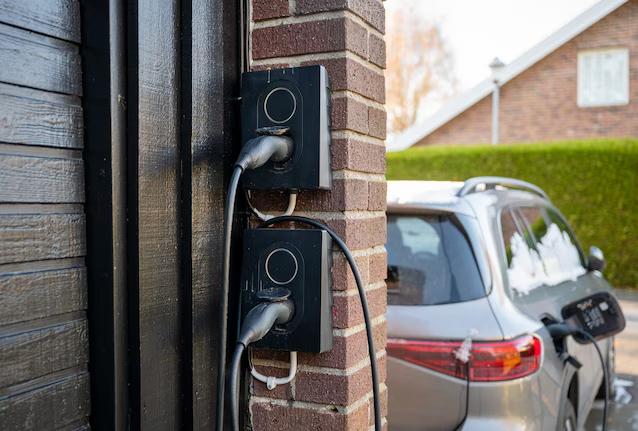
The situation is different for home charging. In this case, the total cost of electricity in the bill is approximately around 0.25 €/kWhalthough the actual value may vary depending on the supplier and the conditions of the contract. Charging at home is therefore, generally speaking, more convenient compared to the use of public charging stations.
Comparison with diesel and petrol per 100km
To evaluate how convenient an electric car actually is, it is necessary compare the cost of the energy needed a travel the same distance with that of traditional fuels. As an example, we will take as a reference an electric vehicle with an average consumption of 17 kWh every 100 km and a 50 kWh battery, capable of guaranteeing an indicative range of approximately 300 km. In this scenario, to travel 100kmcharging domestic it would cost approx 4.25 euros. Instead using a public column in alternating currentthe expense would be between 7.65 and 10 euroswhile with a fast charge in direct current it would come to approx €12-14depending on the tariff applied.
To travel the same distance, a car a gas with an average consumption of 6 liters per 100 km, considering a price of €2.10/l, it would require approximately €12.60 of fuel. For a car Diesel with an average consumption of 5 liters per 100 km, the expense would be approximately 11 eurosassuming a diesel price of €2.21/l. The comparison highlights a particularly significant difference in the case of home charging. In the hypothesis considered, travel 100 km with an electric car recharged at home would involve an energy expense lower by more than 60% compared to that needed to travel the same distance with a petrol or diesel car. On one average annual mileage of 10,000 kilometresthe gap becomes even more evident. The energy expenditure forelectric car recharged at home it would be approx 425 euroswhile for the car a gas it would come to approximately 1,260 euros and for the Diesel to around 1,100 euro. It is important to underline that this is a comparison based on exemplary values. The actual cost can vary significantly depending on the car model, actual consumption, the price of energy and fuel and the charging method.
What to know before going electric
A further element to consider for those who are considering the transition to electric is the so-called break-even thresholdor the maximum energy price electric car beyond which, with the same consumption, the electric car does not present more of an advantage on the cost of energy compared to a specific fuel. In the analyzed scenario, the price of electricity could reach approx €0.73/kWh before the energy cost of the electric vehicle reaches that of the car a gas. In comparison with the Dieselthe threshold is instead placed around €0.64/kWh.
Nonetheless, to establish which solution is actually more convenient in the long term, the cost of energy alone is not enough. The comparison should also take into account the initial purchase price of the vehicleof any incentives available, gods maintenance costsof theinsurance and of the possible car devaluation.
