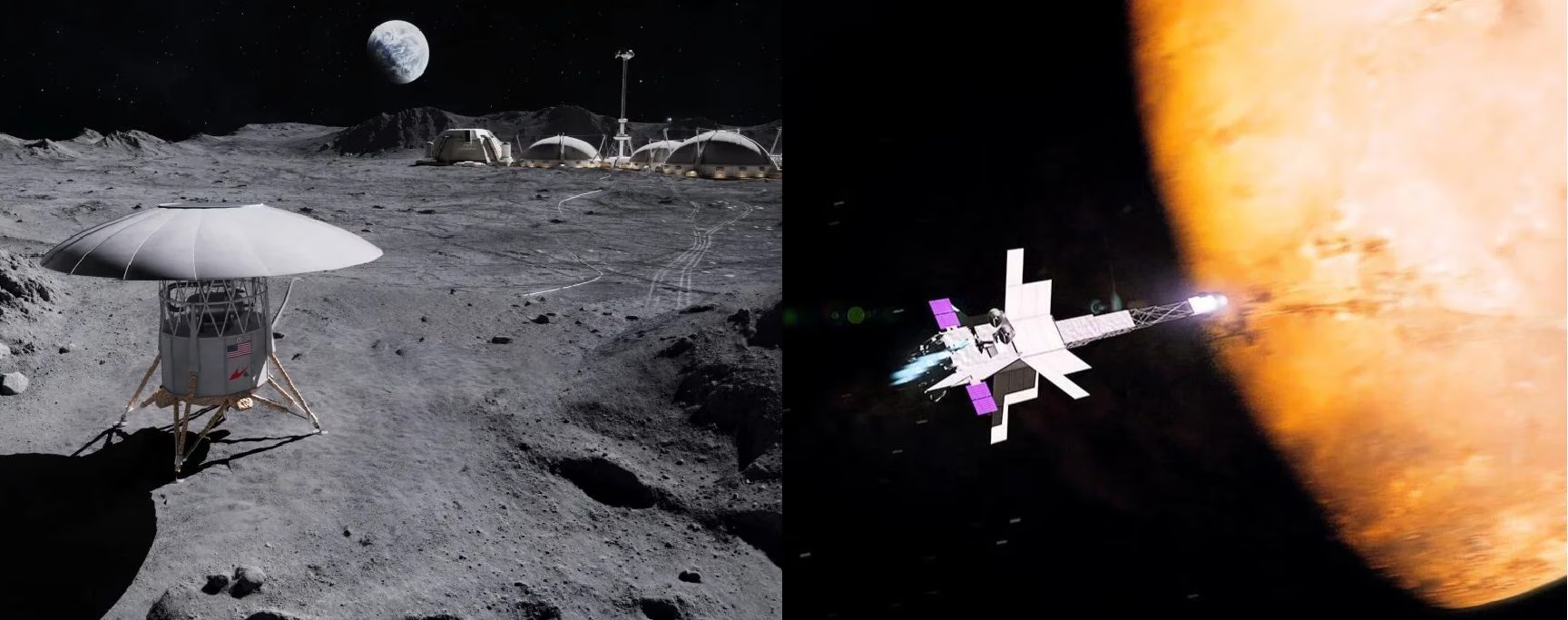
There NASA and the Department of Energy (DOE) of the United States signed an agreement on development and the use ofnuclear energy for the next one space exploration which will serve both lunar bases at the South Pole than for the long ones travel to Mars. The development is coordinated by Space Reactor Officea new department recently activated at NASA, which concentrates space nuclear authority and funds in a single structure.
NASA wants to use nuclear power in space two specific projects which will share some of the hardware and uranium-based fuel. The first is Lunar Reactor-1 (LR-1), a system of nuclear fission of surface created by 2030 and which will be used for lunar settlement missions and intended to power the lunar base to the South Pole of our natural satellite, expected as the final phase of Artemis program of NASA.
The second is called Space Reactor-1 Freedom (SR-1) and is a nuclear electric vehiclethat is, a reactor that produces electricity and powers thrusters that will push a spacecraft to Mars.
The US space agency has accelerated the times on the development and use of nuclear power as an energy source for space missions for one purely geopolitical reason: the aim is to obtain the primacy as first nation who will be able to build the first one human base on the Moon. Even the China (in cooperation with Russia) is in fact moving towards this goal, planning to use a reactor on the Moon to power its research station.
In short, NASA NASA is trying to speed up its two flagship space programs, the lunar bases and the first human missions to Mars, to search to beat China and maintain space primacy in future space exploration.
Why we need a fission reactor for the moon bases at the South Pole
There are two main reasons why a nuclear reactor for moon bases it is very useful. The first is that the lunar night which lasts approx 14 Earth daysduring which the photovoltaic panels produce nothing. The reactor, therefore, would be used to easily produce energy, given that the batteries they wouldn’t have the capacity enough to power a base for that long continuously.
The second reason concerns i craters in permanent shadow of the South Pole, where there could be water ice which could be used as a resource for human bases. Inside these craters, in fact, the Sunlight never comes and nuclear energy would ensure access to a permanent energy resource in these areas otherwise unexplorable.
A nuclear fission reactor is therefore designed to provide energy during the long lunar nights, allowing for maintain activate ei habitats life support systemscommunications, rovers and scientific equipment.
Lunar Reactor-1 is the final stage of the space nuclear program from NASA, actually started in the 1960s and which, over the years, has undergone continuous changes. In fact, US research on space nuclear reactors began in those years with SNAP-10AAmerica’s first fission reactor in space. In 2015 NASA started the program Kilopower, culminating in 2018 with the experiment KRUSTY (Kilopower Reactor Using Stirling Technology), which demonstrated the feasibility of small reactors for future lunar missions.
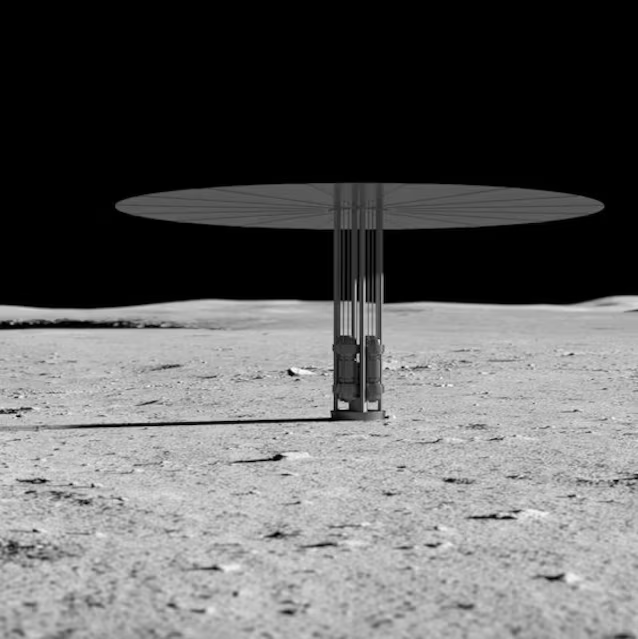
Then, in 2021, the Fission Surface Power program was born which planned to build a reactor 40 kilowatts. In 2025 the goal has risen to at least 100 kilowatts, with the ambition of putting a nuclear reactor on the Moon by 2030.
In short, the LR-1 program is the final piece of this long development program. LR-1 predicts that a single reactor can provide at least 20 kilowatts of electricityeven after transporting them up to a kilometer to the surface, and at least five years of continuous operation at full power without maintenance.
A fission reactor like the one being developed with LR-1 will use nuclei of uranium to produce heat. The heat will then be transformed into electricity and the excess will be disposed of in the space with radiators. The fuel used will be HALEU-type uranium-235an acronym used to indicate a type of uranium enriched between 5% and 20%more concentrated than that of civil power plants but below 20%, the threshold beyond which it is considered highly enriched.
Nuclear power will also be used for interplanetary missions
Space Reactor-1 Freedom (SR-1) will instead become the first interplanetary mission of NASA with on board a nuclear reactor to power the spacecraft’s thrusters, which according to current plans, should leave in the direction of Mars at the end of 2028. The over 20 kilowatt reactor will provide the electricity that will power the Hall effect thrusters, in which a propellant gas is ionized and accelerated by electric and magnetic fields.
SR-1 is not a manned mission and it won’t have to land on Mars. It’s a technology demonstrator which will carry a scientific cargo called SkyFall, composed of three robotic helicopters derived from the drone Ingenuity. The launch is scheduled for end of 2028 with the aim of reach Mars in 2029.
The reactor will be mounted on the module Power and Propulsion Element (PPE) initially conceived for the Lunar Gateway (the lunar space station initially designed by NASA and the European Space Agency) which will become the central element of the spacecraft headed to Mars. With the reorganization of the Lunar Gateway program in 2026, NASA decided to salvage part of the project to make SR-1, reducing the need to develop an entirely new spacecraft.
The race to the lunar South Pole and the uranium supply chain
On the other hand, the China (along with Russia as main partner) is planning the construction of the ILRS station (International Lunar Research Stationor International Lunar Research Station) at the lunar south pole and of a nuclear reactor on the surface between 2033 and 2035. The competition with the United States is intense because both programs, ILRS and Artemis, have similar objectives and in the same geographical area of the lunar South Pole.
The weak point of American space nuclear development is the fuel supply. In fact, HALEU-type uranium does not yet have domestic commercial production in the United States such as to regularly supply all the advanced reactors planned in the coming years.
Until a few years ago, the Russia and China they were the unique countries considered to have infrastructure for produce HALEU on an industrial scale. The United States’ difficulty in producing HALEU on a commercial scale therefore represents a possible bottleneck for NASA’s space nuclear program, especially for the SR-1 Freedom mission.
