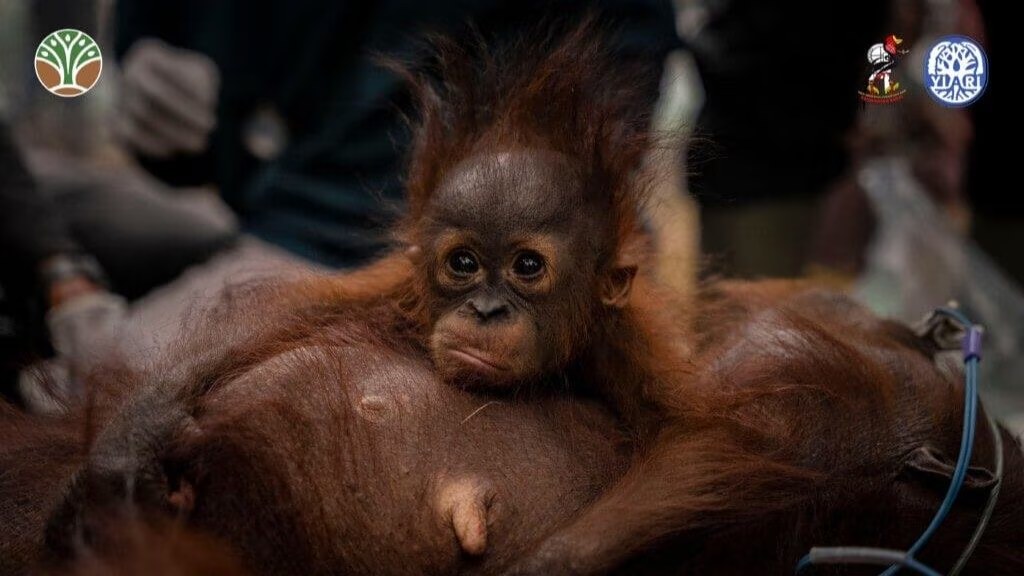
Eight orangutans, including three females with their daughters and two males, were recently released into the forests of Borneo after being rescued from forest fires. But while some specimens manage to return to their habitat, the situation for the species remains critical. In Indonesia, in fact, fires are devastating forests and peatlands, especially on the island of Borneo, also putting animals at serious risk orangutans. According to a statement from the IUCN primate specialists, the habitat that hosts the 52% of the population total number of Bornean orangutans are now affected by fires. The situation is made particularly serious by the extremely hot and dry conditions associated with El Niño, which is encouraging the spread of fires this year. But there is an important detail: it is not El Niño is the cause of these fires.
Why forest fires in Borneo are becoming so difficult to stop
Forest fires occur every year in Indonesia, as fires are often set to clear land to make way for oil palm or cellulose plantations. However, the arrival of a El Niño particularly intense brought exceptional drought conditions, causing the rapid propagation of fires in some areas of Sumatra, Kalimantan (the Indonesian part of Borneo) and Papua.
The role of El Niño is not just a hypothesis. A study published in a Nature group journal in 2026 estimated that, in Indonesian Borneo, the probability of large-intensity fires is increased approximately 2.7 times during El Niño. However, the authors point out that extreme fires can also occur in the other phases of ENSO: El Niño increases the risk, but is not the only cause.
What makes the situation even more complicated are the peat bogsecosystems that accumulate large quantities of organic matter in the soil. When naturally saturated with water, peat is much less vulnerable to fire. But in Indonesia large areas of peat bog have been drained for agricultural activities: when the soil loses water, the peat dries out and becomes much more easily flammable. What makes these fires particularly insidious is the fact that the fire can continue to burn beneath the surface. Once the peat layers have been reached, in fact, the fires can remain active as slow combustions and smolder underground even after the flames on the surface have been extinguished.
What’s happening to orangutans in Indonesia
For orangutans the problem is not just the risk of being caught by flames. When the forest burns, animals also lose their habitat and the food resources they depend on. This is exactly what rescuers in Indonesia are observing: some orangutans were found starving and dehydrated, in areas where there were no leaves or fruit available after the fire had passed. Still others, however, suffered serious burns to their hands.
But even orangutans who manage to escape can suffer the effects of the smoke. This was shown by the study published in Scientific Reportswhich followed four adult male Bornean orangutans during and after the 2015 fires. During the smoke-filled period, the animals spent more time resting; subsequently, they reduced both the time dedicated to moving and the distances travelled, however showing a greater mobilization of fat reserves, compatible with an increase in energy expenditure.
A second study, published in 2023 in the journal iSciencehighlighted another possible consequence of exposure to smoking. During the period characterized by heavy smoke, four adult male orangutans have vocalized less frequently and produced lower quality vocalizations. Most of these changes persisted for about two months even after they stopped smoking and, according to the authors, could be associated with a worsening of their health conditions.
And the problem doesn’t necessarily end when the flames go out. According to experts, after a large fire the forest may produce less food for orangutans, while vegetation can take years to recover. Indeed, in burned peat forests, tree diversity may remain reduced even 12 years after the fire.
This is why the emergency does not only concern orangutans who today are found burned, dehydrated or trapped by smoke. The risk is losing the forest they depend on to survive. Orangutans live at low densities and need large territories: if some habitat is destroyed, it is not enough to simply move them all into what remains of the forest.
Sources
Lam, T., Catto, J.L., Kay, G., et al. Major fires in Indonesian Borneo are possible under all ENSO phases. npj Nat. Hazards 3, 46 (2026). Erb, W.M., Barrow, E.J., Hofner, A.N., et al. Wildfire smoke impacts activity and energetics of wild Bornean orangutans. Sci Rep 8, 7606 (2018). Erb WM, Barrow EJ, Hofner AN, Lecorchick JL, Mitra Setia T, Vogel ER. Wildfire smoke linked to vocal changes in wild Bornean orangutans. iScience. 2023 Jun 14;26(7):107088. Harrison, Mark E., et al. “Impacts of fire and prospects for recovery in a tropical peat forest ecosystem.” Proceedings of the National Academy of Sciences 121.17 (2024): e2307216121.
