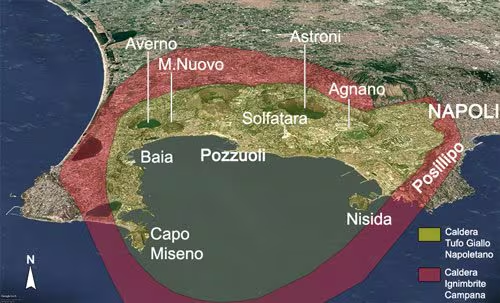
The Council of Ministers approved a new Extraordinary plan for the Campi Flegreiwith the aim of dealing with the effects of the evolution of the bradyseismic phenomenon in the area. The extraordinary measures, contained in a legislative decree, arrive extremely late, after 75 days from the 4.7 magnitude earthquake (the strongest ever recorded in the Campi Flegrei in the instrumental era) which caused several damages to buildings, making it impossible for some families to return to their homes.
The Plan includes, among other things, the establishment of two funds 50 million euros per year for ten years (destined respectively for private and public building stock), the suspension of the installments of the mortgages until 31 December 2027 for cleared properties and incentives for “voluntary relocation”, or to transfer to less risky areas.
It must be said, however, that the provisions mainly concern economic interventions and building redevelopment, essential to deal with seismic risk. As regards the classification of danger in the Phlegraean area, however, the phase 2 of attention of the yellow alert for volcanic risk, confirmed by the Major Risks Commission – Volcanic Risk Sector of the Civil Protection.
Interventions in favor of the population
First of all, the Extraordinary Plan provides that the President of the Campania Region (currently Roberto Fico) will assume the role of Extraordinary commissioner for interventions in the Campi Flegrei areawith jurisdiction over the territories of the municipalities of Bacoli, Naples, Pozzuoli and Monte di Procida.
The Government, on the proposal of the President Giorgia Meloni and the Minister for Civil Protection Nello Musumeci, has also provided for the establishment of two funds of 50 million euros per year for ten years, which will be allocated respectively to reduction of seismic vulnerabilityrepair and redevelopment seismic of private building stock and the public sector, infrastructures and public services.
From a tax and contribution point of view, for i citizens who reside in properties cleared (or for which verification of usability has been requested), the Plan provides for the suspension of a series of obligations:
- From 31 July to 30 November 2026 I am suspended the deadlines for tax paymentsthe obligations and payments of social security and welfare contributionspremiums for compulsory insurance, as well as payments deriving from payment orders and executive assessment documents.
- Until December 31, 2027 And suspended the payment of mortgage installments and financing relating to cleared main homes and properties intended for economic and professional activities
- THE rental agreements of the homes located in the intervention area and expiring between 1 October 2026 and 30 October 2027 are extended by two years in favor of tenants with an income of less than 28,000 euros, unless the landlord needs to be deferred.
Measures for public and private buildings
Looking instead at homes and public buildings, the Extraordinary Plan provides for even more substantial structural interventions. First, a is established Permanent conference for the Campi Flegrei areachaired by the Commissioner, who expresses a mandatory and binding opinion on the urban planning instruments implemented by the municipalities and approves public intervention projects.
As for the private buildings (with at least one main residence), damaged and cleared following the earthquakes, the Council of Ministers will establish, annually, the resources to be allocated for seismic repair and redevelopment.
To speed up the return of families to their homes, however, municipalities are asked to prioritize the applications for amnesty and amnesty: the contribution, in fact, is granted only after their positive conclusion. For situations of greater exposure to risk, the voluntary relocationwhich it predicts the purchase of areas or alternative properties to be implemented as a priority in the most vulnerable areas.
In practice, to repair the minor damage and making the main homes evacuated in Bacoli, Monte di Procida, Naples and Pozzuoli accessible is expected:
- A contribution up to 30,000 euros for each real estate unit and for the common parts of the buildings, with requests to present by 31 December 2026;
- There delocalization of complex of public residential construction Via Coste d’Agnano – Solfatarain Pozzuoli, with a cost of 10 million euros for each of the years 2027 and 2028 and 10.078 million euros for 2029.
For public property, however, the Commissioner prepares a multi-year program of seismic repair and redevelopment, giving priority to schools and universities, buildings intended for essential public services, public housing and buildings that house minors, prisoners or people with disabilities. To complete this picture, for the restoration and reduction of seismic vulnerability of churches and places of worship instead they are 5 million allocated euros for each of the years 2027 and 2028.
