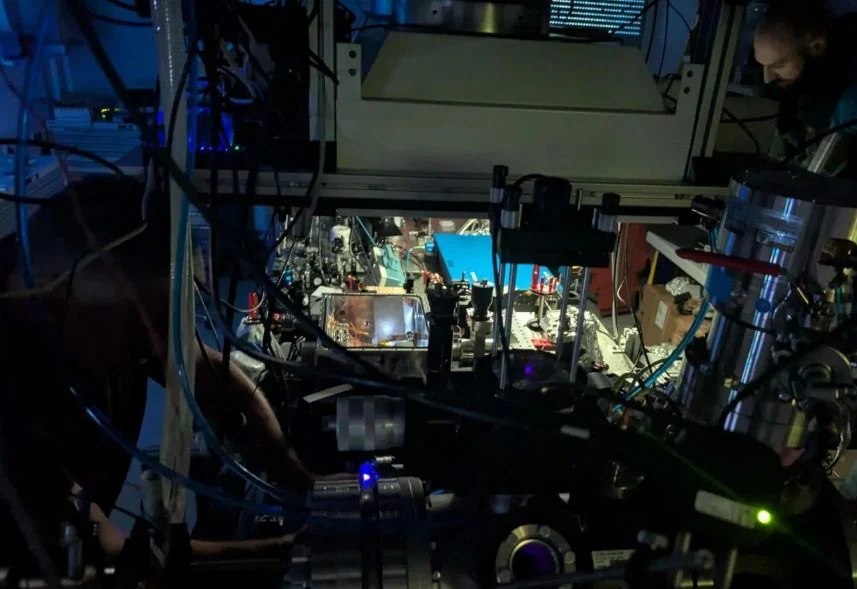
Two research groups, one from TU Wien University in Austria and the other from Tsinghua University in Beijing, have independently demonstrated the functioning of the first prototypes of nuclear clock, based on thorium-229. The results, published in Nature in two separate studies and curiously published in the same issue of the journal, mark a important step for a technology studied for over twenty years in physics laboratories.
Unlike the atomic clocks conventional, which are based on the transitions of atomic electrons, the nuclear clocks they exploit the energy transitions of the nucleus of the atom as a frequency reference for measure the passage of time.
Atomic clocks are already present today in fact synchronization of communication networks Internetin telecommunications and in satellite navigation systems such as the GPSand it is precisely in these applications that a precision jump it could make a difference.
How a nuclear clock works
Every watch needs something that you swing at a steady pace and regular. In an atomic clock, it is the light absorbed and emitted by an electron when it jumps between two energy levels of the atom. The fundamental unit of measurement that we use every day, the secondis precisely defined counting the oscillations associated with a transition of the electrons of the atom cesium (in the case of atomic clocks this element is used).
A nuclear clock move this principle into the nucleus of the atomwhere protons and neutrons also occupy different energy levels.
When an electron passes from one energy level to another, it absorbs or emits energy at one well-defined frequency. A laser can be used to measure this transitioncalibrating its frequency with that characteristic of the atom. If the laser frequency changes even slightly, the system can detect the deviation and correct it and in this way a extremely stable reference of time measurement.
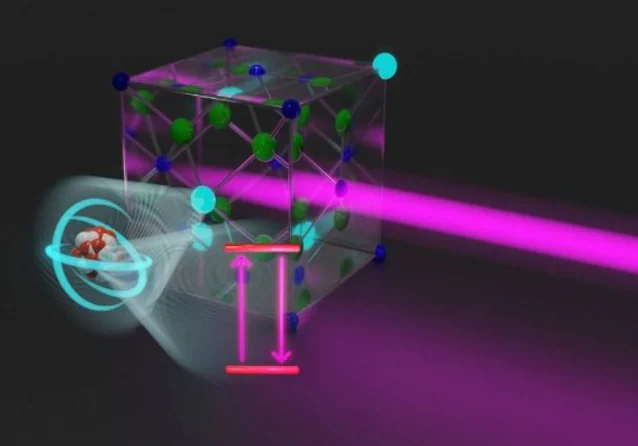
Nuclear clocks apply a similar principle, but change the origin of the energy transition. Instead of electrons, they use the protons and neutrons that make up the atomic nucleus. Even the nucleus can in fact pass between different energy statesabsorbing energy.
The advantage compared to atomic clocks is basically to use the nucleus of the atom, which is beyond ten thousand times smaller of the atom itself e reacts Very less to the external disturbances (i.e. the continuous external electromagnetic disturbances that influence and disturb the electronic transitions): it is therefore a chronometer much more reliable.
In practice, compared to an atomic clock, a nuclear one it would drift less as time passes: they would accumulate in the measurement less errors which, as time goes by, would always do so less precise.
The prototypes of Vienna and Beijing compared
The two groups caught up complementary results in their research. TO Vienna researchers have developed a nuclear clock with a feedback system which automatically corrects the laser frequency, realizing the first self-stabilizing nuclear clock. It remained stable for more than 24 hours without intervention, with an accuracy of about one part in a million billion, equivalent to one one second error in about 30 million years.
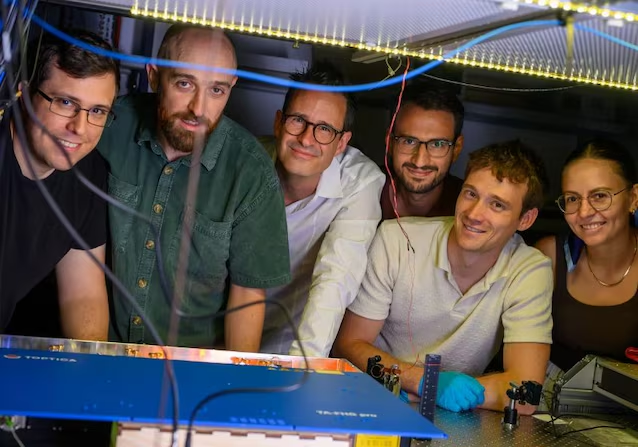
The Chinese Tsinghua group has instead demonstrated one greater frequency stability in the short term and verified that two crystals made independently they return concordant frequencies. The Chinese result highlights above all stability and reproducibility, while the Viennese one demonstrates the automation of operation and the possibility of technologically reproducing the system while maintaining its functionality.
Why thorium-229 is used
The technology used by the two research groups is based on thorium-229an isotope of thorium. Its core has a peculiar characteristic and this is the reason why it was chosen: thorium-229, in fact, has two nuclear energy states separated by a quantity of energy particularly small compared to that typical of nuclear transitions.
This difference allows for excite the nucleus using ultraviolet lightrather than resorting to the much higher energies that would be necessary for most other nuclear transitions (X-rays or gamma rays are much more difficult to control with the same precision as a laser).
To make thorium nuclei usable, both groups incorporated them into calcium fluoride crystals (CaF₂). The material allows you to accommodate a large number of nuclei and to interact with them using the ultraviolet laser.
In practice, a laser illuminates a calcium fluoride crystal containing thorium-229; at this point, the laser excites the nucleus of thorium-229 and the frequency of the light that is used to do this is always the same, identical for all nuclei. The crystal, transparent to ultraviolet light, serves to hold many thorium nuclei still.
THE nuclei absorb light only if its frequency is the right onea bit like when we try to tune into a specific frequency on a radio. Laser oscillations, approximately two million billion per second, are the fundamental unit of time: counting the oscillations of the laser locked to that frequency yes measure time.
Real applications
One of more interesting prospects for applicative uses of the nuclear clock concerns the satellite navigation who uses the system GPS (Global Positioning System). In fact, to determine the position of a receiver, the satellites of the GPS network transmit time signals that allow the distance traveled by the light to be calculated.
A error of just one nanosecond corresponds to approximately 30 centimeters in the estimated distance on the surface of the Earth. More stable clocks could therefore contribute to improve accuracy of the positioning provided by the GPS.
A more reliable time reference would also be useful for synchronize satellite networks and coordinate communications between spacecraft and Earth stations.
But the potential applications of nuclear clocks could also serve research in fundamental physics: not surprisingly, an application area of research proposed by the Vienna and Beijing groups was that of searching clues about nature from the dark matter.
In fact, some theoretical models predict that a form of ultralight dark matter can cause tiny variations in the fundamental constants of nature, modifying so the frequency of atomic and nuclear transitions. By comparing different clocks, scientists can look for these variations. The Vienna group has already used their prototype to verify some of these hypotheses, without however detecting signals, but being able to provide boundary values to the possible theoretical models that predict this type of dark matter.
