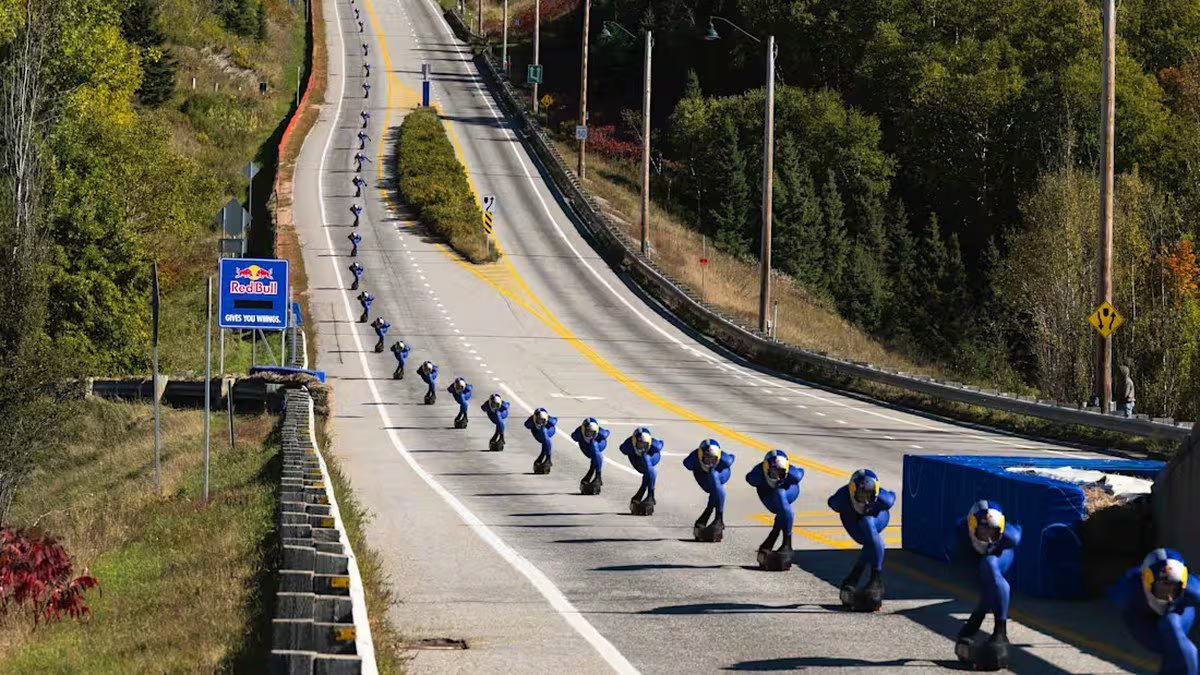
The Spaniard Diego Poncelet reached 151.83 km/h standing on a skateboard while speeding down a slope in Quebec, beating the record that had stood since 2017. A true record-breaking feat. Behind the number there is a challenge against air resistance, which consumes about half of the energy given by the slope, and a help from the wind.
Spanish Diego Poncelet he became the fastest man ever to stand up on one skateboardtouching i 151.83 km/h along the Route des Éboulements, in Quebec. The new world speed record in the category standingset on September 22, 2026, erases the 146.73 km/h that Britain’s Peter Connolly had clocked in 2017 on the same hill. At that speed you travel 42 meters every second, without an engine and above all without brakes, with only the push of gravity and an opponent that becomes stronger with every meter gained, that is, the air. A Guinness World Record sporting achievement.
Diego Poncelet standing on the skateboard: a record broken twice in five days
The athlete had already surpassed the previous record during the tests, with 146.88 km/h, a few hundredths above Connolly’s record. However, Poncelet was aiming for the psychological threshold of 150 km/h, and attempted the record again five days later, taking advantage of more favorable weather conditions: during the descent of the record the wind behind him was blowing between 10 and 14 km/h, an ideal situation for rewriting a new limit.
The road was not chosen by chance: the Route des Éboulements it descends towards the San Lorenzo river for approximately 2.2 km and includes a long straight stretch of 600 meters with a gradient of up to 18%, i.e. 18 meters of altitude lost for every 100 journeys. It is a very well-known place among skate speed specialists, so much so that on the same descent in 2012 the Canadian Mischo Erban had already brought the record to 129.94 km/h.
Downhill you don’t accelerate infinitely
You can also experience the sensation simply by cycling down a slope: in the first moments the speed increases quickly, then the increase in speed slows down until it stops, even if the road continues to descend. This happens because the push of gravity always remains the same, while the air resistance increases with the square of the speed, so at 150 km/h the air brakes four times more than at 75 km/h. When the two forces become equal, the speed stops increasing.
In this specific case, approximately half of the energy given by the descent is consumed by the air and, to a lesser extent, by the friction of the wheels. This is why Poncelet’s work focused on the shape of the body rather than the strength of the legs. The Spanish athlete carried out several sessions in a wind tunnel to find the most compact posture and understand how long he could maintain it, and in the gym he worked on the mobility of his neck and torso to be able to assume a position on the board with a low head and a flat back. The price you pay is in terms of visibilitybecause in that position he could only see a few meters of asphalt.
How important the exposed surface is is demonstrated by the street sled, the so-called “street luge”, in which you go down lying on your back. On the same hill the American Mike McIntyre reached 164 km/h in 2016, and Guinness keeps the two records separate precisely because when lying down you offer much less friction to the air.
The danger of high-speed oscillations: the physics study
Anyone who rides a skateboard also knows it “speed wobble”an oscillation of the board that starts almost imperceptibly and widens until the person on top falls. A study by the University of Bristol and the Budapest Polytechnic has shown that the problem arises largely from the reaction time: each correction arrives with a small delay and, beyond a certain speed, that delay is enough to transform the adjustments into a push that amplify the oscillation instead of dampening it. If we consider that at 151 km/h a tenth of a second is equivalent to more than 4 meters of road, we understand why Poncelet controlled speed and stability only with minimal movements, lowering himself to accelerate and raising himself to slow down, managing to make the perfect descent.
