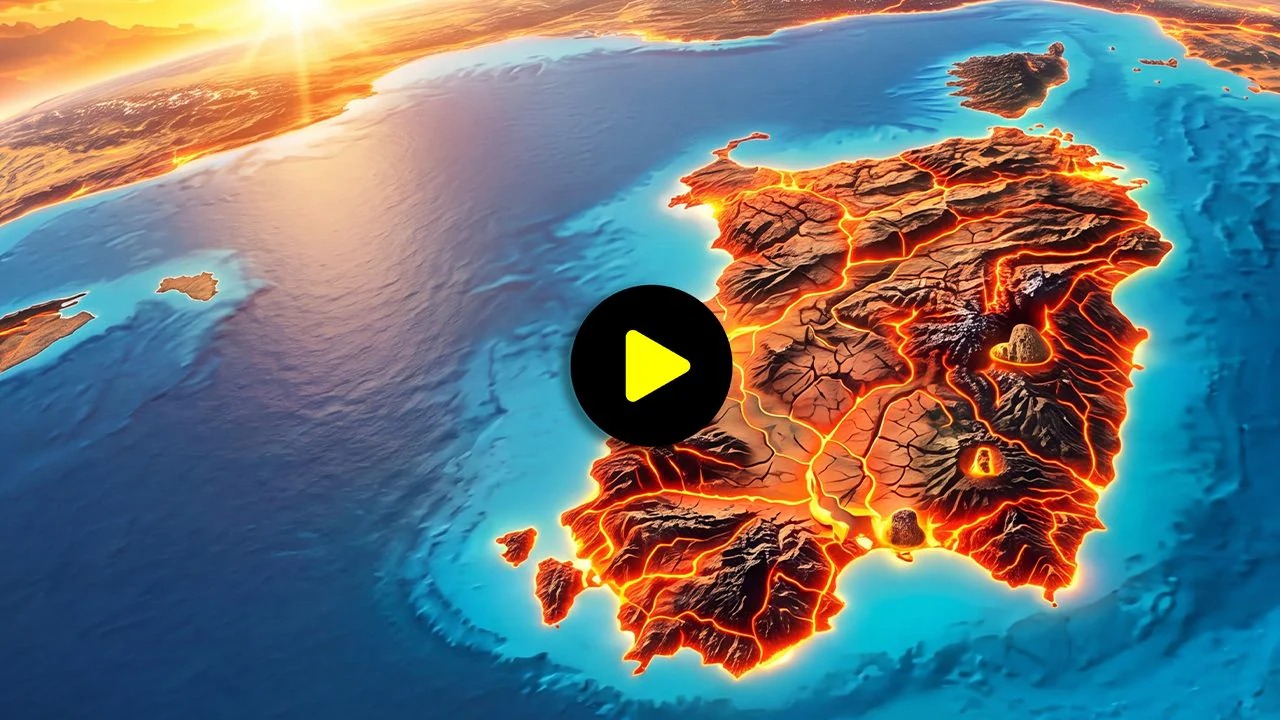
Detached from Europe with an anti-clockwise rotation, Sardinia combines a past of volcanism with half a billion years of geological evolution. This complex history has concentrated exceptional mineral deposits and coalfields, profoundly shaping the landscape and history of the island.
There Sardinia she hasn’t always been in her current position. Paleomagnetic data and geological reconstructions show that the island and Corsica were part of the European continental margincompared to Provence. A new study published in 2026 on Tectonics proposes for Sardinia and southern Corsica an overall rotation of approximately 90° counterclockwise between 30 and 15 million years agocontemporary with the opening of the Liguro-Provençal basin. Central-northern Corsica instead seems to have undergone a much smaller rotation, a sign that the deformation of the system was more complex than a simple rigid block.
Between the Oligocene and the Miocene the western Mediterranean passed through a profound tectonic reorganization. The crust fractured progressively separating Sardinia and Corsica from the Provençal margin. The movement occurred over geological timescales: a few centimeters per yearmultiplied over millions of years, are enough to move entire blocks of lithosphere hundreds of kilometers. Sardinia did not ‘float’ like an island: it moved together with the lithosphere of which it was part.
The history of Sardinia brings together plate tectonics, volcanism, formation of mineral deposits and history of human communities. The island is a fragment of European crust that has changed position and orientation, but it is also a territory in which hundreds of millions of years of sedimentation, collisions, magmatism, hydrothermal fluids, metamorphism and alteration have concentrated different resources. It is this intertwining, not a single event, that explains why Sardinia had one of the most important mining histories in Europe.
The ancient eruptions in Sardinia and the 90° rotation: from volcanoes to obsidian
There breaking and rotation phase was accompanied by an intense magmatic cycle. Between approximately 29 and 13 million years ago Sardinia was affected by Oligo-Miocene volcanism with andesitic lavas and pyroclastic products, including large ones ignimbriti; the main successions emerge in areas such as Anglona-Logudoro-Bosa, Arcuentu, Sarroch and Sulcis-Cixerri. It is therefore not just a landscape of lava flows: some phases were highly explosive.
Today Sardinia it does not host active volcanoesbut it preserves numerous testimonies of volcanism. To read them correctly it is necessary to distinguish at least two great Cenozoic cycles. The first, Oligo-Mioceneis the one contemporary to the great tectonic reorganization and mainly affects the western part of the island. The second, Plio-Pleistoceneis younger and includes complexes such as Monte Arci and much of Montiferru. In Monte Arci, volcanism also produced the famous obsidians, exploited and traded by Neolithic communities in the western Mediterranean.
500 million years of deposits and the carbon of Carbonia
Saying that Sardinia is rich in minerals is correct in common parlance, but geologically the point is another: the island is rich in depositsthat is, areas in which certain elements have been concentrated in anomalous quantities. A deposit is created when geological processes take elements normally dispersed in the crust and select, transport and accumulate them. THE hot fluids they can melt metals and deposit them when temperatures or chemistry change; there sedimentation it can concentrate them in specific layers; metamorphism, alteration And karst they can then remobilize and reconcentrate pre-existing mineralizations.
Sardinia is exceptional because its crust has been subjected to many of these processes, multiple times, over half a billion years. In the Cambrian, enormous rocks were formed in Sulcis-Iglesiente stratiform Pb-Zn depositswith over 120 million tons of ore historically mined. During the Variscan orogeny, the deformation, metamorphism and intrusion of large granite masses activated new fluid systems and remobilized older deposits; subsequently the Cenozoic magmatism and the alteration of the volcanics produced other mineralizations and industrial minerals. This is why Sardinia is not mining for a single cause: it is a metallogenic palimpsest in which multiple events have concentrated different elements in different eras.
Carbonia shows almost perfectly how geology can influence human history. The Sulcis coal does not derive from Miocene volcanism, but from one Paleogene sedimentary succession. During the regressive phase of an ancient coastal basin, paralic and marshy environments were formed in which organic vegetal matter accumulated; buried by sediments, this matter transformed into levels and banks of lignite and coal. In the years 1936-37 research identified the extensive Serbariu deposit. The Municipality of Carbonia was established with RDL n. 2189 of 5 November 1937 and the city was inaugurated on December 18, 1938 like a real mine mouth city. There Great Serbariu Mine it officially went into production in 1939 and ceased operations in 1964.
