
The INGV bulletin on the Campi Flegrei does not indicate short-term developments. Soil heave is stable at 10 mm/month. 68 earthquakes recorded (max Md 2.5). Constant temperatures: 173°C at Solfatara and 94°C at Pisciarelli. Since 2025, Rione Terra has risen by 32.5 cm.
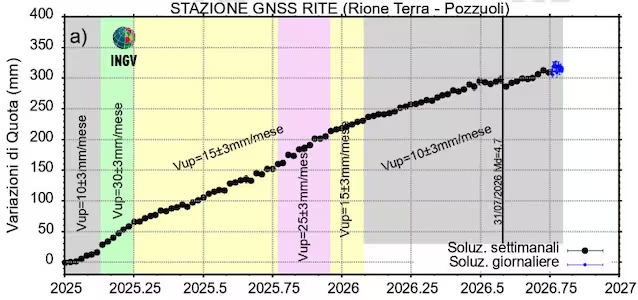
Almost three months after the strongest seismic event ever recorded Phlegraean Fieldsthat of Md 4.7 which occurred on July 31, the bulletin of the Vesuvian Observatory of the INGV relating to the week of 12-18 October shows a situation that does not indicate a short-term evolution. Ground heave due to bradyseism is stable at 10±3 mm per monthwith 35 earthquakes located having magnitude Md≥0.0 on a total of 68 seismic events recorded. At the Solfatara fumarole the temperature is stable at 173°C. The overall ground rise in Rione Terra in Pozzuoli is 32.5 cm from January 2025.
The seismic data and the values of the geochemical parameters recorded at the Campi Flegrei
Between October 12th and 18th they were recorded 68 earthquakes with magnitudes between -0.5 and 2.5. If you are wondering how it is possible to record an earthquake with a negative magnitude, the answer is simple. When the magnitude scale was invented, the “zero” value was set based on the seismographs of the time. Today’s seismographs, however, are so sensitive that they are able to detect micro-seisms even weaker than the reference zero. Instead of recalibrating the entire scale, seismologists simply prefer to use negative mathematical values.
The data relating to the geochemical parameters at Campi Flegrei are consistent with the trend of previous periods. In the Pisciarelli area, where degassing has been particularly intense in recent years, the release of CO2 has rremained at high values although slightly decreasing. Over the past week the temperature in this area has shown an average value of approximately 94°C. In the area of the Solfatara crater, the sensors measured an average temperature of approximately 173°C in the reference week. The high temperature is in line with the significant increase in recent years.
Raising the soil
From the beginning of February 2026 the average speed of ground lifting, due to the phenomenon of bradyseism, in the area of maximum deformation of the Campi Flegrei is 10±3 mm per month. Deformation patterns also occurred in the reference week did not show significant changes compared to this average trend. Compared to the period before February 2026, when the uplift occurred at a rate of approximately 15±3 mm/month, there was therefore a slowdown (although several GNSS stations recorded coseismic discontinuities in conjunction with the earthquake swarm of 31 July). The overall lift recorded by the RITE GNSS station (Rione Terra, Pozzuoli) is approximately 32.5 cm from January 2025.
The summary of the INGV weekly bulletin
To summarize, the INGV weekly bulletin relating to the Campi Flegrei for the period 12-18 October 2026 highlighted the following situation.
- Seismicity: 35 localized earthquakes with magnitude Md≥0.0 (Mdmax=2.5±0.3), out of a total of 68 earthquakes recorded (-0.5≤Md≤2.5).
- Bradyseism: Soil heave rate stable at 10±3 mm/month from early February 2026.
- Geochemistry: the parameters confirm the previous trend, with a temperature of approximately 173 °C at the Solfatara fumarole and a temperature of approximately 94°C at the Pisciarelli fumarolic emission.
