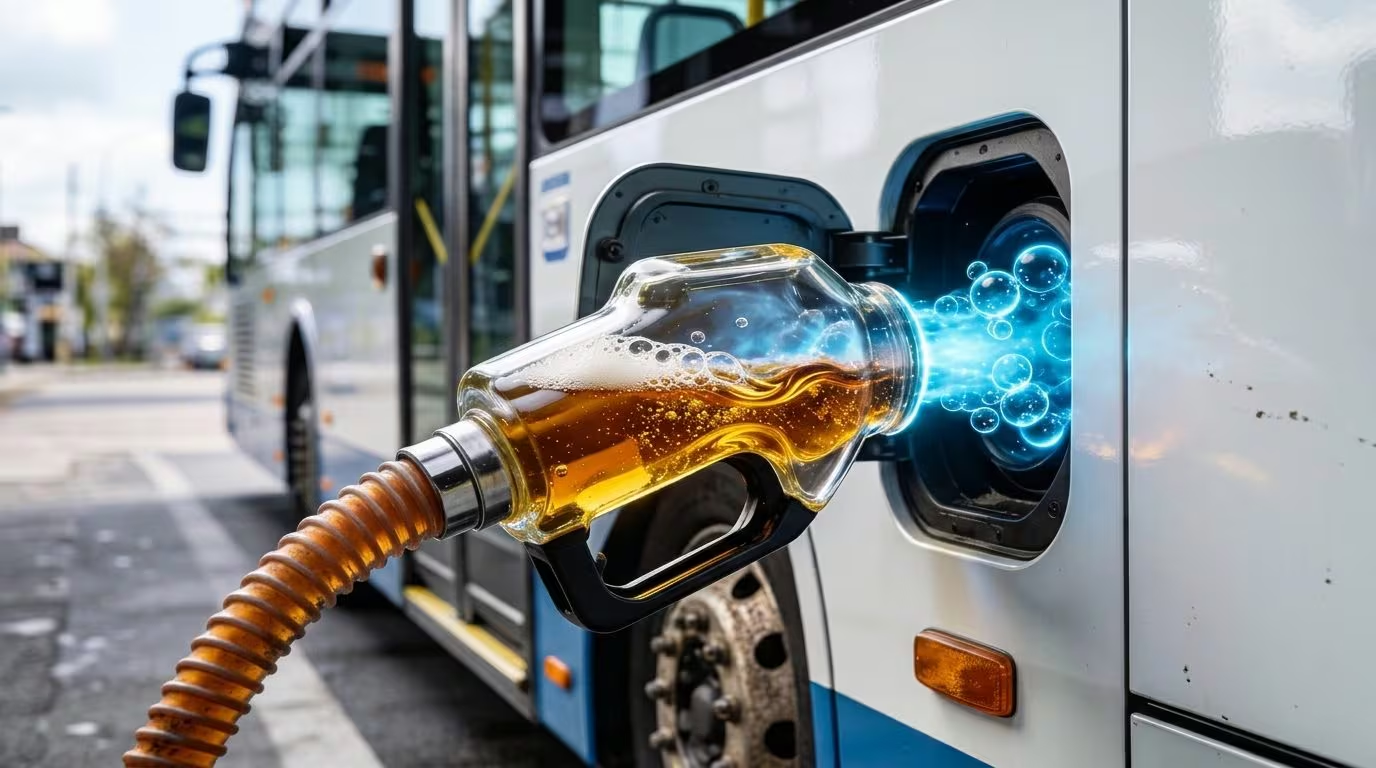
In Sweden, instead of being thrown away, contraband beer, wine and spirits are transformed into biogas. The process involves bacteria and large digesters to produce pure biomethane.
For years there Sweden use all thealcohol seized to produce biogas And power their public transport: it is a form of alternative energy that is decidedly outside the box but which is now quite consolidated in the country. This intuition was born to solve a practical disposal problem linked to the rigid state monopoly on alcoholic beverages. In practice, a recycling system has been developed that exploits the action of bacteria to convert ethanol into methane through anaerobic digestion.
Why do Swedes “import” so much alcohol?
To understand this we need to take a step back. In Sweden drinks above 3.5% alcohol they can only be bought retail in the shops of the state monopoly, Systembolaget, and the taxes are very high. The result is that many Swedes stock up abroad, especially in Denmark and Germany.
In fact, European regulations allow transport alcohol for personal use without strict limitsbut they set reference quantities that customs use as an alarm bell: we are talking about 10 liters of spirits, 20 of fortified wine, 90 of wine and 110 of beer. If these quotas are exceeded, it is the traveler’s responsibility to demonstrate that it is all for personal use. If he fails, the court can order confiscation and the alcohol will never be brought back.
A well-known phenomenon in the country is that of spritbussarthe “alcohol bus”: organized buses in which passengers were paid to declare as their alcohol which in reality was intended for illegal resale.
700,000 liters of alcohol: the new use seized
For years the solution was apparently the most banal: pour everything down the drain. But customs in the mid-2000s managed to manage approx 700,000 liters of alcohol per year: it was realized that throwing them away was a huge waste.
And so here was the brilliant idea: the bottles and cans were crushed, the liquid mixed with water up to a strength of about 10% and then collected in a large tank – jokingly called by customs officers “the giant cocktail”. From there a tanker transported it to the Svensk Biogas plant in Linköping, where everything, together with other organic waste, was converted into biogas: the same that supplied the 64 city buses of the city.
How beer becomes methane: the process
The key process is that of digestion anaerobicthat is, the decomposition of organic matter in the absence of oxygen. Once the alcohol reaches the plant, it is placed in large silos called digesters together with other organic waste. Inside the digesters there are bacteria and other microorganisms that “eat” the ethanol and produce methane and carbon dioxide. Doing the math, one liter of pure ethanol can give in theory almost 600 liters of methane at atmospheric pressure.
Once the process is finished, methane and carbon dioxide are separated until obtained biomethane pureready to end up in the tank of a bus.
Is it still done today? The answer is yes and as of 2019 Customs has changed recycling center: Today all alcohol ends up in a single plant in Scania. Here, machines autonomously open bottles and cans, replacing the time-consuming manual work previously required of customs officers. Consider that in that very year they were transformed into biogas approximately 300 thousand liters of alcohol. However, it is right to point out that seizures are decreasing: in 2025, Swedish customs seized around 52 thousand liters of alcohol, compared to 54 thousand the previous year.
