The WMO Bulletin no. 22 confirms new greenhouse gas records in 2025: CO₂ rises to 426.8 ppm (+53% compared to 1750).
The 22nd World Meteorological Organization (WMO/WMO) Greenhouse Gas Bulletin has just certified an incontrovertible fact: in 2025 the levels of the main greenhouse gases present in the atmosphere broke all historical records. The global average concentration of carbon dioxide (CO₂) has reached the unprecedented height of 426.8 parts per million (ppm)marking an increase in 53% compared to pre-industrial levels of 1750. Historical records and impressive percentages also concern methane (CH4which reached 1,948 parts per billion, or +167%) and nitrous oxide (N₂Owhich reached 339.1 parts per billion, equal to +26%).
We often think of global warming as a tap: if we turn off emissions, the climate immediately goes back to how it was before. Atmospheric physics, unfortunately, doesn’t work like that. Understanding the latest WMO report means understanding what theinertia of the Earth systemwhy the molecules we are emitting today will affect the climate of future generations and how the El Niño phenomenon risks short-circuiting the planet’s natural defense mechanisms.
The graph highlights the accumulation trend in the atmosphere and the seasonal cycle of vegetation. Source: NOAA
A record ever recorded in human history: accumulation rate
If the overall figure of 426.8 ppm sets a record never recorded in human history, the scientific community monitors the speed with which this accumulation is occurring. The WMO highlights how the increase in CO₂ between 2024 and 2025 will remain at a pace higher than the annual average of the last decade (2016-2025). To understand the extent of this accumulation, a historical comparison is enough: when the WMO Bulletin was published for the first time twenty years ago (in 2004), CO₂ was at 377.5 ppm. In just two decades we have added about 50 parts per million.
But why is every single extra “part per million” so physically dangerous? In climatology the parameter of is used radiative forcing (radiative forcing), defined as the imbalance between the solar radiation entering the atmosphere and the infrared radiation exiting towards space (measured in W/m²).
Greenhouse gases act like an ever-thicker thermal blanket. By increasing radiative forcing, excess energy is “trapped” in the planetary system: we are literally supercharging the oceans and atmosphere with energyaltering the global heat engines that regulate winds, sea currents and precipitation cycles.
Not all greenhouse gases behave the same way
One of the most underestimated technical aspects concerns theAtmospheric Lifetime (the residence time in the atmosphere) of the different gases. Not all greenhouse gases behave in the same way and with the same timing:
- Carbon dioxide (CO₂): it is the long-term determining factor. Once released into the atmosphere, CO₂ does not degrade spontaneously in the short term. A substantial portion remains in circulation for centuries or even millennia. This means that even if we completely eliminated global emissions overnight, the heat accumulated so far would continue to drive global warming for generations to come.
- Methane (CH4): it has a shorter lifespan (around 12 years), but a climate-altering power in the first years of its permanence that is tens of times greater than CO₂.
- Sulfur hexafluoride (SF6): it is a synthetic gas for industrial use used in high voltage electrical equipment. Despite being present in minimal concentrations (measured in parts per trillion), it has an atmospheric lifetime that approaches 3,200 years and a global warming potential 24,000 times higher than that of CO₂.
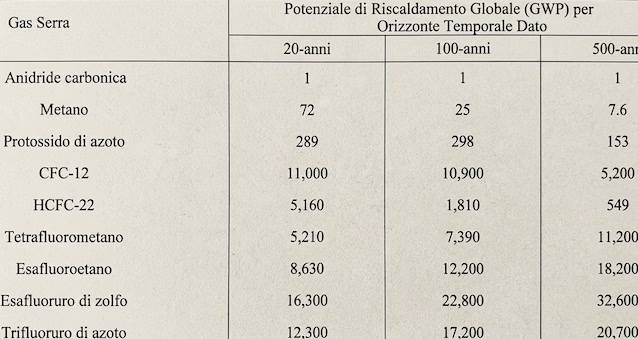
Gases such as methane act in the short term, while fluorinated molecules persist for centuries. Source: ResearchGate
El Niño and excess carbon, a short circuit
There is a fundamental detail that links greenhouse gas surveys to large planetary climate cycles: the relationship between the El Niño phenomenon and the Earth’s ability to absorb excess carbon.
Under normal conditions, natural ecosystems give us an immense “discount”: approximately half of the CO₂ we emit by burning fossil fuels is reabsorbed by the so-called carbon sinks (carbon sinks), i.e. forests (via photosynthesis) and oceans (via chemical dissolution).
However, when an intense event develops in the tropical Pacific El Niñothis balance is undermined through a dangerous positive feedback mechanism:
- Drought and blockage of photosynthesis: El Niño brings severe droughts to large tropical regions such as the Amazon, Southeast Asia and Australia. Plants, under severe water stress, reduce photosynthesis and stop absorbing CO₂.
- From sponge to carbon source: due to extreme temperatures and large-scale forest fires, dead vegetation and burning forest masses begin to release back huge amounts of carbon stored for decades.
- Ocean saturation: warming of the sea surface reduces the solubility of gases in water, decreasing the ocean’s ability to absorb CO₂.
As underlined by the WMO report, the recurrence of climate flare-ups such as El Niño risks temporarily suffocating the absorbing capacity of natural sinks, leaving an even higher percentage of our emissions to remain “stuck” in the atmosphere, pushing the record bar upwards.
