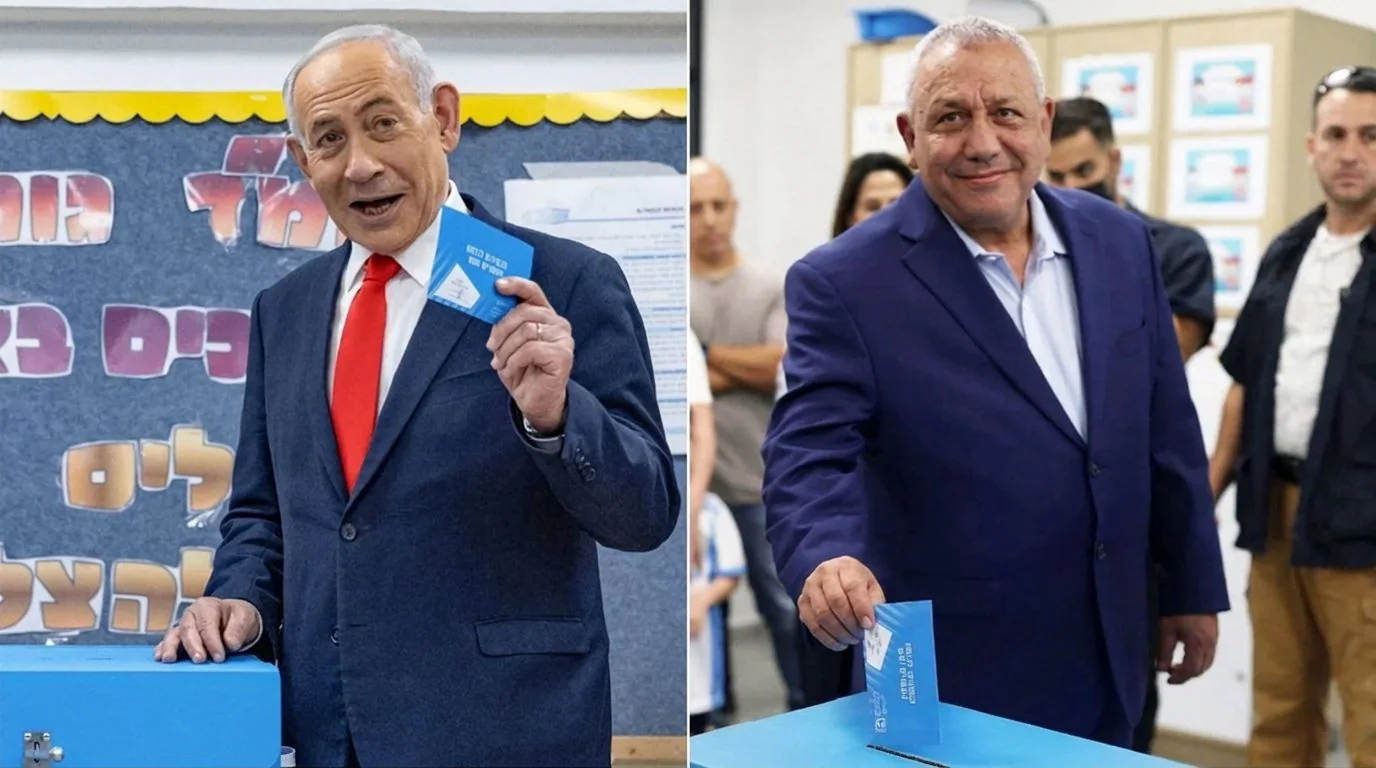
Voter turnout in Israel reached 77.7%, the highest level since 1999. With counting still ongoing, Benjamin Netanyahu’s bloc is ahead with 53 seats to Eisenkot’s 48, but currently falls short of the 61 seats needed for the government. The weight of the Arab parties, currently with 19 seats, could prove decisive, while the positions of the main factions remain far from a substantial turning point on the war in Gaza and the future of the Palestinians.
The elections in Israel they have not decreed a certain winner. With the 100% of votes counted at the pollsthe outgoing prime minister Benjamin Netanyahu comes out ahead with 53 seatsbut his party doesn’t seem to have the numbers to independently obtain a majority Knesset, the Israeli Parliament.
An important element is the result of Arab-Israeli parties, currently with 19 seats, which could have sufficient numbers to influence the formation of the next government. The final count, however, will not arrive before Friday, when they will be counted 600,000 “double envelopes”, i.e. votes cast by correspondence and remotely.
According to local media, the Israeli president, Isaac Herzogwill meet both in the next few days Benjamin Netanyahu than the rival Gadi Eisenkot, to assess the feasibility of a government of national unity.
In fact, if no bloc manages to build a majority, several weeks of negotiations could be necessary and, in case of failure, new elections in 2027.
Meanwhile, Lrecord turnout of 77.7% reports a particularly high participation in these elections characterized by themes such as national securitythe situation in Gaza and the political and military budget of recent years. But a possibility change of government it doesn’t seem to mean a change in Israeli politics towards Gaza and the West Bank.
Record turnout in Israel: voting in a deeply divided country
To understand the result of the elections we must first start from the electoral system present in the country: in Israelas in Italy, the prime minister is not directly elected. Voters vote for a party list and seats are distributed proportionally to the votes received, provided they pass the electoral threshold of 3.25%. The Knesset – the Israeli Parliament – is made up of 120 deputies, therefore to obtain an absolute majority and support a government they are at least needed 61 seats. Since no party normally manages to win this number of deputies on its own, the executive training it depends on agreements between multiple political forces.
One of the most significant elements of these elections is the participation in the polls: According to the Israeli Central Election Commission, turnout reached 77.7%, against the 70.6% recorded at the same time in the 2022 elections. It is the highest figure since 1999, according to The Times of Israel: participation was particularly notable even among Arab citizens of Israel, which represent beyond a fifth of the population.
For many of them, voting was an opportunity to challenge the policies of the outgoing government and try to influence future decisions, in particular on the creation of a Palestinian state. The context is that of a country marked by the attack led by Hamas on 7 October 2023, by the war in Gaza and by subsequent regional conflicts and the elections have put the safety issue, trust in Netanyahu’s leadership and the internal divisions to Israeli society. The high turnout, however, does not automatically equate to a consensus for one of the two sides: we must in fact look at the distribution of seats and the concrete possibility of forming a majority.
The weight of the Arab parties: can they have a decisive role in the formation of the government?
The result of Arab lists it is one of the politically aspects more relevant of the vote. Netanyahu’s bloc, in fact, is in the lead, but without the numbers to govern autonomously. Even the Yashar party, led by Gadi Eisenkot, former chief of staff and main rival of the prime minister, remains under the absolute majority with 48 seatsand in this scenario the Arab parties play a decisive role.
Not because they are necessarily destined to enter the government, but because their parliamentary support or, on the contrary, their abstention could contribute to allowing the birth of an alternative executive. The president of Joint List, Yousef Jabareenindicated a willingness to offer conditional parliamentary support for a political alternative. The list brings together three parties: Hadash, Ta’al and Balad.
Another force, Ra’am, led by Mansour Abbas, presented itself separately. Jabareen he asked among other things interventions against crime in Arab communitiesstop the house demolition and reopen the discussion on a path towards creation of a Palestinian state. The formation, however, ruled out wanting to give unconditional support to a possible opposition government.
There is, however, a political obstacle: several Israeli opposition parties have declared that they do not want to depend on the Arab lists to govern and the same Netanyahu ha excluding the formation of an executive that is based on their support. If no bloc manages to build a majority, Israel could face weeks of negotiations and, if they fail, the prospect of new elections.
What are double-envelope ballots and why they can affect election results
The picture, however, still remains provisional: a significant part of votes it still has to be verified and counted through the so-called system double-envelope ballotsi.e. the cards inserted into one double envelope. The Central Election Commission estimates that they are approximately 600,000a higher number than recorded in the 2022 elections.
It’s mostly about votes expressed by soldiers and reservistsbut also from prisoners, healthcare workers, diplomats abroad and people voting far from their usual polling place. The double envelope allows you to verify the voter’s identity and ensure that he has not voted more than once, keeping the ballot anonymous.
Since these votes are counted separately, they can change the final distribution of seats. Historically these cards have relatively favored i Zionist parties compared to the Arab and ultra-Orthodox lists, also for the greater military presence among voters who use this procedure. However, it is not possible to predict with certainty the effect on the final result; what is important, however, is that if the margins between the parties remain small, even changes of one or two seats could affect the negotiations for the formation of the government.
What happens now? Possible scenarios
Once the counting was completed, the Israeli president Isaac Herzog will consult the representatives of the political forces and will entrust a parliamentarian with the task of attempting to form a government. The choice will depend on the evaluation of who has the greatest chance of obtaining the Knesset support, not only by those who received the most votes.
The candidate in charge will then have to negotiate with the other parties to achieve at least 61 seats. If no one manages to build a majority, the country could find itself faced with one again political crisis and to possibility of new elections. The current result therefore has a seemingly contradictory message: Netanyahu keep a consistent supportbut does not have the numbers to autonomously govern the very political forces that the Israeli system has often relegated to margins they could become decisive in deciding who will lead the country. The question is therefore not only who will rule Israel, but which government will be able to form and which ones consequences will have for the war, for Gaza and for the future of the Palestinians.
Gaza and the Palestinians: could anything really change?
In this regard, a possible change of government it wouldn’t involve a turning point in Israeli policy towards the Palestinian people. Netanyahu has built part of its political line precisely on national security, on contrast to Hamas and on theopposition to the creation of one Palestinian state independent.
His government also supported the expansion of Israeli settlements in the West Bank and included forces of‘extreme right in favor ofannexation of the territory. Eisenkot represents a political alternative to the prime minister, but not a change on the Palestinian question.
According to a Reuters analysis dated October 22, 2026, both leaders do they oppose to the creation of one Palestinian state independent and argue that Hamas must disarm before a withdrawal of Israeli forces from Gaza. Both said they resume massive military operations if these conditions are not met. Slight differences concern the West Bank: Eisenkot does not support unauthorized Israeli outposts and some settlement expansions, while Netanyahu supported broader colonization policies. For the Palestinians, therefore, even with a change of government it currently appears unlikely that there is one end of military operations in Gaza or a concrete opening towards the two-state solution.
