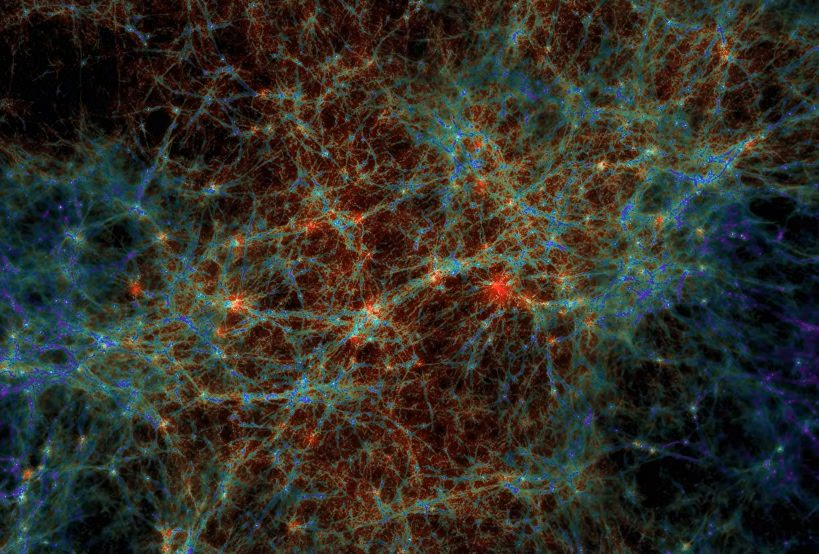
It’s called Lumina and it is the largest simulation ever created, in terms of resolution and volume simulated on the supercomputer. The project reconstructs the evolution of galaxies, stars and cosmic gas in the first two billion years of the universe’s life.
It was made largest simulation of the first two billion of life of the Universe: Lumina includes a huge universe volumewith a side of approx 1.6 billion light years. The simulation starts from approximately 45 million years after the Big Bangfollowing the evolution of cosmic structures until the universe was little more than two billion years.
The project was developed by an international group of researchers using the calculation of supercomputers Frontier, at the Oak Ridge National Laboratory in the United States, one of more powerful existing computers on Earth capable of handling complex calculations such as cosmological simulations.
The combination of a large simulation volume, of high numerical resolution (i.e. how many elements are simulated) e the inclusion of the interaction between matter and radiation allows you to rebuild with greater realism both the formation of individual galaxies and the processes that transformed intergalactic gas (i.e. the plasma of hot gas spread between galaxies and galaxy clusters) on cosmological scales.
The peculiarity of Lumina is that it allows you to follow simultaneously the formation of the first galaxies And the evolution of the interaction of matter and radiation, coupled in two major events in cosmic history, which are called reionization of hydrogen and helium (the ionization it is a chemical phenomenon that deprives the atom of all its electrons, making it one ioni.e. a positively charged nucleus).
These two processes have profoundly changed the properties of intergalactic gas and the conditions under which cosmic structures evolved and changed distribution of matter. Lumina was created precisely to thoroughly study the two cosmological reionization events.
One of the most important results stands out distinction between mechanisms that they have drove the two reionizations. Radiation from early stars and galaxies played the main role in the reionization of hydrogen while that from active supermassive black holes (i.e. the black holes at the center of galaxies) drove the subsequent reionization of helium.
The largest simulation in terms of volume and resolution
Lumina simulates approx 432 billion numerical elementsdivided into approximately 216 billion gas cells And 216 billion dark matter particles, as seen in the video below. The gas cells describe the distribution and properties of intergalactic gas while the dark matter particles numerically represent the mass of this component whose gravity contributes enormously to the formation of cosmic structures.
Other similar simulations like Thesan And ASTRIDuse fewer elements and simulate smaller volumes of space. Furthermore, Lumina also simulates the interaction between matter and radiation, which is the central factor in understanding the processes in the epochs of the two reionizations.
Each simulated element represents a very large quantity of matter. There mass associated with one gas cell it is indeed about 3.6 million times that of the Sun while that of one dark matter particle it’s about 19 million solar masses.
The number of elements therefore determines, together with the dimensions of the simulated volume, the level of detail with which it is possible to reconstruct the universe. More elements are simulated and the more it is effective at representing smaller structures and to better follow its evolution.
The challenge is therefore to combine a large cosmic volume with a high resolution to be able to correctly represent individual galaxies and the interactions between radiation and matter.
The primordial universe after the Big Bang and reionization
Understand when and how it happens reionization means reconstruct when the first light sources came on (i.e. largely primordial stars) and how they modified the surrounding gas, influencing the conditions in which large-scale cosmic structures such as galaxy clusters evolved.
In the first minutes after the big Bang it happened there primordial nucleosynthesisthat is, the set of nuclear reactions of the primordial universe that produced above all hydrogen and helium nuclei(as well as small quantities of deuterium and lithium). The electrons bonded to the nuclei only later, forming neutral atoms about 380,000 years laterwhen the universe cooled enough and became transparent to light. In a subsequent phase the universe entered the so-called dark agesor when yet there were no stars capable of producing photons.
With the formation of the first stars, ultraviolet radiation was produced and began to strip the electrons to neutral hydrogen atoms transforming them into positive ions. It is the first event of the process called reionization, that is, the transformation of neutral atoms into charged particles through radiation.
Lumina shows that the reionization did not occur everywhere at the same time. Bubbles of ionized gas formed around the most massive galaxies and continued to grow until they merged. The regions that were less dense and further from the light sources remained neutral for longer. In the final part of the process the stars of the galaxies continued to provide the majority of the ionizing photons.
It’s exactly this irregular distribution of bubbles to explain why this is important to simulate such a large volume. A limited region may contain few bright galaxies, or may not adequately represent the large empty zones where hydrogen remained neutral the longest. There would thus be a risk of reconstructing a simulation that is not very representative of the true evolution of the universe. Lumina therefore allows us to compare different cosmic environments and evaluate how the distribution of the sources influences the speed and geometry of reionization.
The role of supermassive black holes in second reionization
After the reionization of hydrogen the universe crossed a second transformation linked to helium. However, to strip the two electrons from the helium atom and make it ionized, they are needed much more photons energy than necessary to ionize hydrogen. The most effective sources are i active galactic nuclei of galaxies (called in English AGN, Active Galactic Nucleus) whose light sources are powered by gas falling towards supermassive black holes.
The Lumina simulation also includes this second ionization of helium from the beginning until the final stages. The model thus links the appearance and distribution of active galactic nuclei to the growth of regions in which helium is fully ionized.
Studying this reionization is important because when an atom absorbs a sufficiently energetic photon, part of the energy transferred helps to heat the surrounding particles. The reionization of helium therefore determines a new phase of heating of the intergalactic medium subsequent to that associated with the reionization of hydrogen.
Following both reionizations in the same model therefore allows us to reconstruct a more complete thermal history of the early universe more precisely.
Lumina allows you to refine models of cosmological evolution
The Lumina simulation was not specifically designed to re-estimate fundamental cosmological parameters (such as the Hubble constant) as other similar models do, but its real goal is rebuild in the best way realistic possible the evolution of cosmic structures during a specific period of the early history of the universe e check if i modeled processes they are compatible with observations.
The researchers then verified various Lumina results with respect to the observational constraints already available (i.e. from the set of observations of available cosmic structures carried out with the present astronomical data) obtaining a good concordance with measurements of the cosmic background radiation (i.e. the residual electromagnetic radiation released by the Big Bang which homogeneously fills the entire universe) and with estimates of the temperature of intergalactic gas.
Another comparison concerns the population of simulated active galactic nuclei with those actually observed. The authors examined the distribution of their brightness and compared it with astronomical catalogs and recent observations. These comparisons are important because the quantity and distribution of quasars determine how much energetic radiation is produced and how quickly the reionization of helium proceeds, thus being able to compare through various simulations which models best represent the observational data.
