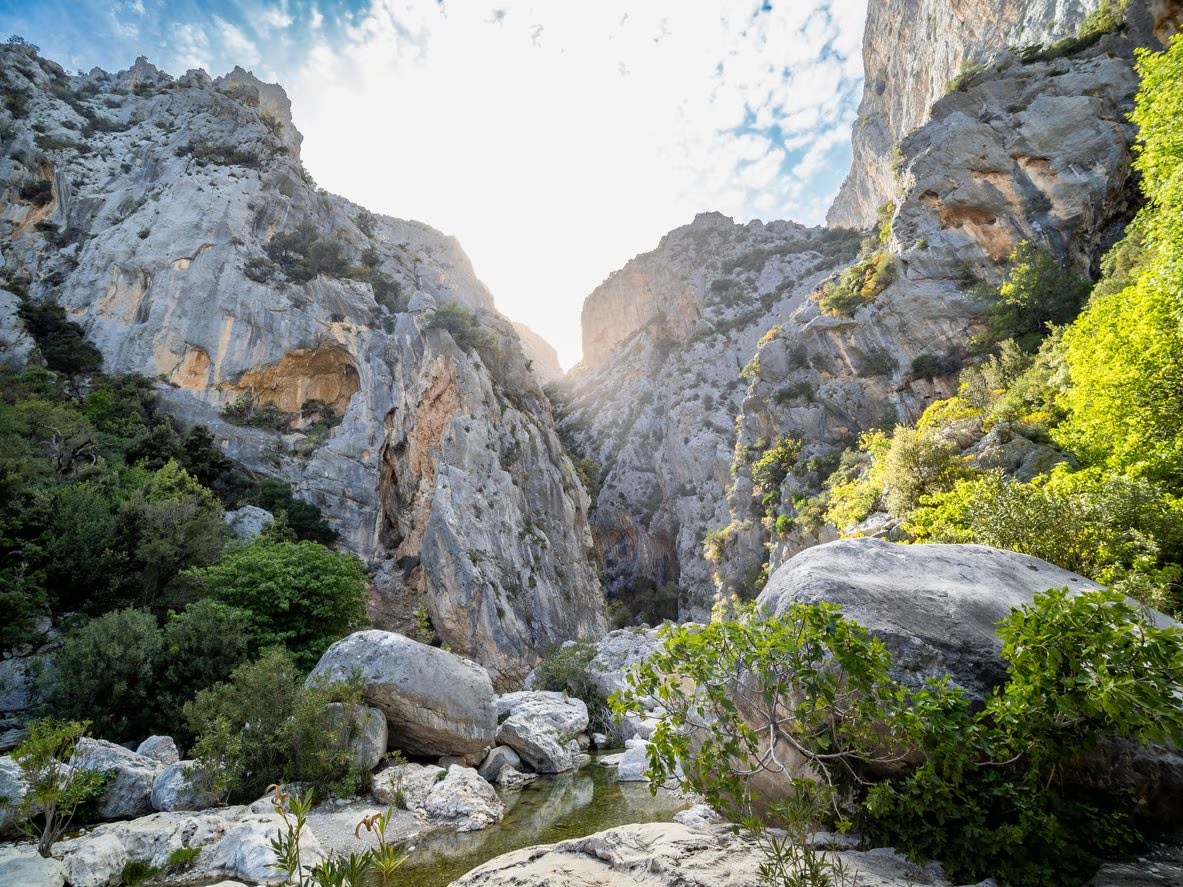
In the Sardinian Supramonte, very high rock walls enclose what is considered the deepest canyon in Italy: the Gorropu gorge, a hidden world, where endemic species and ancient legends live.
Among the municipalities of Urzulei And Proudin the Central-eastern Sardiniathe deep karst fissure of the Gorropu Gorge: a canyon with impressive vertical walls, considered the deepest in Italy and one of the deepest on the continent. We are right in the middle Supramontea vast mountain complex of limestone origin which extends between reliefs and plateaus for approximately 350 square kilometersfrom the center of Sardinia to the eastern coasts of the island.
Precisely in this wild and truly unique environment, our gorge is located, whose history has very ancient origins. The rocks surrounding it were in fact formed in a prehistoric marine environment: between the period Jurassic and the period Cretaceousthe continuous stratification of sediments of organic origin gave rise to imposing underwater formations, which, during a slow but inexorable geological process lasting tens of millions of years, emerged to become land. The rich deposits of fossils of marine organisms that can be observed in this environment today bear witness to its long and complex genesis.
Only later, the flow of surface water and the phenomenon of chemical dissolution of rockstypical of areas karsthave deeply affected the formation, creating a canyon whose limestone walls can reach up to 500 meters high and in the narrowest points the sunlight struggles to reach the bottom of the crack.
A large contribution to the erosion of the area has been made by the river known as Rio Fluminedduwhose waters, during floods, cross the gorge with impressive force, and then return to flow under the river channel for most of the year.
Such a particular environment does not bring with it a considerable biodiversitymuch of which is also endemic, that is, not found elsewhere. The golden eagle nests among the rocky walls, while the species that inhabit the Supramonte live in the surrounding area, such as mouflons, martens, foxes and wild cats. The Sardinian newt and the Sardinian trout also find refuge in the pools fed by the spring waters. But one of the most singular presences is thenuragic columbinea very rare plant that grows spontaneously only here, and which has very few specimens.
The area also guards very ancient traces of human presence. The position of the throat and the nuraghi that surround it suggests that this territory played a strategic and defensive role in the ancient communities of the island. And obviously numerous and evocative legends cannot be missing, which are intertwined with the history and traditions of the region. In fact, it is said that they lived in the canyon Sa mama de Gorropu (Gorropu’s mother), a fearful creature, and sos drulliosevil and supernatural beings who came out of the canyon during stormy nights to kidnap men and animals.
