Who were the witches really? From the sorceresses of antiquity to medieval persecutions, up to the symbol of female emancipation: a journey through myths, religion and power to discover how societies have transformed fear into a legendary figure.
Few figures of the Western collective imagination have passed through the centuries maintaining a symbolic strength comparable to that of the witch.
Elderly and solitary woman, connoisseur of herbs and remedies, nocturnal creature capable of transforming into an animal, or young seductress capable of manipulating the forces of nature: the witch takes on different appearances depending on the eras and societies that represent her.
His figure he inhabits an ambiguous space, suspended between the human world and the supernatural onebetween knowledge and transgression, between fear and desire.
But historically speaking, where it comes from the figure of the witch? Is it possible to identify a precise origin, or are we faced with a cultural construction developed through the superposition of myths, religious beliefs, ritual practices and power relations?
Ancient origins: nocturnal divinities, spells and women at the edge of the human world
The first testimonies of magical practices and fears linked to witchcraft precede the birth of the Christianity.
In the’ancient MesopotamiaIn fact, ritual texts and protection formulas document the belief in individuals capable of cause diseases, misfortunes and alterations of the natural order through occult actions. In that era, however, magic was not necessarily considered negative: it could constitute a healing tool or a hostile force, depending on the intentions attributed to those who practiced it.
From the Greek mythologyInstead, figures emerged that anticipated some characters of the European witch, such as Circe, Medea and Hecate. Circe, described in Homer’s Odyssey (8th-7th century BC), he possessed magical knowledge capable of transforming men into animals; Medeaprotagonist of tragedy by Euripides (431 BC)instead embodied the ambivalence between knowledge, female power and transgression. Hecatea divinity associated with the night, crossroads and magic, represented the link with the invisible dimensions of existence.
These figures share a symbolic “border” position. The concept of “liminality”, developed by the anthropologist Victor Turner in “The Ritual Process” (1969), offers an interpretative key: the witch ideally inhabits the space between nature and culture, human and supernatural, order and disorder.
However, they are not direct ancestors of modern witches, but mythological references subsequently reworked.
From the Middle Ages to witch hunts
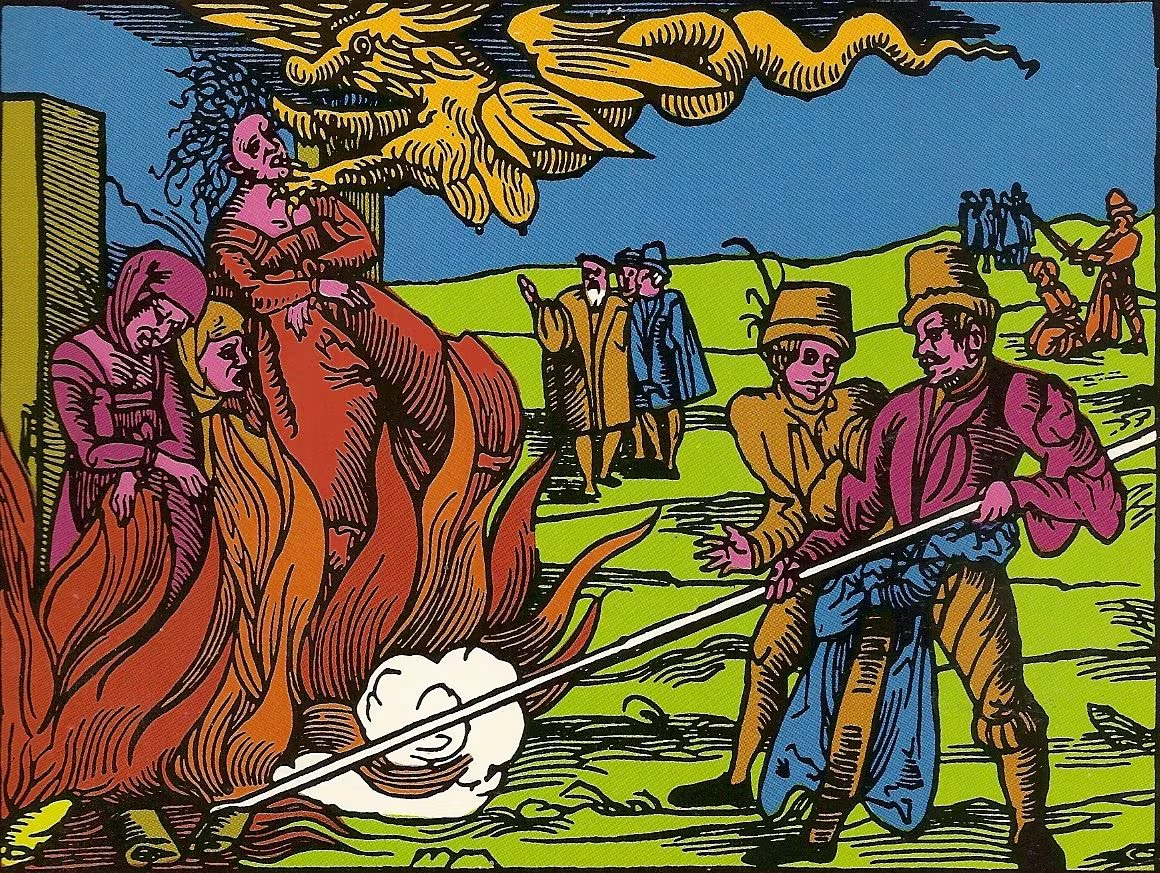
Between the 15th and 17th centuriesthe witch progressively took on the characteristics of an enemy of the religious and social order. Popular beliefs relating to curses and nocturnal rituals were reinterpreted through the Christian demonologywhich associated the witchcraft to the pact with the devil and the sabbat.
A significant work was the “Malleus Maleficarum” (1486-1487), attributed mainly to the Dominican Heinrich Kramer, who contributed to spreading a highly misogynistic depiction of witchcraft.
Historian Brian P. Levack, in “The Witch-Hunt in Early Modern Europe” (1987), interprets the persecutions as the result of the interaction between religious conflicts, judicial institutions and community tensions. Historical estimates indicate around 40,000-60,000 witchcraft executions in early modern Europe, predominantly of women.
The witch could become responsible for destroyed crops, epidemics or sudden deaths. This dynamic beckons the scapegoat mechanism analyzed by René Girard in “La Violence et le Sacré” (1972): a community affected by tensions can identify a marginal subject as the symbolic person responsible for its crises. The accusation of witchcraft thus also became an instrument of social exclusion.
The characteristics of witchcraft: gender, fear and power
Anthropology has shown how beliefs in witchcraft can constitute coherent systems of interpretation of reality. Edward Evan Evans-Pritchard, in “Witchcraft, Oracles and Magic among the Azande” (1937), observed that among the Azande (population spanning the north-east of the Democratic Republic of Congo, the south-west of South Sudan and the south-east of the DRC) witchcraft it did not necessarily replace material explanations of events, but it allowed us to understand why a misfortune struck a particular person.
Mary Douglas, in “Purity and Danger” (1966), also highlighted how societies build symbolic boundaries between purity and impurity, order and contamination.
In this perspective, the witch represents an ambiguous figure, perceived as threatening because it is difficult to place in the dominant social categories.
There gender dimension was explored in depth by Silvia Federici in “Caliban and the Witch” (2004), which links the persecutions to formation of capitalism and the disciplining of female bodies. This is an influential but debated interpretation: not all of the accused were healers or midwives, nor can the witch hunts be traced back to a single cause.
The witch nevertheless became one representation of fears linked to female autonomy, sexuality, aging and the transgression of social expectations.
From the old women of fairy tales to the symbol of emancipation
As persecution waned, the witch survived into the European folklore frequently taking on the role of antagonist.
In the fairy tales collected by the Brothers Grimmas “Hansel and Gretel” (1812), lives on the edges of the community, often in the forest, a symbolic place of the unknown and danger.
The historian Carlo Ginzburg, in “I benandanti” (1966) and “Storia notte” (1989), investigated the complexity of popular beliefs linked to spiritual battles, night flights and the Sabbath, showing how demonological categories have sometimes transformed different traditions into manifestations of alleged diabolical witchcraft.
In the twentieth century, the figure of the witch was progressively re-appropriated by neo-pagan and feminist movements. With the spread of “Modern Wicca“a term coined by Gerald Gardner in “Witchcraft Today” (1954), the witch has been reinterpreted as practitioner of a spirituality linked to nature.
In 1968, the American feminist collective WITCH transformed the figure of the witch into a symbol of political protest.
The witch is therefore not born from a single tradition, but from the encounter between magical beliefs, religious imagery and social dynamics: from mythological figure to enemy of the community to contemporary symbol of autonomy, his identity has continually been redefined.
