Which countries import the most oil in the world? The most recent OPEC ranking sees China, the USA and India at the top. Meanwhile, in 2026 the cost of crude oil imports into the EU increased by 55.8%, returning close to the 2022 peaks.
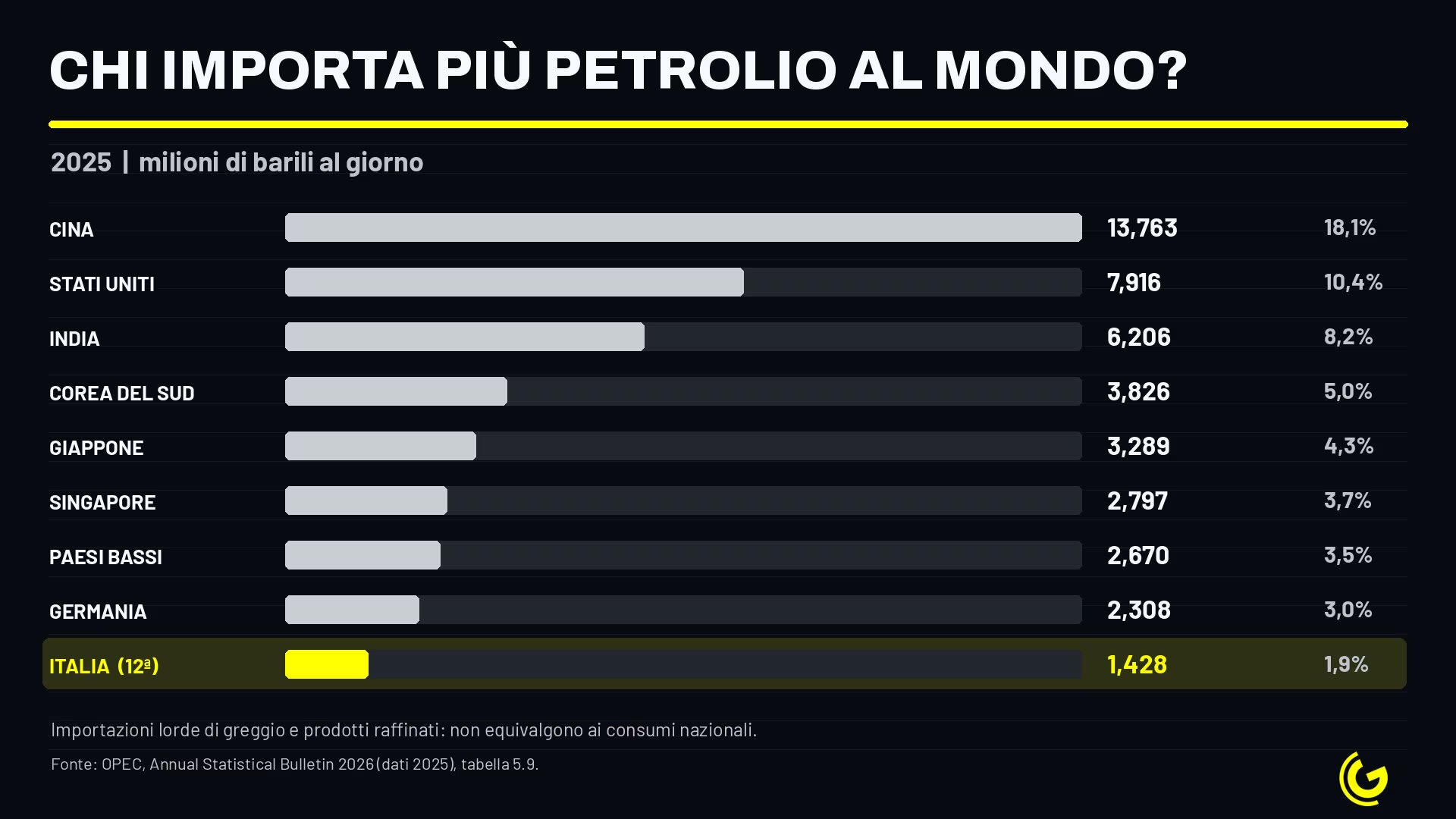
Which countries import the most oil in the world? According to the latest annual data from OPEC, relating to 2025, in first place we find the Chinawith approx 13.8 million barrels per dayequal to 18.1% of world imports. One barrel of oil (bbl) equals 158.987 liters, rounded to 159 liters.
Right away:
- The United Stateswith 7.9 million barrels per day (10.4%);
- theIndiawith 6.2 million (8.2%);
- there South Koreawith 3.8 million (5%)
- The Japan, with 3.3 million (4.3%)
- Singaporewith 2.8 million (3.7%) confirming Asia’s weight in international oil trade;
- in Europe the Netherlandswith 2.7 million barrels per day (3.5%);
- there Germany with 2.3 million (3%).
Italy ranks twelfth among the main importers reported in the ranking, with approximately 1.4 million barrels per day (1.9% of the total).
It is important to specify that these data, they do not necessarily represent actual oil consumption of each country: the ranking considers the gross imports of crude oil and refined petroleum productswithout subtracting any re-exports. For this reason, countries that host large ports, refineries and commercial hubs, such as Singapore and the Netherlands, can appear at the top also by virtue of the oil that is subsequently exported.
Europe also has an important role in global oil trade: according to OPEC, in 2025 the European countries belonging to the OECD imported a total of almost 18 million barrels per day of crude oil and refined products. This data does not coincide with that of the European Union, because it also includes non-EU countries, such as the United Kingdom, Norway and Türkiye. But in addition to the imported quantities, there is another aspect to consider: How much does it cost to import all this oil? In 2026, in fact, the European Union recorded a strong increase in spending on crude oil imports, despite the volumes purchased remaining almost stable.
How much the cost of barrels has increased in Europe in 2026
In 2026, meanwhile, the European Union faced a significant increase in the cost of oil imports.
According to Eurostat data reported by Euronews, in the second quarter of 2026 the EU spent an average of 27.6 billion euros per monthcompared to the 17.7 billion monthly average recorded in 2025. An increase of 55.8%, equivalent to almost 10 billion euros more every month. Yet, in the same comparison, imported quantities grew by just 1.2% (from 36.3 million tons per month in 2025 to 36.7 million tons).
What had an impact above all was the rise in international crude oil pricesfueled by tensions in the Middle East and supply disruptions across the Strait of Hormuz. The average cost per tonne imported has gone from 487 euros on average 2025 y 750 euros in the second quarter of 2026approaching the peaks of the 2022 energy crisis.
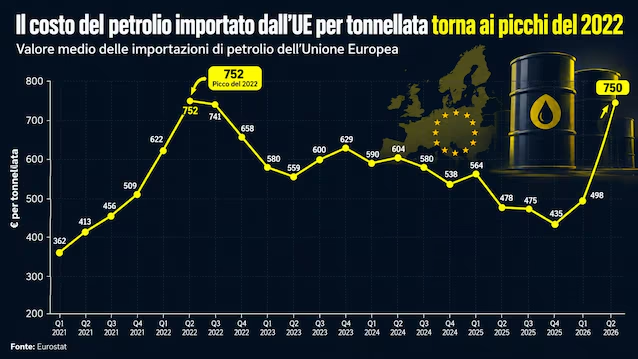
The comparison is about the monthly average for the whole of 2025 and that of the second quarter of 2026not two complete years and these latest data concern the European Union as a whole, unlike the OPEC ranking which considers individual countries.
As explained to Euronews by Szymon Kardas, senior policy fellow at the European Council on Foreign Relations (ECFR), these shocks hit the European Union hard because it depends for 90-95% from oil imports from outside the bloc (a dependence which according to Eurostat was 96.6% in 2024), but they also depend on global demand: as noted by Wolfgang Eichhammer, senior expert at the Institute for European Energy and Climate Policy (IEECP), Europe also competes for oil with Asian buyers, China in particular.
