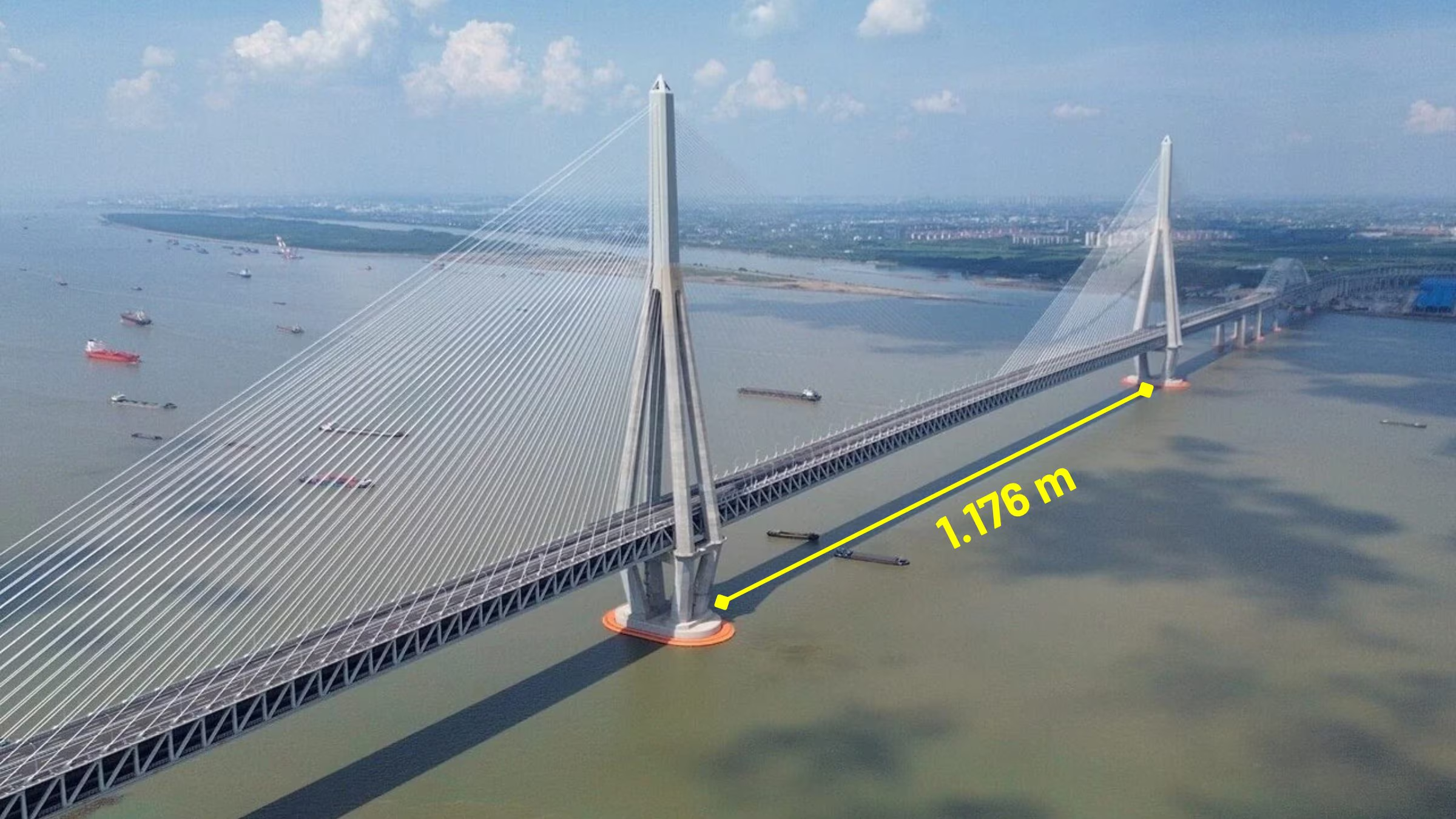
The Changtai Yangtze River Bridge, inaugurated last year in Jiangsu province, China, sets new world records in large infrastructure engineering: it is the cable-stayed bridge with the longest main span in the world (approximately 1,176 – 1,208 meters) and the largest combined highway and railway structure with a steel truss girder.
The Changtai Yangtze Bridge (Changtai Yangtze River Bridge) is an impressive transportation infrastructure located in the province of Jiangsuin China, which establishes a series of new ones engineering records: it is the cable-stayed bridge with the longest main span in the world (1,176 meters), The arched bridge in combined road-rail steel truss with the longest span ever built (388 meters), the bridge with the longest continuity of steel lattice girders and, with its 352 meter pylonsthe tallest bridge structure in the worldpassing the Millau Viaduct in France.
The work, inaugurated in September 2025, was designed by the prestigious China Railway Major Bridge Survey and Design Institutewhile the construction was directed by Jiangsu Provincial Transportation Engineering Construction Bureau.
The characteristics of the Changtai Yangtze River Bridge
The project consists of a huge infrastructure complex over 10 kilometers long that crosses the Yangtze River connecting the cities of Changzhou and Taizhou. From a structural engineering point of view, the work adopts a configuration double level, in which the upper level hosts a six-lane highway (the Jiangsu S30 Ruchang Expressway), while the lower level is designed for a multimodal transport system that prepares within it four lanes of road And two intercity railway tracks.
THE main pylons have a height of 352 metersand support the deck via a very high resistance stay system. Among the most complex engineering challenges, the most demanding one concerned the geotechnical management of clayey and silty river beds. The realization of this mega project required the use of systems digital twin (digital twin) for real-time monitoring of structural stresses, deck geometry and advanced prefabrication of high-strength steel reinforcement.
The economic impact of the cable-stayed bridge
From a socio-economic point of view, the bridge represents a strategic accelerator for the integration of the Yangtze Deltaone of the most vibrant and industrialized areas of China. Before its construction i road and rail connections between the northern and southern banks of the river suffered from significant bottlenecks, forcing cargo and passengers to costly diversions or slowdowns linked to the saturation of ferries and neighboring bridges.
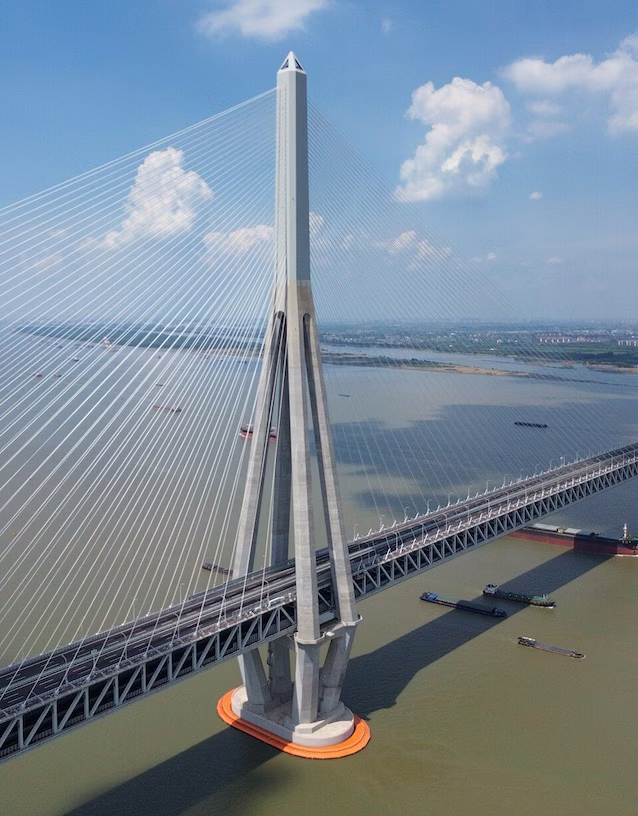
With the realization of this mega work, the time required was drastically reduced mileage Between Changzhou and Taizhouletting him pass from about 80 minutes to just 20 minutes. This reduction in transit times stimulates commuting mobility and significantly reduces the logistical costs of the local industrial and manufacturing supply chain.
The environmental impact of the project
The planning and execution of a work of this magnitude on a complex river ecosystem like that of Yangtze have required compliance with very rigorous standards of protection of the river environment. In the preliminary phases and during construction sites, low impact construction technologies were adopted in order to safeguard the fish fauna and the quality of the river water, limiting the dispersion of sediments thanks to the use of foundation caissons of large dimensions and confined excavation techniques.
However, it can be said that the long-term environmental impact is largely compensated by the efficiency of the transport network. The elimination of traffic congestions and the “lubrication” of vehicular and freight flows reduce emissions direct greenhouse gas emissions linked to longer alternative routes. The bridge was also equipped with complex systems low energy consumption lighting and highly durable materials designed to minimize the need for extraordinary maintenance during the life cycle of the work, thus integrating the maximization of structural performance with the principles of sustainability.
