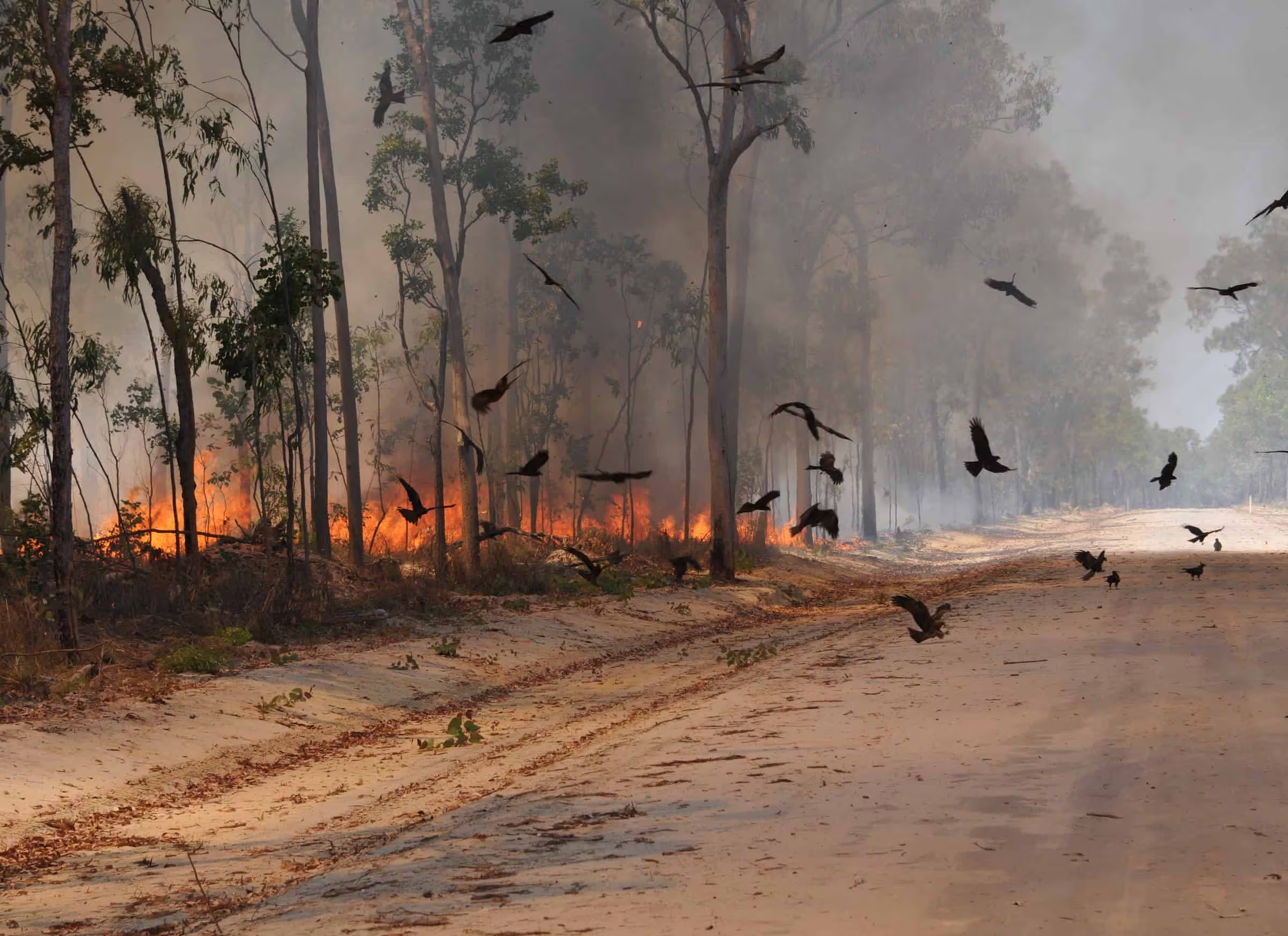
Firehawks are kites and falcons from Northern Australia which, according to Aboriginal and firefighters’ testimonies, carry lit twigs to spread fires and flush out prey. The only study, from 2017, is based on stories: videos and experiments are missing, and intentionality remains a hypothesis.
THE firehawks (“fire hawks”) are birds of prey from northern Australia such as the black kite (Milvus migrans), The whistling kite (Haliastur sphenurus) and the brown hawk (Falcon berigora) who, according to Aboriginal traditions and local testimonies, would grab lit twigs and let them fall into the dry grass, so as to apply new fires and flush out the prey from the dens. The behavior of these birds is described in a single scientific study, published in 2017 on Journal of Ethnobiology and based on literature and interviews: there are no photos, videos or experiments that confirm the intentionality of the gesture. However, it is documented, in different continents, that some predators hunt at the edges of fires.
The study on fire hawks in Australia
Between 2011 and 2017, geographer Mark Bonta of Penn State University and Robert Gosford (Australian Central Land Council) collected 20 reports distributed over approximately 2,400 km of savannah, from some non-Aboriginal informants (an anthropologist, a linguist, some livestock managers, some firefighters) and Aboriginal groups.
This is a study of ethnobiologythe discipline that studies the relationship between human populations and living organisms, that is, how people know, classify, use and interpret plants and animals; more precisely than ethno-ornithology (the same approach applied to birds). The method is not based on systematic observations or measurements. The authors reviewed scientific and historical literature, then interviewed witnesses with open-ended questions: what they had seen, under what conditions and whether the gesture seemed intentional. Vague reports, those from those who did not respond to requests for verification and testimonies from Aboriginal people linked to sacred traditions were discarded.
For example, one of the authors, Dick Eussen, said he turned it off seven outbreaks attributed to kites at a uranium mine near Kakadu Park. Tennant Creek Fire Chief Nathan Ferguson said he saw the behavior about one dozen times since 2001, with twigs transported over 50 metres.
The limits: no videos or experiments
The researchers asked the witnesses for photos and videos, but write in the text that they did not receive them nothing usable as well as admitting that no biologist has conducted experimental tests on the phenomenon.
Furthermore, theSpecies identification is often uncertain due to the difficult environmental conditions during a fire that make it difficult to accurately distinguish one bird of prey from another. Even the frequency of behavior it is not known with certainty, with current knowledge it seems to occur rarely. Some outbreaks have been attributed to birds by exclusion but the authors themselves recognize that the causes could also include mammals fleeing with their fur on fire.
The most important question is that ofintentionality. It cannot be ruled out, as several experts cited in the same paper believe, that transport could be accidental: the bird dives into prey near the fire but accidentally grabs a burning twig and then drops it in an adjacent area. As ornithologist Suhel Quader noted in a comment on the study, many more observations or a well-designed experiment would be needed, and not even a photo would be enough to demonstrate the intention:
It’s a story that hopefully is true, because it’s truly incredible. Eyewitness accounts are compelling, but surprisingly few, considering the frequency of fires in the region and the number of people working to contain them.
However, however many doubts remain about the phenomenon, it is not just an academic curiosity. According to land managers interviewed, fires that “jump” roads, rivers and fire lines (the strips of land cleared to stop the flames) are a real problem. Skepticism makes it difficult to include actions towards birds of prey in fire plans, and the study even reports the case of a farm where birds workers shoot birds of prey to protect pastures.
How the strategy works: use fire to hunt
When the savannah or prairies burn, to escape the flames and save themselves, insects, reptiles and small mammals encounter another danger: lurking predators. Many birds take advantage of this opportunity, it is the so-called fire-foraging (literally “foraging over the fire”). In northern Australia it is a widespread practice due to the kites that gather in hundreds along the front of the flames. Similar behaviors are described in Africa, Papa New Guinea, Brazil and the United States.
It is not a hunting method widespread only among birds. A study published in September 2026 on Journal of Animal Ecology analyzed the movements of gray wolves in the boreal forest of British Columbia in Canadain an area hit hard by the record fires of 2023 and 2024. The wolves chose areas close to active fires but they avoided the front of the flames and moved faster than the smoke. For the authors of the research this choice represents a compromise between risk and hunting opportunityalthough predatory success was not measured.
In any case, c‘It’s a huge difference between exploiting a wildfire and intentionally propagating it. Today human beings are considered the only animal capable of lighting and controlling flames; yet, according to the firehawks hypothesis, there is a possibility that these birds of prey have learned to “tame” fire even before us. To test this theory, researcher Mark Bonta and his colleagues proposed setting controlled fires, so as to document the birds’ behavior with appropriate scientific instruments. To date, however, there are still no definitive publications with these results. In short, until proven otherwise, the Firehawks hypothesis remains a fascinating and plausible hypothesis, but not a scientifically proven fact.
