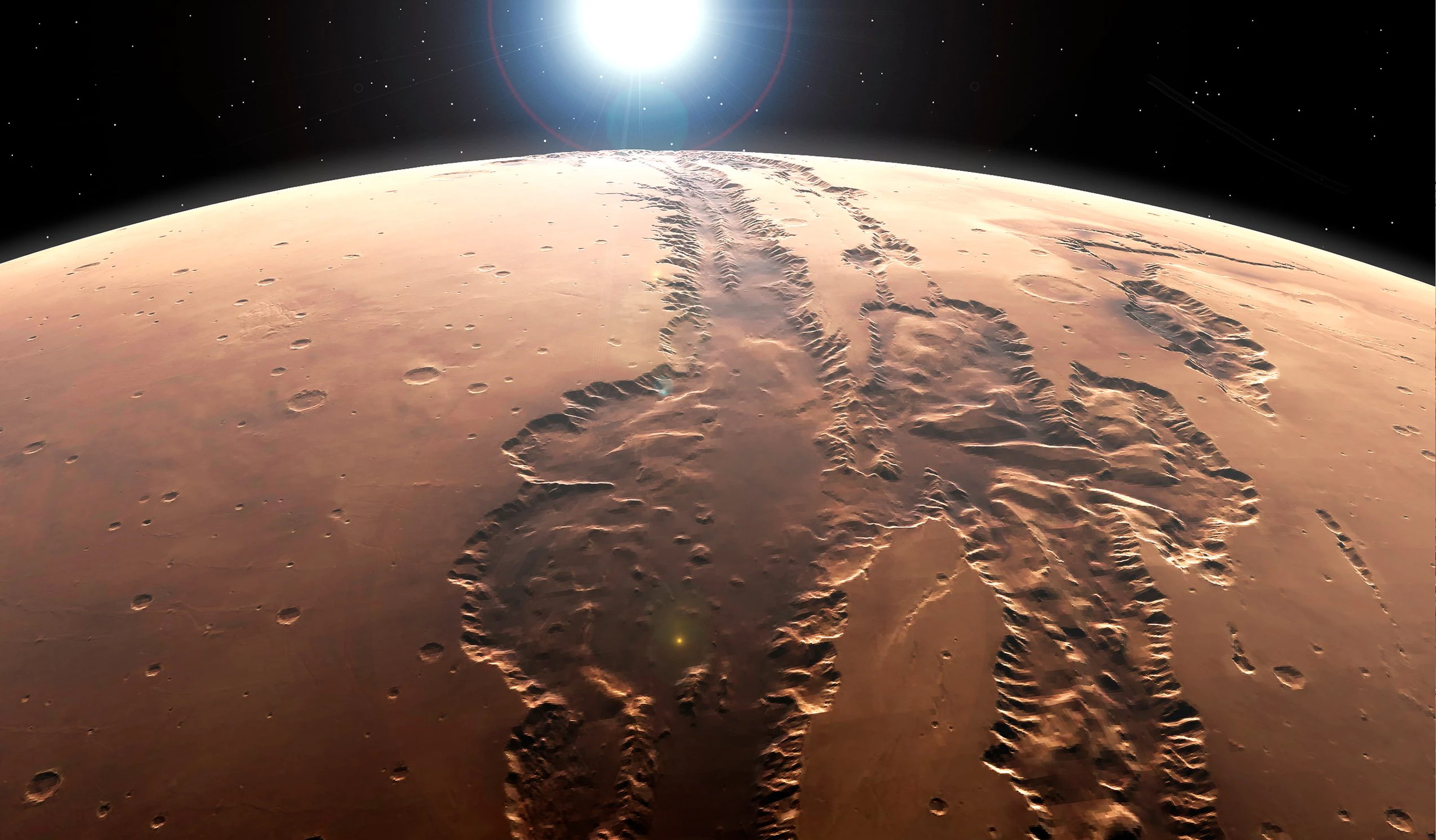
An earthquake recorded by the NASA InSight probe reveals that some faults under the Valles Marineris canyon (3900 km long and about 600 km wide) can still move today. The discovery offers new clues about the geological evolution of Mars and its past.
A new study published in Nature Communications he identified the presence of tectonic activity under Valles Marineristhe gigantic Martian canyon system almost 4,000 km long. Analyzing the seismic waves recorded by the NASA probe InSight in 2021, researchers reconstructed the movement of a deep faultfurther confirming that the Martian crust can still deform and generate earthquakes.
This discovery offers new clues to the reconstruction of the past evolution of Mars and its past habitability.
Mars is in fact often described as a geologically extinct planeta world that lost much of its internal activity billions of years ago cooling quickly due to its small size (the average radius of Mars is about half that of the Earth, about 3300 kilometers and its mass only a tenth of that of the Earth) which have accelerated the solidification process of the mantle and the molten core.
The Martian magnetic fieldwhich primordially protected it from the solar wind and allowed the planet to possess an atmosphere and surface waterit was in fact actually generated by the dynamo effect in the metal core of the planet (similarly to what happens for the Earth’s magnetic field).
As the nucleus cooled, it would have disrupted its ability to generate the dynamo and to support a magnetic field. Without a magnetic field, the atmosphere of Mars was exposed to the action of particles and ionizing radiation coming from the Sun, starting a progressive dispersion into space of most of the gases that composed it.
A process that, together with other phenomena, would have transformed Mars from a potentially habitable planet, with liquid water on the surface, to the present day cold and arid world.
The discovery of a relevant one tectonic activity in the largest Martian canyon also opens interesting possibilities on the potential presence of subsurface life forms.
The fractures of the faults detected in Valles Marineris may in fact represent circulation routes for any underground fluids towards the surface. The presence of liquid water and geothermal heat in these environments near the Martian surface it could therefore constitute a niche relatively protected from the most extreme surface conditions (low temperatures and presence of ionizing radiation) and potentially capable of hosting life forms currently present or retain traces of an ancient biological activity.
Valles Marineris, the largest canyon in the Solar System is located on Mars
The group of researchers from Imperial College London and Columbia University who collaborated on the study identified the first seismological evidence direct from tectonic activity below Valles Marinerisrecognized as the largest canyon system in the Solar System discovered so far.
It’s one huge geological structurewith one length of approximately 3900 km and one maximum width of approx 600km. Valles Marineris represents one of the most peculiar features of the Martian surface, clearly visible from Earth even with an amateur telescope.
The Valles Marineris canyon is deep up to 7-9 kilometers at its maximum points, and if its lowest point was located on our planet it could almost contain the entire height of the Mount Everest (8,848 meters high).
The entire canyon system develops mainly from west to east just below the Martian equator: it was formed billions of years ago, probably as an effect of the enormous deformations of the Martian crust associated with the formation of the Tharsis volcanic regionlocated a little further west.
There Tharsis region (or Tharsis Bulge) is a vast plateau and bulge of volcanic origin, approximately 4,000–5,500 km and rises for approx 10km above the surrounding areas. Some gods are found on Tharsis more impressive shield volcanoes of Mars, whose most famous representative is theOlympus Monsthe highest volcano in the Solar System (over 25 km high and approximately 600 km in diameter).
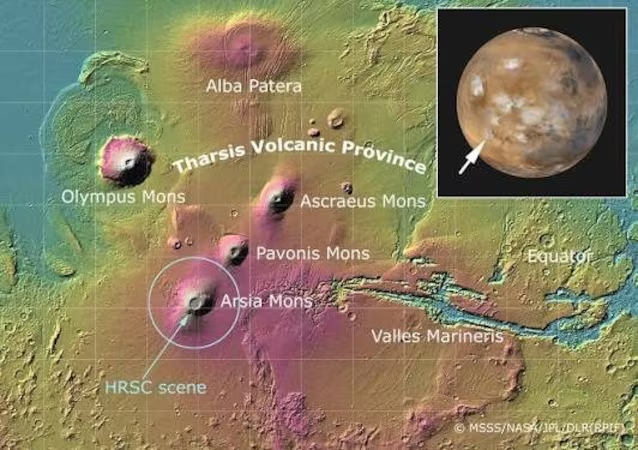
The huge plateau weight caused tension in the surrounding areas of the planet’s crust, creating primordial fractures and faults and contributing to the opening of Valles Marineris canyons and concentric fracture ring systems.
How Martian earthquakes are generated
However, this study shows that some of the faults present in this region still exist capable of moving and generating earthquakes. The discovery comes from the analysis of a seismic event recorded on August 25, 2021 by the InSight probe.
InSight’s seismometer recorded a seismic event coming from the opposite hemisphere of Mars. Scientists analyzed the different seismic waves and compared arrival times, amplitudes and polarities with computer simulations, reconstructing the origin of the event.
The InSight probe (acronym for Interior Exploration using Seismic Investigations, Geodesy and Heat Transport) was designed as a stationary lander (therefore not a mobile rover) with the fundamental objective of explore the deep layers of Mars. InSight remained stationary in the same spot (on the plain of Elysium Planitia) from its landing in November 2018 until the official end of its mission in December 2022.
The seismometer on board the lander has in the past allowed scientists to map the thickness of the crust, the geological nature of the mantle and the size of the core of Mars.
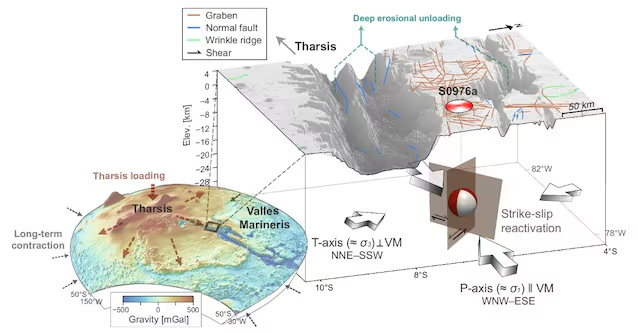
By analyzing seismic waves, researchers have established that the earthquake yes it is originated under the western part of Valles Marineristo one depth estimated at approx 20-40 kilometers. It is therefore not a superficial movement but a deformation that affects the deep crust of the planet.
On Earth, earthquakes are concentrated mainly at the edges of plates, which accumulate tension as they move. Mars, on the other hand, does not have plate tectonics and its outermost part (the superficial crust) behaves like a single rigid shell.
The slow cooling of Mars causes a slow contraction of the planet’s surface. This phenomenon, combined with the enormous weight of the nearby volcanic region of Tharsis and the continuous erosion of the canyon, they modify the tensions in the crust over very long time scales.
These stresses can concentrate on pre-existing fractures, weaker than the surrounding rocks, and reactivate them. The ancient faults so they can continue to generate earthquakesa phenomenon that continues up to the present time.
The seismic signal measured by InSight indicates a strike-slip faulta fracture along which two blocks of rock slide sidewaysas happens for example along the San Andreas Fault in California.
Numerical models to simulate seismic waves of other origins such as those due to meteorite impacts, landslides and other surface phenomena have failed to correctly reproduce the characteristics of the observed waves, which has strengthened the hypothesis of the purely geological origin of the seismic event.
