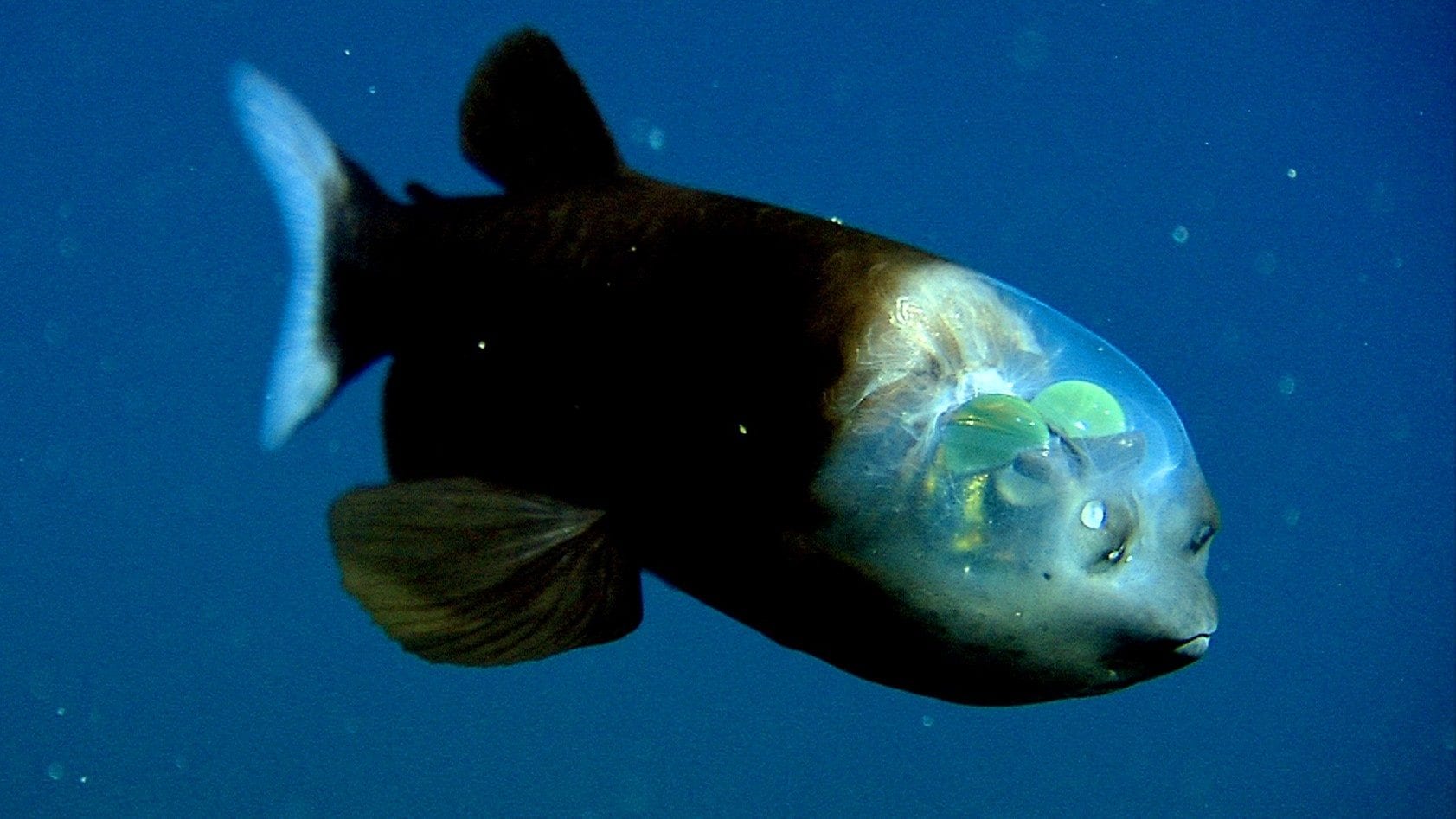
MBARI researchers filmed a rare specimen of Macropinna microstoma in 4K at about 600 meters deep. This fish from the ocean’s twilight zone is known for its transparent head and large green tubular eyes, capable of rotating to follow prey.
At about 600 meters deep, off the coast of California, researchers from the Monterey Bay Aquarium Research Institute (MBARI) encountered one of the most unusual inhabitants of the twilight zone (between 200 and 1000 meters deep) of the North Pacific Ocean: Macropinna microstomaa species of bony fish belonging to the order Argentiniformescharacterized by a transparent head and from large green tubular eyes (in fact, in English it is called Barreleye). It lives in the northern Pacific Ocean, in the temperate and subarctic zones, at depths that can exceed 1000 meters.
The specimen was observed for about 20 minutes and filmed for the first time in 4K, thanks to the cameras of the remote-controlled vehicle Doc Ricketts.
The encounter is anything but common: in almost 40 years of exploration and around 7000 dives with underwater robots, the institute has observed this species just 11 times. A rare encounter that could help researchers better understand how this singular fish and its eyes work, adapted to depths that only one can penetrate. very weak amount of light.
How tubular eyes work Macropinna microstoma
The most characteristic feature of M. microstoma it is, in fact, precisely his visual system. The two large tubular eyes are enclosed within a transparent dome that covers the upper part of the head and, in their usual position, are facing upwards. This setup allows the fish to intercept the silhouettes of possible prey which stand out against the little light coming from the surface, a particularly useful strategy in the mesopelagic area where it lives.
Tubular eyes have a large lens and a very specialized retina, characteristics that allow them to collect as much light as possible and to better perceive the contrasts in the twilight of the mesopelagic area. On the other hand, green lenses could instead work as a selective filter: attenuating some components of the light coming from the surface would help Macrofin to distinguish the weak more easily bioluminescent signals of possible prey.
The downside of such a system, however, is a narrower field of vision compared to that guaranteed by more spherical eyes. The problem, in fact, is that with the eyes turned upwards the mouth remains out of the field of vision. For years this has represented a small anatomical paradox: how does he do it Macrofin to follow a prey until the moment he captures it? As explained in an article published in the journal Copeia (now Ichthyology & Herpetology) in 2008, the eyes of this fish are not fixed, but they can rotate inside the transparent headmoving from a dorsal to a frontal position. In this way, the animal can first locate prey above itself and then continue to visually follow it as it approaches to capture it. In the tests described in the paper, the observed rotation arrived up to about 75 degrees.
Why Macropinna microstoma It has a transparent head
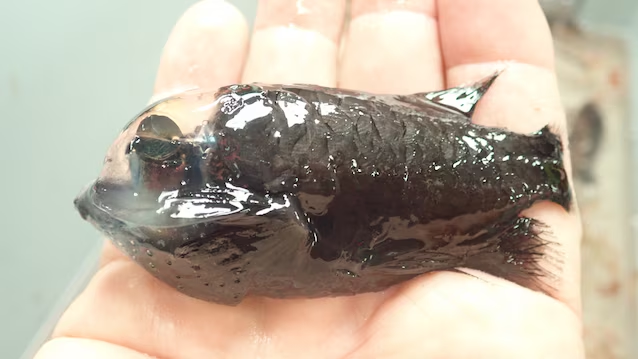
Even the particular head of Macrofin it is closely linked to his visual system. The transparent dome that encloses the eyes, in fact, contains a chamber full of liquid and is made of a resistant and flexible fabric that helps protect them. Overall, however, it is a very delicate structure. In specimens caught with nets, for example, it often tends to become damaged or collapse, which is why – for a long time – the real shape of this fish remained little known.
This protection could be particularly useful during feeding. Again according to the 2008 paper by Robison and Reisenbichler, the transparent shield could protect Macrofin by the stinging tentacles of some cnidarians – the group of animals that includes jellyfish – which it seems to feed on; remains of similar animals were actually recovered from the stomachs of some analyzed specimens.
AsMacropinna microstoma hunting in the abyss
But to fully understand how Macrofin he moves and hunts, we must also focus on his fins which – as the name suggests, from Greek makrós“large” and from Latin finwhich means “big fins, small mouth” – are particularly developed compared to a body that only reaches about fifteen centimeters. The broad pelvic fins contribute above all to keep it stable while it remains almost immobile in the water column, scrutinizing what is happening above it, while it mainly uses it for travel the caudal fin and the pectoral fins.
This combination allows it to hover with great precision and slowly approach its prey. Once he spots something above him, he can follow it with his eyes as it changes position and finally bring it in front of his mouth, keeping the target in his field of vision during the capture.
The exceptional meeting: the specimen filmed in 4K by MBARI
The rare sighting occurred almost by chance, when the day’s scientific operations were over and the Doc Ricketts it was returning towards the surface. To recognize Macrofin was researcher Shannon Johnsonwho immediately asked the pilots to stop. The news quickly brought scientists and crew members back to the control room to observe one of the strangest inhabitants of the ocean depths.
«See a Macrofin it is a rare and special event,” said Steven Haddock, researcher senior of the MBARI. “Deep-sea animals capture the imagination and inspire wonder and awe, feelings that we hope will encourage protection of the largest habitable environment on Earth.”
