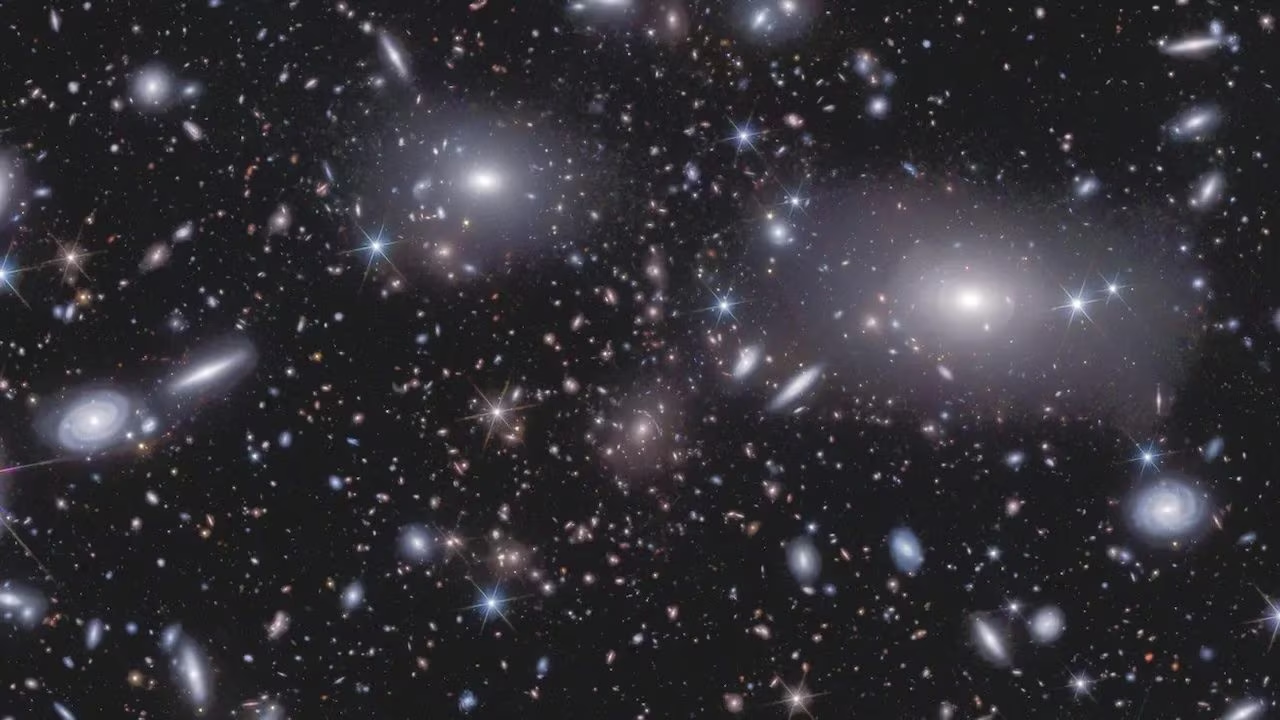
Over a billion celestial objects, including 900 million galaxies, a portion of the sky the size of 9,500 full moons. These are the measurements from DR1-Foundation, the first large data package released after 13 months of work by the Euclid space telescope: thanks to this information, the most extensive three-dimensional map of the cosmos will be created.
There largest 3D map of the cosmos ever made begins to take shape. The mission Euclid of the European Space Agency published DR1-Foundationthe first large data package since the space telescope launched in 2023. The release includes about 13 months of observations and collects light from over a billion celestial objectsin a portion of the sky equal to 9500 full Moons.
As the European Space Agency explains, the data concerns 1,900 square degrees of skytotaling 1.7 million GB of data, and include raw observations, calibrated images, catalogs, spectra and large mosaics of the cosmos.
Inside there are more than 900 million galaxiesover 60 million quasar candidates (i.e. the extremely bright nucleus of a distant galaxy, powered by matter falling towards the central supermassive black hole) and the spectra of more than 160 million sourcesas well as around 15,000 strong gravitational lens candidates, i.e. galaxies that with their own gravity bend and magnify the light of more distant objects until it deforms it into arcs, multiple images or, in the rarest cases, rings.
DR1-Foundation: ESA’s telescope data package
“This major data release from Euclid represents its largest survey from the space of its kind, lays the foundation for the future discoveries in a new regime for astronomy and demonstrates the excellence of European technology, science and international collaboration,” said ESA’s Science Director Carole Mundellwho explained that these «are much more than pretty images; today’s is a scientific milestone in our study of the cosmos”.
For ESA, DR1-Foundation it’s there largest space observation campaign of its kind and puts into the hands of scientists the first pieces with which to compose a detailed three-dimensional map of the cosmos.
It will also be a useful tool for investigating the so-called dark universe, from dark energy to dark matter, up to the cosmic spider web, i.e. the web along which galaxies are distributed, arranged in a structure that resembles a spider’s web, with densely populated areas and others that are almost empty.
The 3D map with 10 billion years of cosmic history
The filaments of the cosmic spider web, explains the ESA, remain largely invisible because they are mainly made of dark matter. The purpose of the map is photograph billions of galaxies throughout the universe and measure the distances of millions of these, crossing the last ones 10 billion years of cosmic history. A work that is the result of the combination of algorithms and people, of machine learning combined with the gaze of thousands of volunteers with the Space Warps project on Zooniverse.
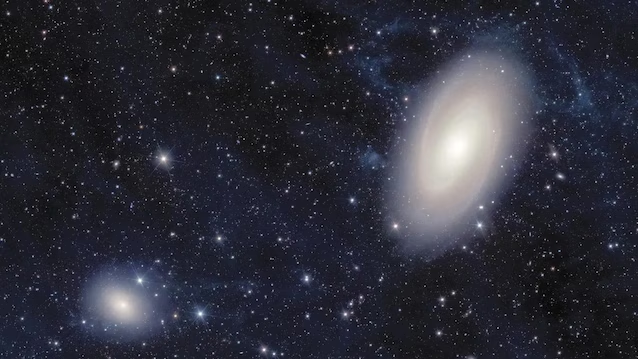
Impressive as it is, this data set barely amounts to approximately 14% of the sky that Euclid will observe during the mission. The complete Data Release 1 is expected in mid-2027 and will start from this first release, enriching it with other decisive elements of the cosmic puzzle.
However, the leap compared to the past remains clear Valeria PettorinoEuclid project scientist for ESA, who recalls that previous releases stopped at around 60 square degrees, and according to INAF DR1 covers a portion of the sky thirty times larger than the previous Euclid release.
Euclid is a space telescope consisting of two modules: The payloadwith the telescope and instruments, and the service modulewhich manages its operation and includes one solar shield with photovoltaic panels on one side and kapton thermal insulation on the other, to keep the instruments protected from the heat of the Sun.
The collected light ends up in two instruments, namely VIS, a 600 megapixel camera that operates in visible light and records the shape of galaxies with great finesse, and NISP, which works in the infrared with 16 sensors of 2000×2000 pixels and, in addition to taking images, it does spectroscopy, i.e. it breaks down light to measure the distance of cosmic objects and map the three-dimensional structure of the cosmos.
Gianluca Polentaof ASI Space Science Data Centerunderlines that near-infrared images allow us to observe faint and remote galaxies, useful for reconstructing the three-dimensional distribution of matter.
