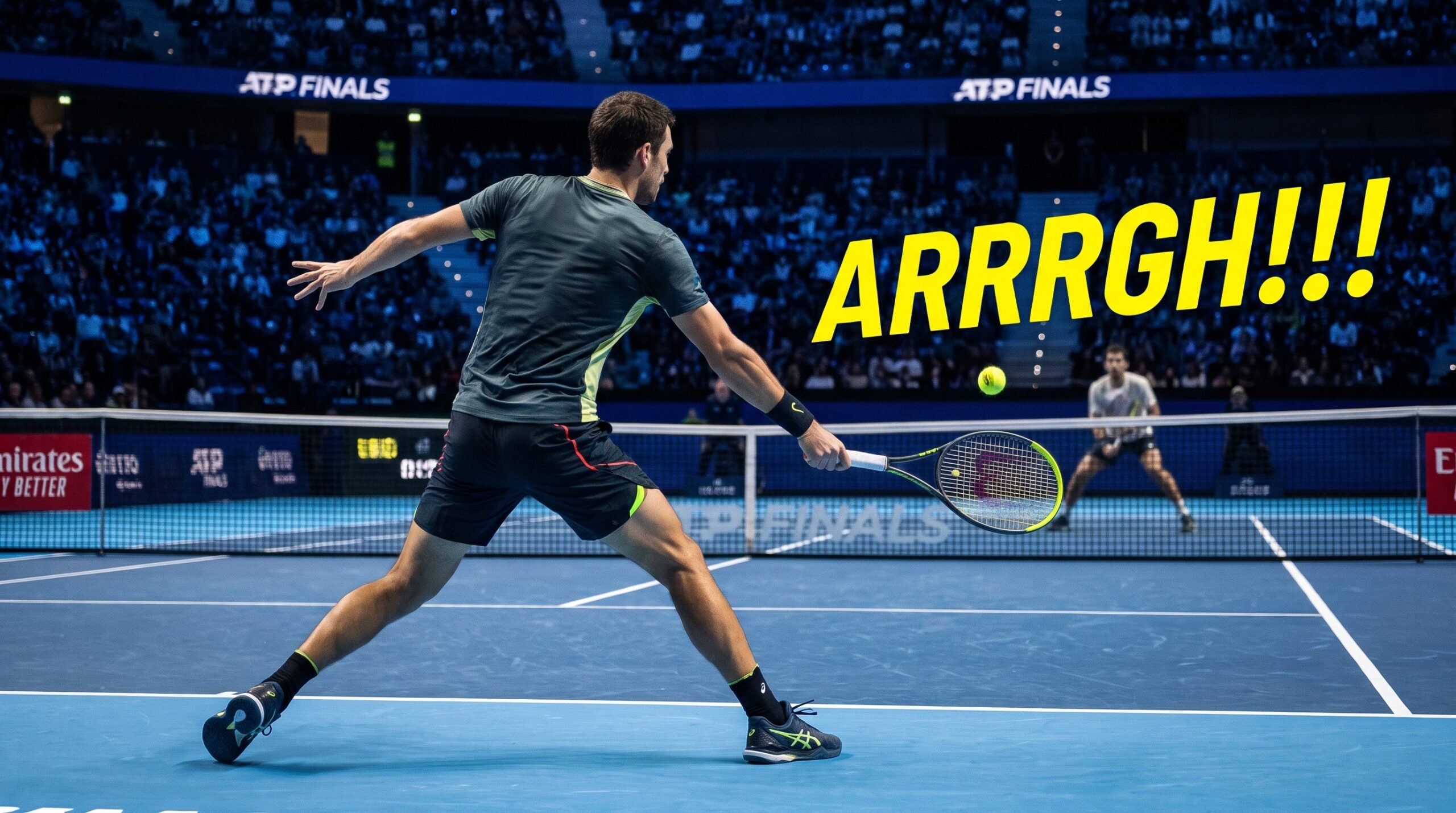
The vocalizations of champions such as Nadal and Alcaraz have been studied to understand their relationship with physical performance. Some research has found an increase in shot speed of close to 5%. Furthermore, grunting in sport could influence the perception of the opponent and cover the sound of the impact between racket and ball, making the reading of the shot less immediate.
If while watching a Wimbledon, Roland Garros or ATP Finals match you have ever turned down the volume on your television for the grunts of Rafa Nadal, Maria Sharapova or Carlos Alcaraz, you are not alone. Many consider them a simple habit or a reaction to effort. But behind those grunts, oh grunting in English, there are scientific reasons: a 2014 study found a increase in service speed close to 5% when players vocalized, while 2019 research showed that more intense grunts can alter the perception of the trajectory of the ball, making it appear longer approximately 18 centimetres. The phenomenon therefore involves both muscular coordination and the way in which the brain interprets sound and visual signals. Without forgetting a possible consequence: the noise could cover the sound of the impact between racket and ball.
Grunting in sports helps you hit harder
In tennis, the speed of the ball depends on a chain of movements involving legs, pelvis, trunk, shoulder and arm. The coordination between these parts allows energy to be transferred to the racket, and breathing during impact also plays a fundamental role.
A 2014 study by O’Connell and colleagues looked at 32 college tennis players, comparing shots performed with and without grunting. When participants vocalized, the average service speed increased by 4.91%while that of the right grew by 5.39%. The researchers also measured the electrical activity of the muscles, detecting in some conditions a greater activation of the pectoralis major and external obliquetwo muscles involved in movements of the trunk and upper body.
But why should making a sound make a difference? One possible explanation concerns theexhalation during the effort. Vocalizing, as seen in the YouTube video below, while striking can accompany coordinated muscle contraction and contribute to stabilization of the trunkfacilitating the transfer of force. To this could be added a mechanism called motor disinhibition: screaming during intense effort could reduce the tendency to retain part of one’s strength, favoring greater explosiveness. It is one of the hypotheses proposed to explain the effect of the grunts, but it is not yet clear how much it contributes to the increase in the speed of the blow.
The noise changes the way we see the tennis ball
Grunting isn’t just about being heard, it can also change how we interpret what we see. This is what an experiment published in 2019 by Müller and colleagues suggests, who used footage of exchanges between Rafael Nadal and David Ferrer in the final of the 2012 Barcelona tournament.
The researchers kept the image unchanged, instead changing the intensity of the grunts: in some versions they were stronger, in others attenuated or absent. Participants were asked to predict where the ball would land. When the grunting was more intense, they tended to estimate a trajectory that was on average 18 cm longer.
The result suggests that the brain does not process sight and hearing separately: it combines the available information to get an idea of what is happening. A more intense sound can therefore influence the perception of the blow. It remains to be understood how much this effect affects players’ responses during a real match, where experience, training and numerous other stimuli come into play.
An advantage also against the opponent?
Then there is a more practical question: can the grunting disturb those on the other side of the network? Some tennis players have long maintained that vocalizations pay off harder to concentrate or hear the sound of the impact between racket and ball. A champion like Martina Navratilova, for example, has harshly criticized this habit because she is convinced that it covers a precious acoustic clue for reading the opponent’s trajectory in advance.
A study conducted between the University of Hawaii and the University of British Columbia looked at a similar thing, but with one important distinction: Participants were shown tennis videos accompanied by short white noises synchronized with the impact, not actual grunts. Under these conditions, reaction times slowed by approx 21- 33 milliseconds they errors in predicting direction they grew up 3-4%. In a high-tempo match, 30 milliseconds of delay means that the ball travels over half a meter more before the returner is able to make the first move.
