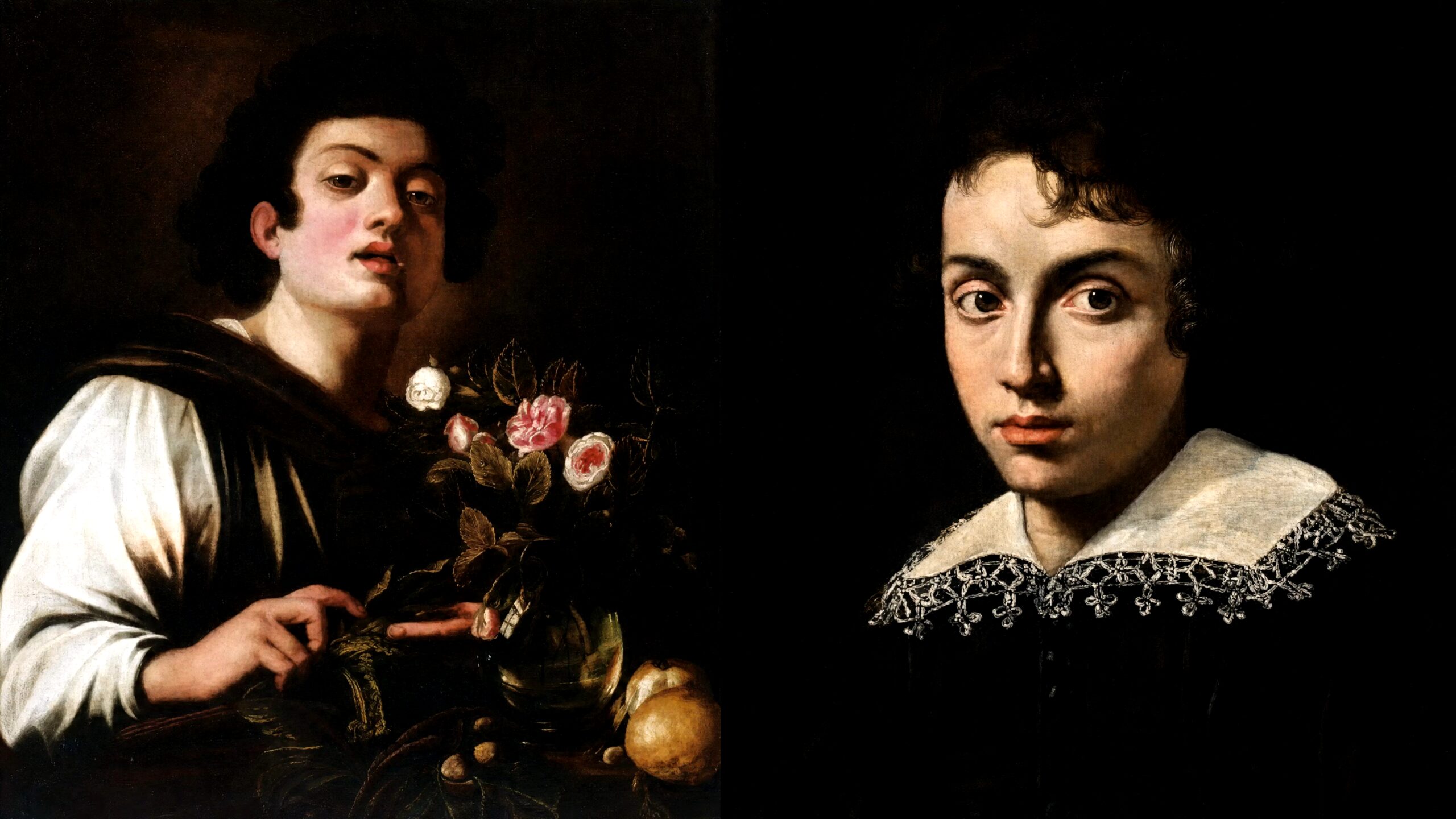
Maria Cristina Terzaghi and Gianni Papi have recognized the hand of Caravaggio in two new paintings, including the Young Man with a Carafe of Roses: from the eye of experts to diagnostic analyses, this is how the attribution process of a work of art works.
Two art historians have recently attributed two new paintings to Caravaggio. It’s about Maria Cristina Terzaghiwho recognized the painter’s hand in a Young Man with a Carafe of Roses preserved in a private collection in Rome, and of Gianni Papiwho instead advanced the attribution for a second painting that emerged on the antiques market.
Two close announcements that immediately sparked debate among professionals and raised a fundamental question: What exactly is the attribution process for a work of art and how does it work? Discovering a “new” Caravaggio, in fact, does not mean having absolute certainty from day one, but starting a long and complex investigative path made up of scientific analyses, archival research and comparison between scholars.
The discovery of the two new paintings attributed to Caravaggio
The case that attracted the most media attention is that of Young man with carafe of rosesan oil on canvas that remained for decades in a private Roman residence and resurfaced thanks to the studies of Maria Cristina Terzaghi, art historian of the Roma Tre University. The work depicts a half-length portrait of a boy next to a transparent glass jug full of roses, a pictorial detail – that of the reflections on the water and on the glass – which immediately recalls the extraordinary optical skill of Caravaggio’s early Roman period (late sixteenth century).
At the same time, the art historian Gianni Papi presented his research on a second canvas attributed to Merisi. Although for the latter work the documentary details are currently less extensive than for the painting studied by Terzaghi, both findings follow the same methodological process: the specialist’s eye identifies an out-of-the-ordinary pictorial quality, formulating a hypothesis which must then be put to the test of facts.
How the attribution process of a work of art works and how appraisals are carried out
Attribution is the process by which it is determined the author, the school or the historical period in which a work of art was created. Obviously, it is necessary where there are no signatures, clear signs of authorship or other documents that can directly trace the artist or school of origin.
To attribute a work we rely above all on expert consensus. For example, Terzaghi is one of the greatest experts on Caravaggio (already in 2021 she attributed the famous painting Ecce Homo to him), and is able to recognize the quality of a work from the period of which she is an expert, and hypothesize its authorship, at first sight.
However, the first impression is certainly not enough: the experts – who can be professors of universities and private institutions, independent scholars or those linked to auction houses, foundations or museums – they carry out appraisals, that is, analyzes of the work so as to first identify the era, then perhaps the authorship (the so-called expertise) and finally the economic value (and in this case we speak of an appraisal).
THE’historical-artistic and technical analysiswhich we were talking about here, involves studying the details of the work, that is, the subject in all its aspects, the expressive medium (oil, pigment, marble, etc.), the support (canvas or panel), the signature and so on: for each of these steps a scientific report is drawn up with images, x-rays and any sampling and analysis of materials.
The context and consensus of attributions
But how do the news of the recognition reach the newspapers before all these analyzes are carried out, perhaps shortly after the discovery? Assuming that this is a first judgement, which will be followed by analyses, a first estimate can be made if you have a lot of experience with the topic.
That is, it must be had great knowledge of the hypothesized artist’s production and of the historical periodtherefore not only style but also similar themes and the system of art commissions: again in the case of Caravaggio, Terzaghi knows the master’s production to the point of hypothesizing that the rediscovered painting should be compared to another, contemporary one (Boy Bitten by a Lizard), and that both are part of a series dedicated to the allegories of the five senses.
Complete knowledge of the reporting period is also a great support: Terzaghi managed to reconstruct the history of the painting from 1607, when Pope Paul V confiscated the collection of the Cavalier d’Arpino – a painter and entrepreneur who had hosted Caravaggio and owned some of his works – to donate it to his nephew, the cardinal and patron Scipione Borghese. The painting was in the Borghese collection until the mid-nineteenth century. It then reappeared in the sales documents of the house in which it was found, sold to the ancestors of the current owners.
The scholars involved must therefore be able to demonstrate each step to retrace the history of the work and its author, following all the relevant analyses. It seems clear that this is a process that must take its time to reach official status.
As is obvious, the degree of professionalism and experience, as well as independenceof the scholar who expresses himself greatly influences the attribution. In fact, when an attribution was made on Michelangelo in the first months of 2026, several experts had warned to welcome the attributions with caution precisely because they came from independent research on which he had not yet been trained. a consensus from the scientific community.
Finally, article 64 of the Cultural Heritage Code (Legislative Decree no. 42/2004) establishes that anyone who sells works of art has the obligation to deliver to the buyer the documentation certifying the authenticity or, if this is not possible, the probable attribution and the provenance of the works.
