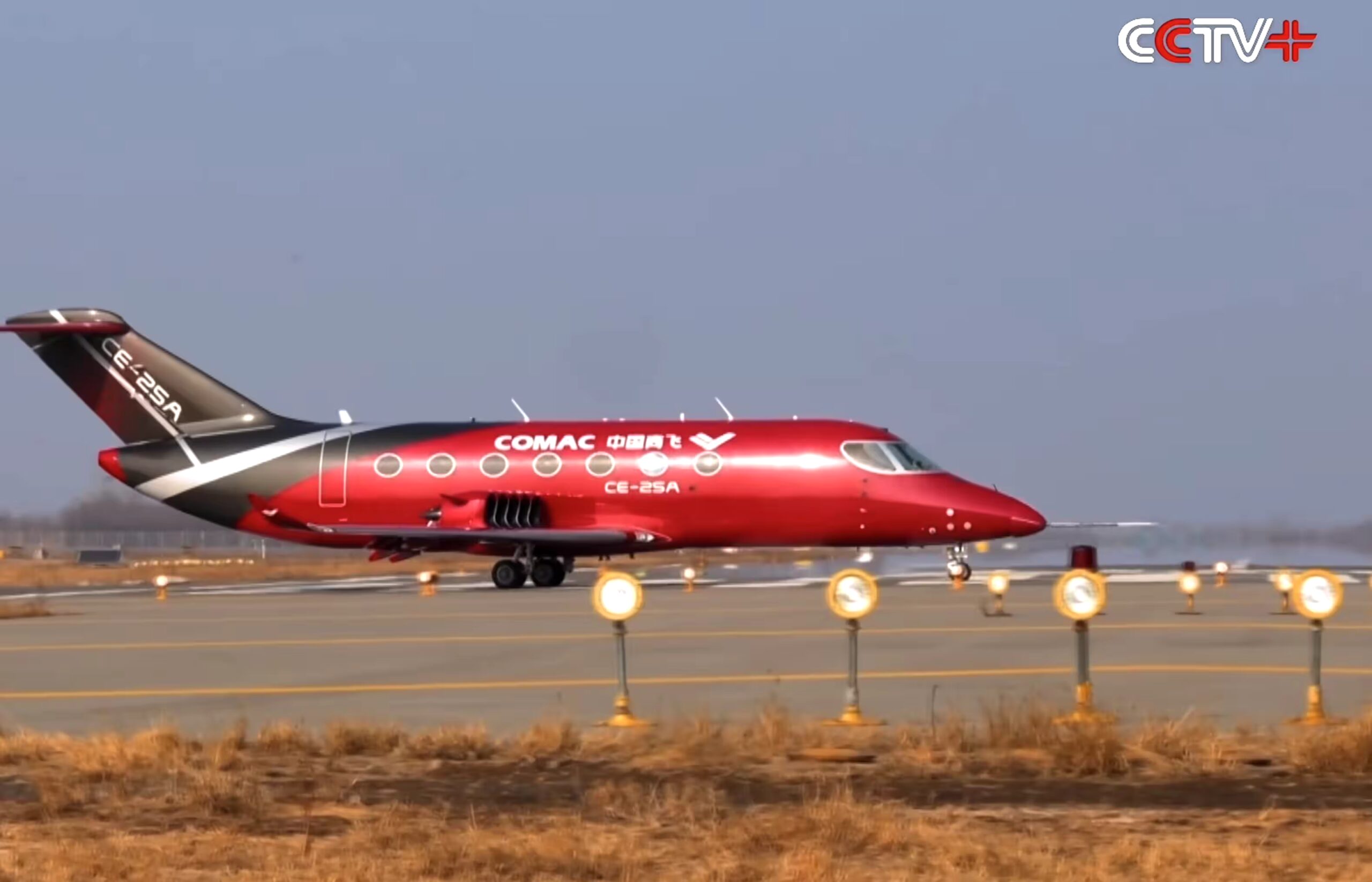
COMAC’s CE-25A, a 19-seat electric aircraft with a range of 400 km, flew for the first time with a crew on board. It is still a prototype, not certified, and the weight of the batteries remains the real obstacle. But behind that flight there is a precise strategy: China aims to exploit the control it has over the electric supply chain, from batteries to engines.
A red and black plane with ten fans above the wings he completed his first manned flight in Binzhou, in the Chinese province of Shandong. It’s the CE-25Athe first electric commercial airplane of COMACthe state company that builds the C919. After 19 uncrewed test flights starting in February, the CE-25A flew Saturday 14 November with two pilots and a test engineer on board. The test lasted 16 minutes and 38 secondsduring which the aircraft traveled approx 60km. In the video released by the Chinese broadcaster CCTV, the aircraft is seen taking off, flying over the Binzhou area and returning to the runway.
Designed for short and frequent routes between neighboring citiesthe CE-25A is designed to carry up to 19 passengerswith a maximum take-off weight of 10 tons. COMAC declares a cruising speed of 300 km/h at 2,400 meters above sea level and aautonomy of 400km. These are ambitious numbers, but before talking about the “first electric airliner”, a clarification is in order: the Chinese civil aviation authority has only accepted the certification application. The CE-25A is therefore today only a prototypenot an aircraft in service, however the name says a lot: the “25” recalls the CCAR-25 regulation of the transport category, stricter than what usually applies to a 19-seater. A declaration of intent.
The Chinese electric plane and its autonomy: 10 fans instead of two engines
The “fans” are electric ducted fans: a rotor with many blades that turns inside a faired duct, moved by an electric motor. COMAC has not released the specifications, but in all likelihood it is permanent magnet synchronous motorsthe same as electric cars and flying taxis. Why ten? Because electric motors, unlike turbines, can be done shrink without losing much efficiency. Distributing many of them along the wing has two advantages. The first is the redundancy: if one engine fails you lose a tenth of the thrust, not half as much as on a twin engine. The second is aerodynamic: Fans mounted on top of the wing accelerate the air over the back and increase lift. The batteries keep the ten fans running. To understand how far it can fly an aircraft like the CE-25A, we must therefore look at how much energy they can store for each kilo of weight: the real enemy.
A kilo of kerosene (1.25 litres) contains approx 12 kWh of energy, how much a washing machine consumes in about ten washes. One kilo of the best lithium batteries contains 0.25-0.3, and even less if you count the casing, cables and cooling. The electric motor uses energy 2-3 times better than a turbine, but for the same weight kerosene is more than ten times ahead. And there is a detail that those who fly know well: a kerosene-powered plane becomes lighter as it consumes, a battery-powered one lands as heavy as it started. Let’s take an example. To keep in flight 10 tons at 300 km/h they serve approx 600-700 kWlike thirty electric cars launched on the highway. For 400 km plus reserves, 1-1.5 MWh is needed, which is what an Italian family consumes in about six months. With today’s batteries they are 4-6 tons on a plane what does it weigh 10 in total. An A320, for comparison, embarks approx 19 tons of kerosene: in current batteries, even taking into account the greater efficiency, they would be approx 300 tonsfour times the weight of the aircraft at takeoff. According to an ICCT study, to fly a 19-seater over 450 km, battery packs of around 650 Wh/kg would be needed, three times the current ones. Project partner CATL, the world’s largest battery maker, presented 500 Wh/kg cells, but COMAC did not say which battery the CE-25A uses.
Then there is a difference between declared autonomy And useful autonomy. No flight leaves with just enough energy to arrive: the rules require be able to reach an alternate airport and to have one reserve final, for jets at least 30 minutes. For electric cars these rules are still to be defined, but the logic does not change: of the 400 km declared, the truly salable ones are much fewer. AND Solar Impulse 2the Swiss experimental plane that flew around the world powered exclusively by solar energy? It had a single pilot, almost no payload, the wingspan of a Boeing 747 and an average speed of under 80 km/h. He demonstrated that you can go around the world by plane using only the sun’s energy, not that you can take 19 people at 300 km/h while respecting a timetable.
The transition from experimental flights to scheduled service also depends on how the batteries are managed in the event of a failure. In fact, an electric plane has no kerosene to burn, but it presents a new risk: the thermal escapei.e. the chain overheating of the cells of a battery. In Europe, EASA requires proof that a fault does not spread and that the plane can still land safely. Solar Impulse also experienced this: le batteries overheated and the plane sat in Hawaii for almost ten months. Furthermore, an all-electric plane does not have a backup power source and can’t shed weight before an emergency landing, as jets do when dumping fuel. And COMAC called the November 14 flight “intelligent” without clarifying how much was piloted and how much was automated, a topic we explored in depth when talking about unmanned cargo.
Flying is “easy”, certifying is not
There type certification it is the test that every new plane must pass before carrying passengers: to demonstrate to the authority, with calculations, ground tests and hundreds of hours of flight, that it respects every single safety requirement. It requires years and enormous capital, and that’s where many companies stop. The American Eviationwith the 9 seater Alicesuspended the program in 2025 after just one 8-minute flight. The German Volocopterpioneer of electric flying taxis, ended up insolvent at the end of 2024 due to lack of funds before certification: its assets were bought by the Chinese Wanfeng group for around 10 million euros. The closest competitor to the CE-25A, the Swedish-American Heart Aerospaceflew his in August X1the largest battery-powered airplane ever flown, but the production airplane, theES-30 with 30 seatswill be hybrid and it won’t arrive before 2031.
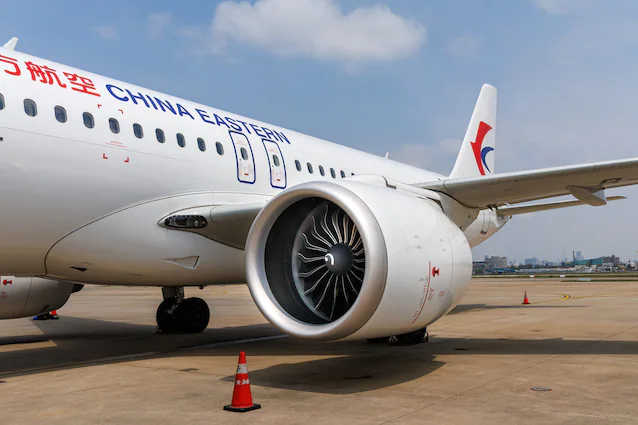
https://www.istockphoto.com/it/photo/a-comac-c919-airplane-operated-by-comac-lands-at-tan-son-international-airport-gm2148097638-569179399?phrase=COMAC%20C919&searchscope=image%2Cfilm
Why China, and why now
On turbines the West has decades of an advantage: the same C919 fly with LEAP engines from CFM Internationala joint company of the American GE Aerospace and the French Safran. In short, the heart of the Chinese jet is Franco-American. In the’electric the game starts again from scratch, and the China has an advantage. COMAC has launched a strategy dedicated to “new energy” aircraft, CATL dominates batteries and the country produces 94% of the permanent magnets used in electric motors. In flying taxis, the heart of what Beijing calls the “low-altitude economy” is already ahead: theEHang EH216-S is certified and has been transporting paying passengers since 2025, while in the United States commercial flights are expected no earlier than 2028. The context also has an impact: the 2026 it was the year of jet fuel crisis caused by the war in Iran, with flights canceled in half of Asia. China, on the other hand, produces electricity at home.
Is it a show of strength? In part yes: the autonomous flights remained hidden for months, the announcement came only after success, and the key data remains secret. But the “$5 electricity” boasted by Heart is also marketing. The difference is that behind the CE-25A there is an industrial supply chain ready to growif physics allows it.
How much will electric really matter?
Be careful with dateshowever. In 2017 easyJet announced electric flights by 2027, then moved them to 2030 and finally abandoned the idea. In 2018 Morgan Stanley estimated the flying taxi market to be worth 1.5 trillion dollars by 2040; three years later he cut it by a third, but added a new estimate: 9,000 billion by 2050. The physics-based studies, however, were right: electric will remain confined to short range for a long time to come. The ICCT estimates that al 2050 electric planes will cut just 0.2% of emissions of passenger transport. IATA attributes 13% of the road to net zero emissions to electric and hydrogen combined, compared to 65% for sustainable fuels (SAF).
The CE-25A will not replace the airliners we know. But on routes under 300-400 km, like i connections with the islands or between nearby citieselectric can become a reality. The next step, the certificationit will be the most difficult.
Safety and certification
