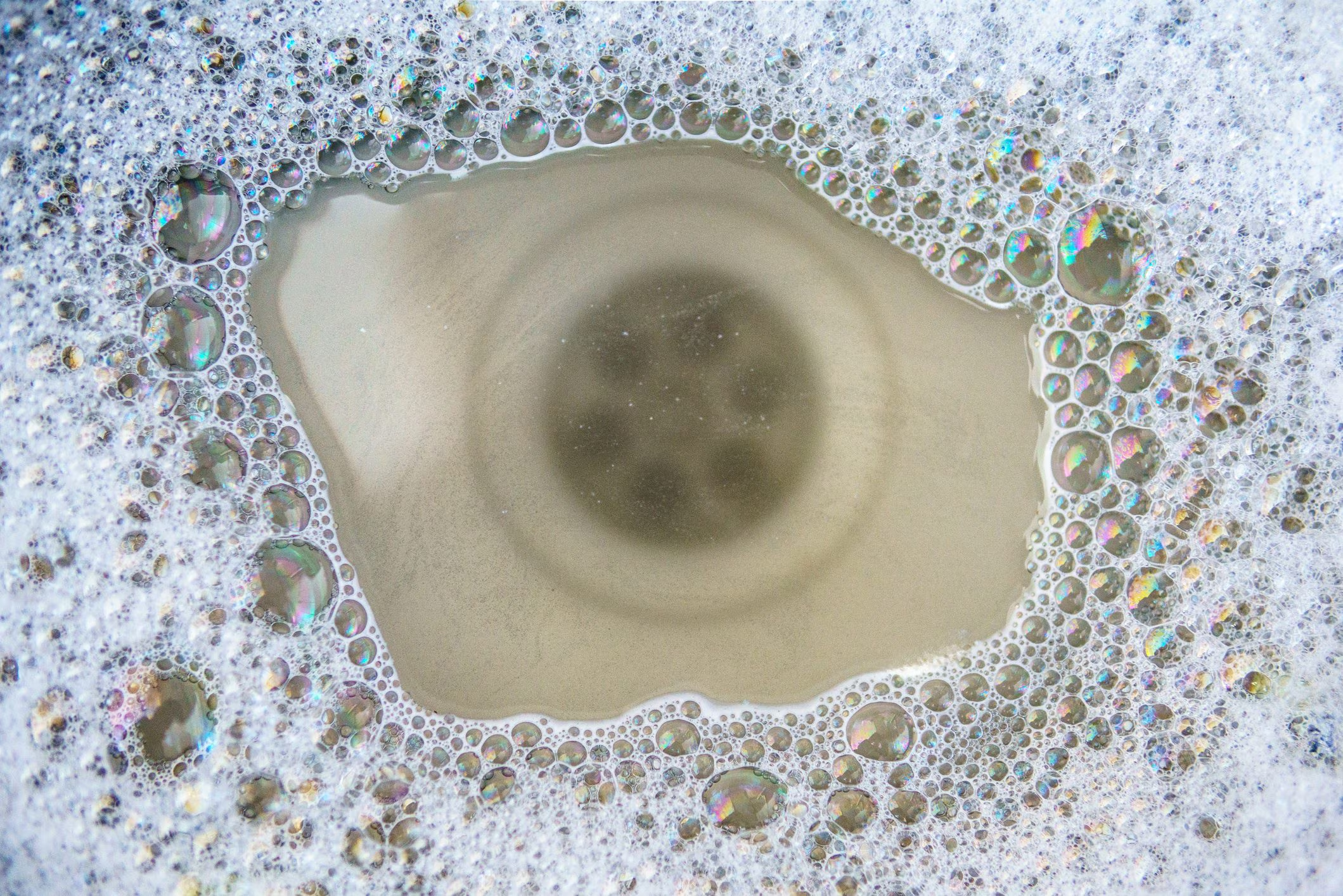
Vinegar (weak acetic acid) and bicarbonate (weak base) do not dissolve fat or keratin: together they only provide a neutralization which releases CO₂ (the foam), it does not act on the blockage. What works are mechanical and chemical methods with caustic soda (NaOH).
THE’vinegar it is, essentially, a mixture of water and a weak acid: acetic acid (CH₃COOH). Vinegar, being weak, will not be able to “dissolve” the blockage if it comes into contact with the keratin of the hair or the fats of food residues. This is because, as we said in the previous paragraph, both hair and fat do not undergo changes in structure if subjected to weak acid attacks.
Bicarbonate (NaHCO₃), however, unlike acetic acid, is a weak base. Consequently, for the same reason, it will not be able to have any “chemical” effect on the traffic jam.
What happens if you mix vinegar and baking soda: foam in the pipes
“But when I add vinegar and baking soda I see bubbles forming! So that means it’s working, right?”
Well, things aren’t exactly like that. The foam only comes from the reaction between vinegar and bicarbonate.
Here, to explain the nature of this foam, it is necessary to talk about chemistry: vinegar is an acid while bicarbonate is a base: when an acid “sees” a base, a chemical reaction immediately occurs, called neutralization.
The products of this reaction are waterfall (H₂O), carbon dioxide (CO₂) e sodium acetate (CH₃COONa):
CH₃COOH + NaHCO₃ → H₂O + CO₂ + CH₃COONa
The foam you see therefore comes exclusively from the formation of a gas: carbon dioxide. There is no reaction between these two ingredients and engorgement.
Do salt and boiling water work?
Often different combinations of fine or coarse salt, vinegar, bicarbonate of soda and boiling water are also used. The latter is the only one that could help, especially when it comes to fat-based blockages.
In fact, high temperatures cause the fat to melt: therefore by going from the solid state to the liquid state it could be easier to free the blockage. Salt, whether coarse or fine, has no effect, neither physical nor chemical.
The most effective mechanical and chemical methods
We have seen that salt, vinegar and baking soda do not help to clear our sink. But so what can we do? There are two approaches: mechanical And chemical.
Mechanical methods
This method does not involve the use of products, but of tools such as:
- The unblocking pump: uses air pressure to literally push the blockage and clear the passage. Usually the plumber you ask for help may have it. Or you can buy it directly from the hardware store.
- The drain cleaner probe: it is a mechanical “arm” that is inserted inside the pipe. Once you have pushed it deep enough and reached the blockage, it will be sufficient to rotate the probe so as to “loosen” the plug of hair/fat and free the passage.
Practical note: Before calling the plumber or buying these tools, you can always try to dismantle the siphon (the pipe under the sink) and clean it manually. However, if the blockage is in the pipes “inside the wall”, then it will be necessary to resort to one of the mechanical or chemical methods.
Chemical method
This method involves the use of a product specifically designed to “dissolve” the blockage. The action of one is exploited strong basespecifically caustic soda: this substance is able to transform the fats in the blockage into soap and partially break down the keratin of the hair. These two chemical processes will make freeing the cork much easier.
Usually it is necessary to leave it to act for at least 6/12 hours (read the instructions on the product label) and then add hot water to facilitate the dissolution of the soap formed.
