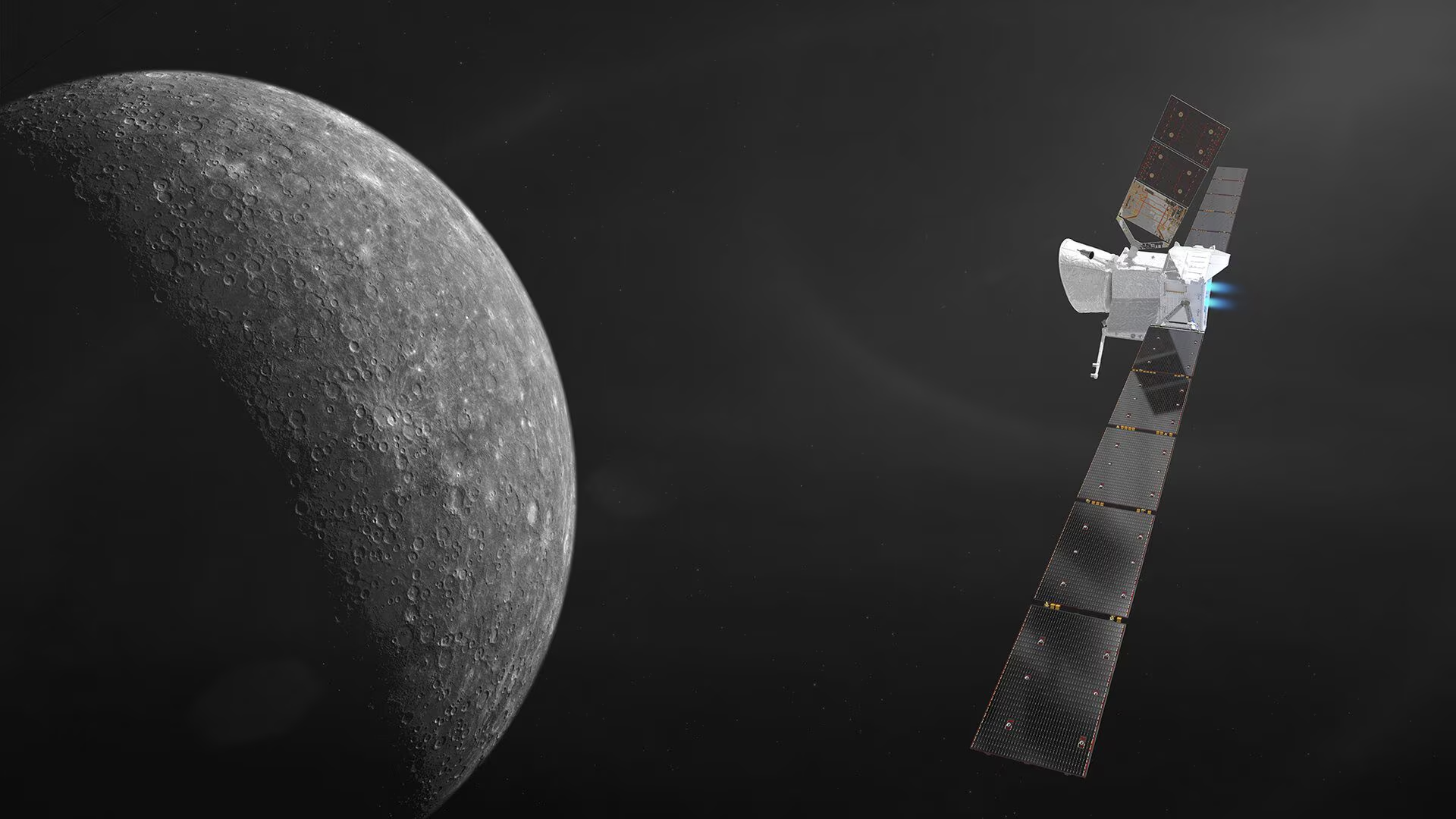
The joint ESA/JAXA mission brings together two orbiters around the planet closest to the Sun to study its surface, internal structure and magnetosphere, facing extreme environmental conditions and revealing the mysteries of a still little-explored world of the solar system.
After further eight years of travel and almost 10 billion kilometers paths in our Solar System, the BepiColombo probe is preparing to reach Mercury. The mission was born from a collaboration between the European Space Agency (ESA) and the Japanese one (JAXA) and is preparing today for decisive step where the probe it will be captured by the planet’s gravity and the two orbiters will be inserted into orbit around it.
The scientific phase, however, will only begin after the separation of the vehicles and their positioning in their respective operational orbits, expected in the following months.
Details of the joint ESA and JAXA mission
BepiColombo is not a single probe but it is one mission designed to lead to Mercury two scientific orbiters distinct. THE’MPO (Mercury Planetary Orbiter) is European and was developed by ESAwhile theMMO (Mercury Magnetospheric Orbiter) renamed My It is Japanese and made by JAXA.
During the cruise, the two vehicles traveled together with a transfer module, theMTM (Mercury Transfer Module), which provided propulsion and electrical power and to a heat shield called MOSIF (Magnetospheric Orbiter Sunshield and Interface Structure) which has protected the probe from extreme temperatures and from intense solar radiation near the Sun until release into orbit.
The MTM transfer module separated last September 3, 2026. MPO and Mio, still united and protected by MOSIF, will then be placed in a polar orbit around Mercury while the actual separation of the two modules is scheduled for December 9-10.
Mio will unhook and will reach its elliptical orbit and on December 16 the MOSIF thermal shield, which protected the Japanese probe during the journey, will also be released. MPO, on the other hand, will continue to correct the trajectory it is on until it reaches its scientific orbit in March 2027.
There scientific phase nominal of both orbiters will begin, however, officially April 2027.
The two vehicles will work in pairs but with different tasks and orbits. MPO will fly relatively close to Mercury’s surface on a polar orbit of about 2.3 hours and will study the planet by mapping the terrain and measuring its chemical and mineral composition.
It will also analyze the large metallic core, the tenuous exosphere and the magnetic field. Mio will instead follow a much more elongated polar orbit (taking approximately 9.3 hours to complete one revolution) which will carry it from approximately 590 up to 11,640 kilometres from the surface of Mercury.
It will focus on the magnetospherethe region where Mercury’s magnetic field interacts with the solar wind, measuring the magnetic gradient, flow of charged particles, and plasma waves. The two probes will therefore allow overall to have one complete overview of the planetfrom the interior of the planet to the outermost magnetic field.
A probe created to withstand extreme temperatures: how BepiColombo is made
When it is in orbit around Mercury it is exposed to a solar flux until 10 times more intense compared to what is perceived from Earth and having to withstand external temperatures that can reach from 350 °C up to 400 °C.
Mercury is in fact located on average at around 58 million kilometers from the Sun against the 150 million that separate the Earth from our star. Its orbit is very elliptical: at perihelion, the point of maximum proximity, it reaches approximately 47 million kilometres. In that stretch the solar radiation can be over ten times more intense than on Earth (while at the average distance it is still approximately 6.7 times greater).
The two BepiColombo probes must therefore endure extreme thermal conditions. The same thing applies to the surface of Mercury, which on the side illuminated by the Sun reaches approximately 430°C and that in the shade can drop to -180 °C.
So antennas, solar panels, sensors and coatings were made with materials and treatments resistant to high temperatures. From what the ESA reported, over 80% of the materials used for the external parts had never been tested before environmental conditions of deep space like that extreme.
A difficult planet to reach and land on: how it will arrive on Mercury
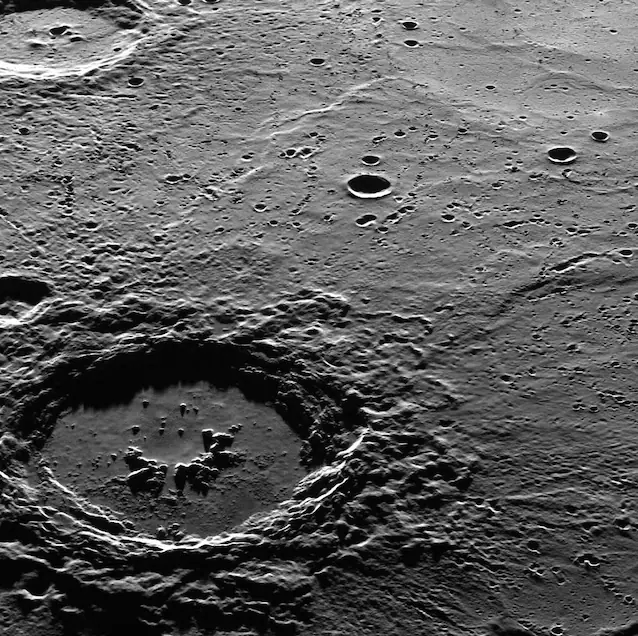
So far only two probes have visited Mercury: the Mariner 10 and the MESSENGERboth from NASA. The first passed close to the planet three times between 1974 and 1975, taking over 2,700 images and revealing a heavily cratered rock surface similar in some ways to the lunar one. However, he only managed to photograph 45% of the planet’s surface. More than thirty years later MESSENGER arrived.
Launched in 2004, it was the first probe to orbit Mercury (entered orbit in 2011) and mapped its entire surface, studying its composition, geology and magnetic field.
The name of the BepiColombo mission pays homage to Giuseppe Colombo (1920-1984), mathematician, physicist and engineer from Padua, known as Bepi.
Columbus understood that it was possible exploit the gravitational slingshot effect also for slow down an interplanetary probe. His contribution to interplanetary navigation was important precisely because he studied the trajectory of the Mariner 10 probe, proposing to take advantage of a flyby of Venus and the particular resonance between the orbital period of the probe and the rotation of Mercury to make it encounter the planet several times in several close flybys.
For reach Mercury in fact a probe does not use the slingshot effect to accelerate, but in reverse to slow down and lose orbital energy. A probe launched from Earth already has the orbital speed of our planet (about 30 kilometers per second).
In its trajectory towards the Sun it accelerates further, exceeding the speed of revolution of Mercury around the Sun (the planet rotates around the Sun at approximately 47 kilometers per second). Not to limit yourself to speed past the planet the probe must therefore reduce its speed in order to be gravitationally captured by the planet. But braking in space requires propellant and would greatly increase the probe’s initial mass.
To save fuel BepiColombo (as well as the other Mariner 10 and MESSENGER probes) followed a route using nine gravity assists: one with Earth, two with Venus and six from Mercury itself. The flybys of Mercury progressively reduced the relative speed between the probe and the planet, allowing orbital capture.
Finally there is a feat that no mission has yet accomplished that is, that of land in a controlled manner on the surface of Mercury. The planet has no real atmosphere (only an extremely thin exosphere) and therefore there is not enough air and pressure to use parachutes or aerodynamic braking systems.
A lander would have to slow down almost entirely with propulsion systems (similar to landing on the Moon) using a large amount of propellant. There are currently no officially scheduled Mercury landing missions by ESA or NASA nor by the Chinese space agency.
