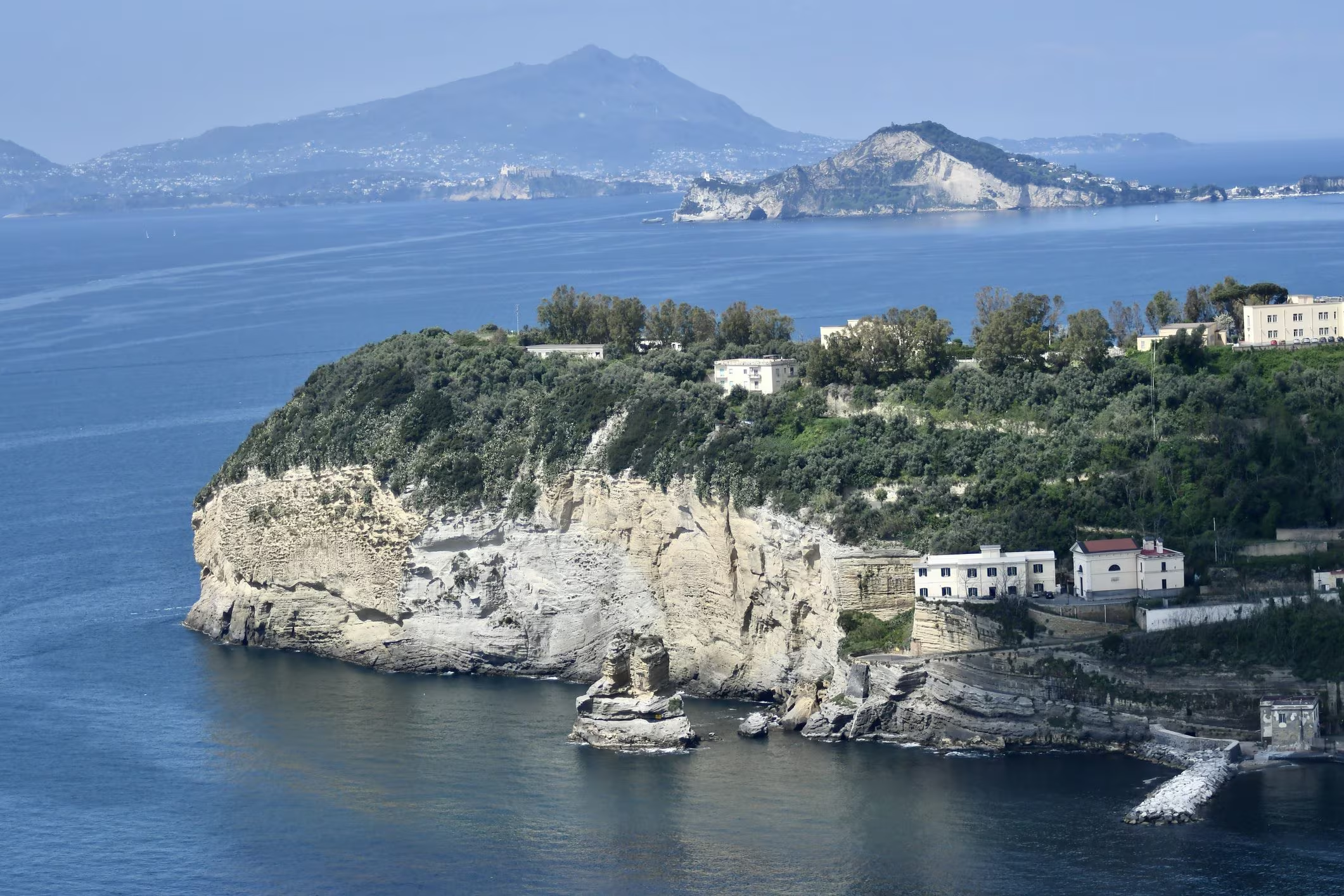
A new study conducted by INGV and some Italian universities sheds light on the history of the Neapolitan Yellow Tuff eruption, the second most violent ever to occur in the Campi Flegrei. It would have occurred 14,000 years ago and would have emitted a volume of magma of 16-20 km3, smaller than previous estimates, in successive phases rather than in a single event.
The eruption of the Neapolitan Yellow Tuff (TGN) is considered the second in terms of impact on the territory and energy released in the history of Phlegraean Fieldsafter that of the Campanian Ignimbrite 40,000 years ago. The eruption completely transformed the landscape and the city of Naples. Reconstructing this event is particularly complex, but now researchers from the INGV (National Institute of Geophysics and Volcanology) and the Aldo Moro University of Bari, in collaboration with other Italian universities, French universities and laboratories, have managed to better define its age, extent and mode of eruption. According to the study, published on Science Directthe eruption dates back to 14,000 years agoand not 15,000 years ago as previously believed, and the volume of magma emitted it was of 16-20 km3lower than previous estimates. The eruption also did not occur as a single destructive event, but in subsequent phases over time. Knowing these details better is useful for improve volcanic hazard estimates of the Campi Flegrei area.
The eruption of the Neapolitan Yellow Tuff, one of the most important events in the Campi Flegrei
At the time of the eruption of the Neapolitan Yellow Tuff, the Campania region was very different compared to today. We were still there during theLast ice agethe ice was very extensive and trapped enormous quantities of water, so the sea level was lower than today. The islands of Ischia and Procida formed a single peninsula and Capri was joined to the Sorrento peninsula. The Neapolitan coast was much more extensive towards the south and the Campi Flegrei area was home to numerous reliefs of volcanic origin. The enormous amount of materials emitted by this explosive eruption filled the depressions with thicknesses of up to ten metresbut at the same time the emptying of the magma chamber caused the collapse of the overlying rocks, with the formation of a caldera. The resulting caldera has a slight shape ellipticalwith a major axis of approximately 8 km and a minor axis of approximately 7 km, and includes part of Gulf of Pozzuoli. Large eruptions that form calderas are among the most complex and dangerous volcanic phenomena, and reconstructing them is particularly difficult. For this reason, researchers continue to study the eruption of the Neapolitan Yellow Tuff and their latest work has redefined many aspects of this event thanks to the integration of new stratigraphic observations, geochemical data And geochronological data.
The study on the eruption of 13,980 years ago
Among the most important results there is one new dating of the eruptionwhich would date back to 13,980 years ago (with a margin of error of only 140 years) rather than 15,000 years ago as previously believed. The eruption would have emitted a volume of magma included between 16 and 20 km3unlike previous estimates, which assumed 30-50 km3. According to past reconstructions, a single magma chamber would have emptied with a very violent eruption, in which the magma would have interacted with surface masses of water, giving rise to devastating pyroclastic flows. The new study makes it clear that they were emptying several magma reservoirsplaced at different depths. The eruption did not occur instantly, but in successive phases over timewith episodes associated with even modest magma emissions.
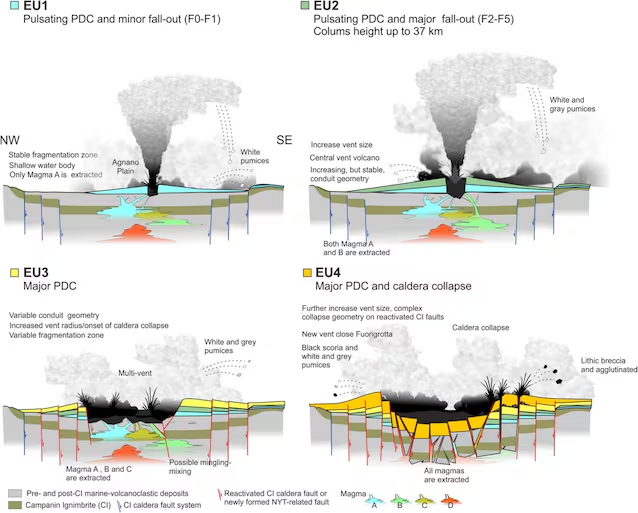
Furthermore, the interaction between magma and water was limited. The end result was the collapse in the most central area of the Campi Flegreiwhich includes Agnano, Fuorigrotta and San Vito. The study is fundamental to better understand the mechanisms by which the caldera was formed and to improve volcanic hazard estimates of the Campi Flegrei area.
