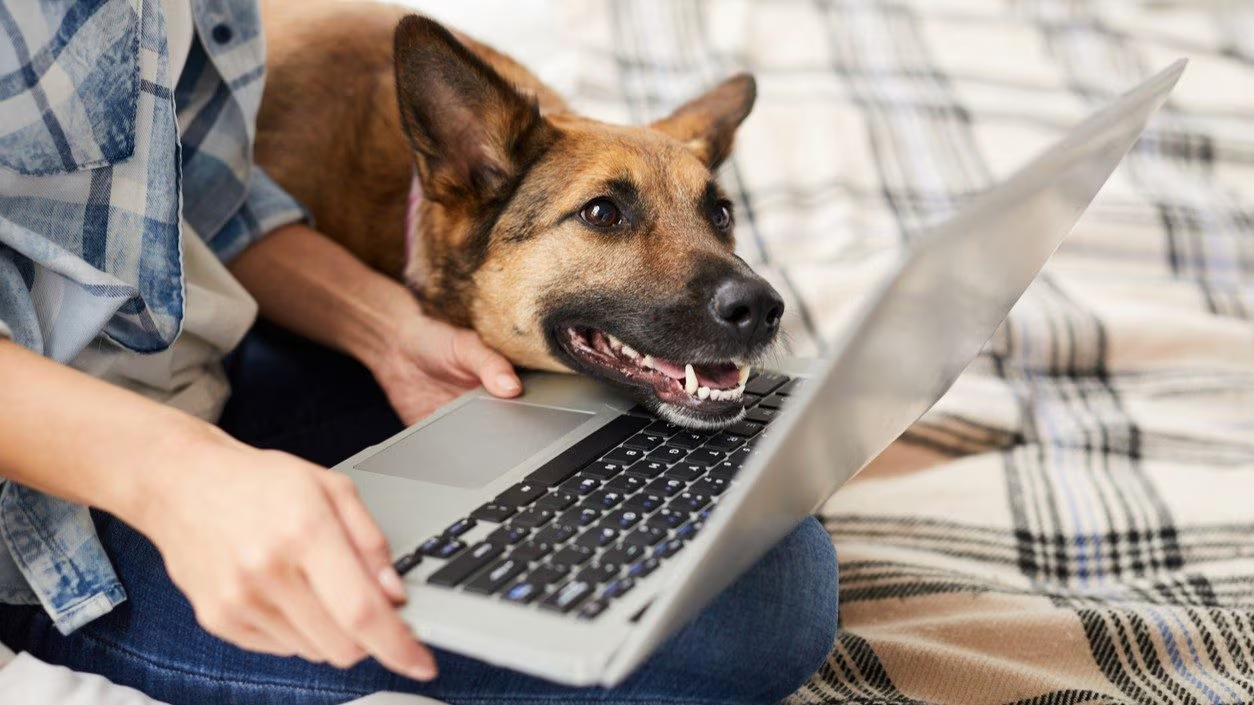
Can dogs imitate human movements by watching a video? A study on two trained dogs showed that they can do it, but with some difficulty: if they see us frontally or from the side they do better, while the perspective from above puts them in difficulty.
«Give your paw», «sit», «down»… These are some of the commands that many owners teach their own dogsshowing them what to do and waiting for them to repeat the movement. But dogs manage to imitate human actions even when they look at them through a screen? And above all, does anything change if they see us from the front, from the side or from above? To answer these questions, a study published in the journal Future Biology tested two dogs already trained to imitate people’s gestures, asking them to reproduce some actions shown in a video. The findings suggest that dogs can do this, although the perspective from which they observe the movement appears to make a difference.
How did they figure out if dogs can imitate a video?
The protagonists of the experiment are Tarea two-year-old Golden Retriever, and Franca six-year-old Labrador. Not exactly two beginners: both had already mastered the training method Do as I Dowhich is based on imitation. In practice, the dog observes a person performing an action and, after receiving the command “Do it!”, must repeat it. This time, however, the challenge was a little different: instead of having someone in front of him, the two dogs they had to observe the movements through a screen.
To do this, the person demonstrating the actions was in another room and communicated with them via live video. The demonstrations were projected from three different angles: frontally, from the side and from above, with the camera positioned above the person. Tara and Franc were asked to reproduce both movements they already knew, such as turning around, crouching or crossing their legs, and some new actions. In short, it wasn’t enough to recognize a familiar gesture: they also had to understand what the person was doing and try to copy it.
And how did they manage? As can be seen from the video below, it is better when the person appears frontally or from the side: in both these conditions, the two dogs are managed to reproduce the gestures met more often than would be expected if they performed a random action. However, when the person was filmed from above, things got complicated. Tara, in particular, failed to imitate familiar movements with better results than expected by chance, while Franc performed better. Then there is another interesting detail: when the actions were shown live, both were able to reproduce all the proposed gestures. In short, it screen it didn’t make imitation impossible, but it seemed to add a obstacle.
Why is it harder to imitate us when they see us from above?
The answer may have to do with a detail that perhaps we don’t often think about: From what angle are dogs used to looking at us?
In everyday life they observe us mainly from the front or from the side, while it is decidedly less frequent that they see us from above. This difference could make it more difficult to interpret a movement when it is shown from an unusual perspective. In fact, to copy a gesture, it is not enough to look at it: you must also recognize what action the other person is performing and understand how to reproduce it with your own body. If the point of view changes, the task may become less immediate.
Naturally, before imagining our dog intent on following tutorials on YouTube, a clarification is needed: the study involved only two animals, both already trained to imitate people. We cannot therefore extend these results to all dogs, nor conclude that they are capable of copying everything they see on television. However, research shows that, at least in some trained dogs, projected images may be sufficient to recognize and reproduce certain movements. And it leaves us with an interesting question: how much does the way a dog observes the world matter when trying to understand what we’re doing?