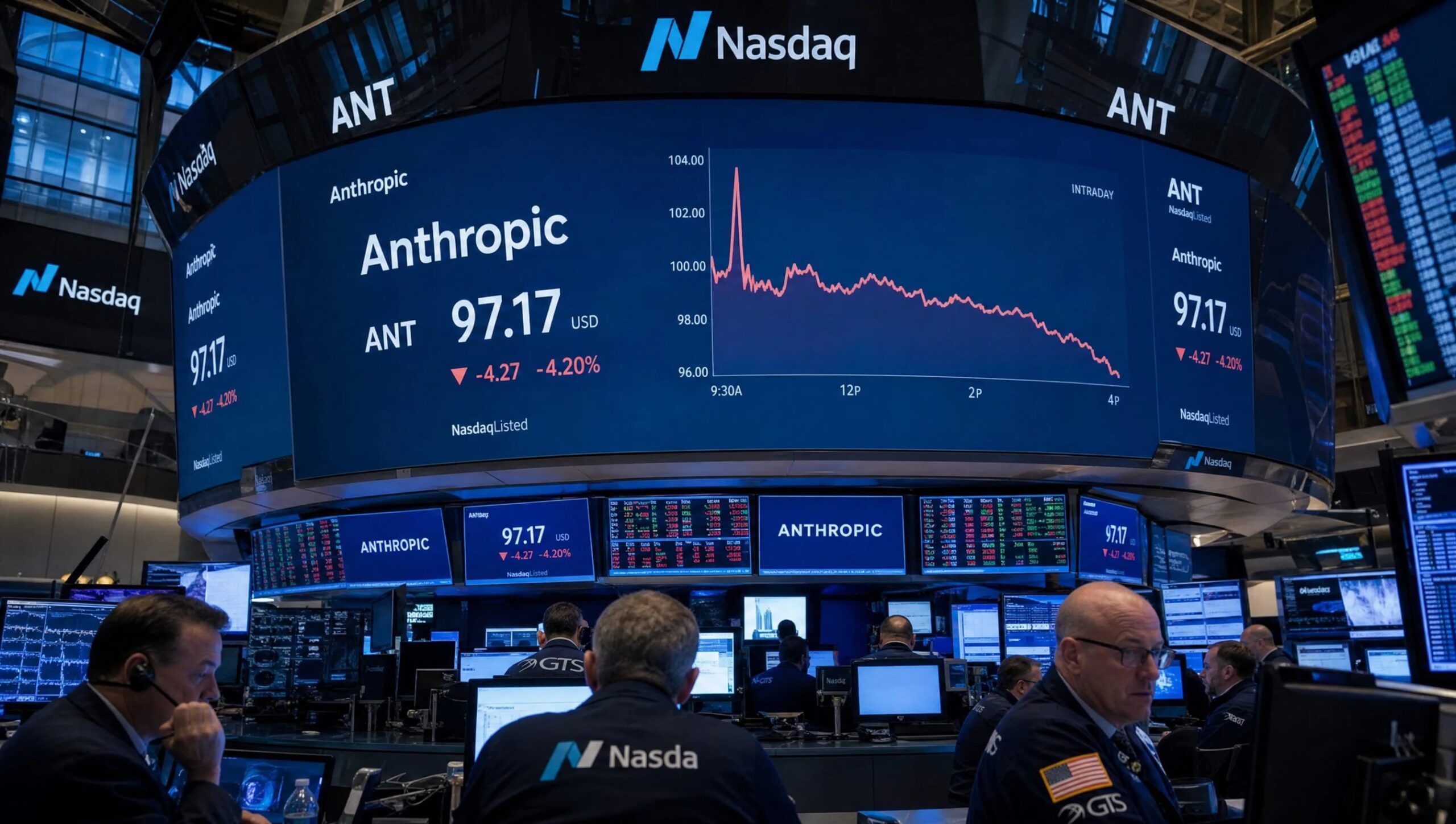
Who decides the price of shares on the stock exchange and why do prices constantly change? Starting from the Anthropic case, we discover how an IPO works, how the value of shares is formed through supply and demand and what influences the performance of financial markets.
Anthropic entered the stock market on November 19, 2026, realizing the largest IPO in history – Initial Public Offeringin Italian initial public offering, the operation with which a company offers its shares to the public for the first time to be listed on the stock exchange. The US company placed 980 million shares at a price of $83 eachfor a total offer of approximately 81.3 billion dollars and an initial company valuation of approx 1,500 billion dollars. Already in the first hours of trading at Nasdaq – one of the main US stock markets, where numerous technology companies are listed – the value of the shares has changed significantly: at the opening the price rose to $111.50about the 34% more compared to the placement price, and then fell and closed the first day at $97.17 – however 17% above the initial price.
What many are wondering is: who decided that an Anthropic share should initially cost $83? Why, once it entered the stock market, did its price change so quickly? And, more generally, who decides how much a company’s shares are worth? To answer these questions and understand better how stock market prices work, how prices are formed and what factors determine their fluctuationswe interviewed Andrea Belatti, Academic Founder EMF – Executive Master in Finance, SDA Bocconi, and Full Professor of Finance at Bocconi University.
How is the initial price set during an IPO and who are the main players?
The price is established through a comparison process between the company which intends to list, investment banks who organize the ei operation potential investors. Banks collect information on investors’ interest and their willingness to pay a certain price. The final price seeks to reconcile the company’s objective of raising capital with that of ensuring the success of the placement, i.e. a price compatible with a subsequent return that is acceptable to investors given the perceived degree of risk.
Why can the placement price change compared to initial forecasts?
The price initially indicated it’s an estimate which can be modified based on the demand actually expressed by investors. If many investors want to buy the stock, the price can rise, as is the case with Anthropic. They also count general conditions of the financial markets, industry prospects and new information about the company. In essence, the price reflects the meeting between supply and demand, even before the start of trading, even if investment banks can test a limited part of the market. In particular, it is difficult to predict the interest of the retail market and therefore unpredictable trends in demand from small investors can have a strong effect on market prices, as happened yesterday for Anthropic and a few months ago for SpaceX.
How do you determine the initial value of a company that is not yet listed?
The value of a company depends above all on its ability to generate economic and financial results in the future. In theory it depends on the discounted value (to take into account time and risk) of the dividends that will be paid to shareholders. To forecast dividends, analysts build forecasts of future revenues, costs, required investments and cash flows, taking risks into account. Another method is to compare the company with similar companies that are already listed. Once the overall value of the shareholders’ capital has been estimated, it is divided by the number of shares to obtain an indicative value for each share.
What is the difference between stock price, capitalization and economic value?
The price is how much the market is willing to pay at a given time for a single stock. Market capitalization is the price multiplied by the number of shares of the company. The economic value, howeverdepends on the company’s ability to generate financial flows over time. The market continually tries to estimate this value, but it is not certain that it always succeeds: prices can deviate from the fundamental value.
How can Anthropic be worth 1.5 trillion without generating profits?
Whoever buys a share does not buy today’s economic results, but above all those expected for the future. A company can sustain high losses because it is investing to capture a potentially huge market. In the case of Anthropic, investors place a very high value on the prospects of artificial intelligence and the company itself has announced that it intends to invest around 1,000 billion dollars in the next 15-20 years to continually develop new models. Naturally, the more the valuation depends on still uncertain future results, the greater the risk that overly optimistic expectations will subsequently be scaled down, especially given the forecast of high investments.
Why does the stock price constantly change?
The price changes because investors change their decisions of buying and selling. New information about earnings, interest rates, the economy, or competitors can quickly change expectations. But the fluctuations can also depend on liquidity needs, operations of large investors or sudden changes in the willingness to buy and sell. Nothing needs to change in the company for its share price to change, especially if investors are subject to mood swings that vary between optimism and pessimism.
Can I put a share worth 100 on sale for 1,000 euros?
Certainly. Every investor can indicate the price at which he is willing to sell, but this does not mean that he will find a buyer. If a share is normally traded at 100 euros, it is unlikely that anyone will be willing to pay 1,000 for it when they can buy it at a much lower price. The market price arises from the meeting between actually executable buy and sell orders, not from the desires of a single investor.
What role do algorithms and high-frequency trading play?
Algorithms allow you to buy and sell securities automatically, based on pre-established rules, often in extremely short times. Some contribute to market liquidity, making it easier to find counterparties and reducing transaction costs. Others react quickly to information or price changes. These systems can make price formation more efficient, but under particular conditions they can also accentuate sudden movements and volatility.
What can cause sudden increases or collapses, and what protections are there?
Very strong swings can occur when information arrives that radically changes investors’ expectations. In the case of NvidiaFor example, predictions about the growth of artificial intelligence can greatly influence valuations. Movements can be amplified by automatic selling, speculative trading and temporary shortages of buyers or sellers. The stock exchanges provide mechanisms for temporary suspension of trading in the presence of anomalous fluctuations, while the supervisory authorities monitor and sanction market manipulations.
How important is investor psychology?
In theory, the value of shares depends on expectations about the future, which by definition is risky. Optimism and pessimism can spread quickly, causing investors to make similar decisions and amplifying price movements. This can generate phases of euphoria or excessive pessimism. In the long term, however, the ability of companies to produce economic results remains a fundamental element in supporting market valuations.