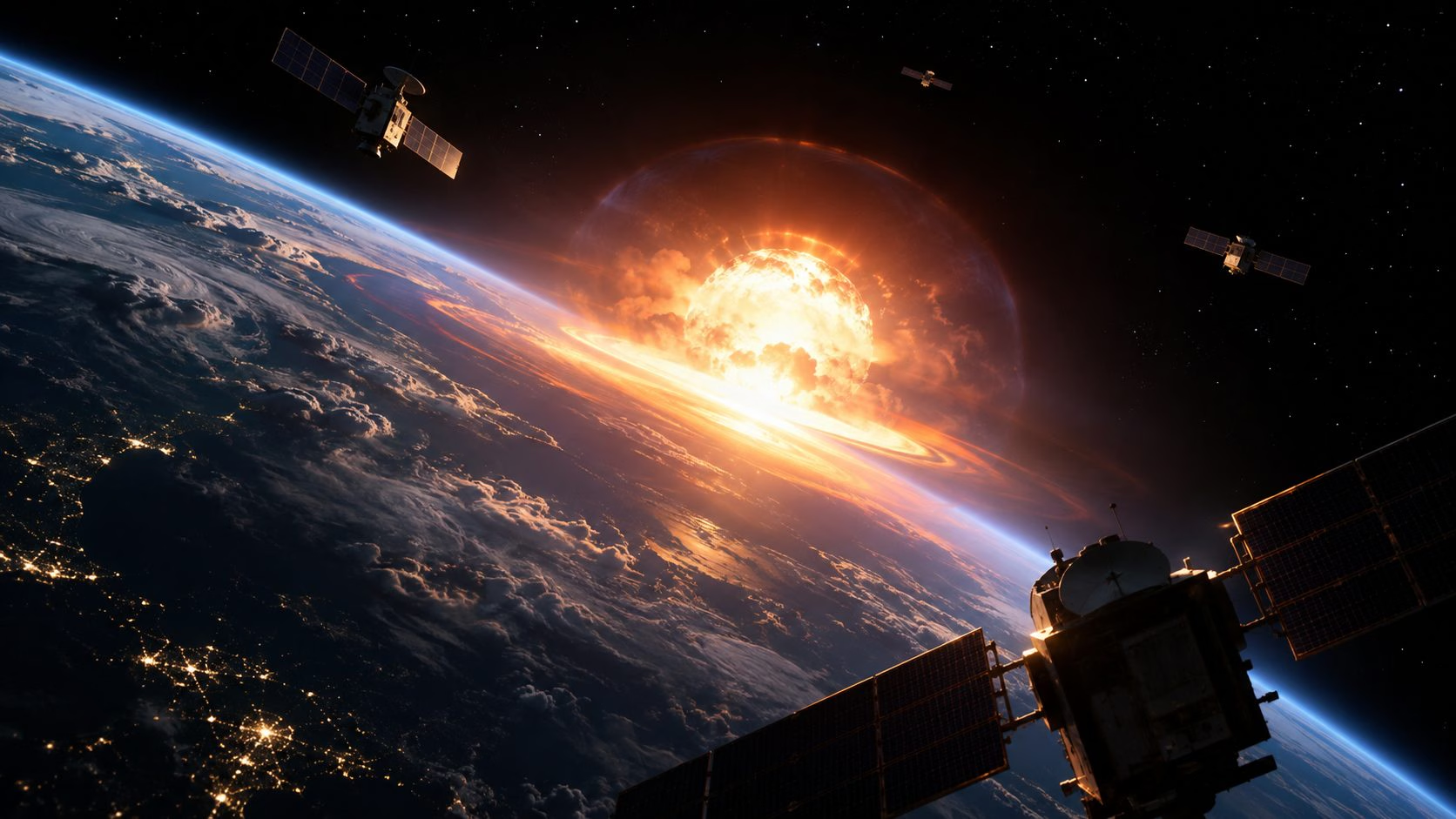
A recent study by the University of Wisconsin and Princeton shows through simulations how a one-megaton nuclear explosion in low Earth orbit could knock out 98% of satellites in a week, creating a radiation belt dangerous for space missions.
Only one nuclear explosion in space could put 98% of satellites out of order in low Earth orbit within a weekcompromising telecommunications, satellite internet services, meteorological observations and numerous scientific activities.
This is what emerges from a new study published on arXiv, still awaiting peer review, in which a group of researchers from the University of Wisconsin-Madison and Princeton University simulated the consequences from the detonation Of a nuclear device by one megaton at about 500 kilometers above sea level. In the main scenario, the 99.4% of the beyond 13,000 satellites in low Earth orbit would reach the threshold of broken down expected within 15 dayswith potentially long-lasting consequences also for future space missions.
The most surprising result is that it wouldn’t be the initial explosion to cause most of the damage, but rather the charged particles released by fission products radioactive which could become trapped in the Earth’s magnetic fieldforming a sort of artificial radiation belt capable of progressively damaging the satellites that pass through it.
A similar phenomenon has already occurred in 1962during a US nuclear test, Starfish Primewhich detonated a 1.4 megaton nuclear bomb 400km above the ground on Johnston Atoll in the Pacific.
It is important to point out that place nuclear weapons in Earth’s orbit is banned by the 1967 Outer Space Treaty and that, to date, there is no evidence publicly verified by presence Of nuclear warheads already deployed in space.
In recent years, the United States has accused Russia of developing an anti-satellite nuclear weapon, but Russian authorities have denied these intentions. The study it’s not about so a upcoming eventbut one hypothetical scenario which allows us to understand how vulnerable space infrastructures can be.
Why a single nuclear explosion could knock out thousands of satellites: the study
The team of researchers, led by Zachary Petersenha simulated the effects of anuclear explosion from a megaton about 500 kilometers of altitude, an altitude occupied by numerous satellites For telecommunications and Earth observation. The model takes into account the radiation emitted during the detonation, its evolution over time, possible satellite failures and subsequent collisions between space objects.
The first effect it would be the emission of an intense impulse of X-rayscapable of directly damaging the electronics of exposed satellites. According to the simulations, however, this first phase would only put the 2.9% of satellites considered.
The real problem would instead be the dispersion, caused by the explosion, of large quantities of radioactive products which, decaying, they would release high energy electrons. A portion of these particles would remain trapped in the Earth’s magnetic field lines, forming a artificial radiation beltsimilar to Van Allen bands that naturally surround our planet.
The satellites would continue to travel their orbits crossing repeatedly these regions. Even when exposure during a single pass isn’t enough to harm them, radiation could accumulate progressively one dose such as to compromise the electronic components.
The results of the main scenario indeed show that after a dayThe 25% of satellites would reach the threshold of broken down predicted by the model, after three daysthe percentage would rise to 78%, after one week at 98%And after 15 days we would arrive at 99.4%.
These are predictions based on specifications hypothesis relating to the satellites’ resistance to radiation and the quantity of particles that remain trapped in the magnetic field. They therefore do not mean that any nuclear explosion would necessarily produce the same results because the location of the detonation, the power of the bomb and the characteristics of individual satellites would influence the consequences of the explosion.
The phenomenon, however, is not purely theoretical. The July 9, 1962during the US experiment Starfish Primea 1.4 megaton nuclear device was detonated at approximately 400 kilometers altitude over the Pacific Ocean. The explosion generated a artificial radiation belt which damaged several satellites and whose particles remained trapped in the Earth’s magnetic field for years. At the time, however, there were very few satellites in orbit compared to the thousands present today.
The consequences for ISS, space telescopes and satellites in orbit
Such an event would have repercussions far beyond the loss of individual satellites. In fact, they are numerous in low Earth orbit infrastructure on which they depend services used dailyfrom connections Internet satellite at communicationsgive it weather forecast to monitoring climate change.
A widespread loss of these satellites would cause potentially very serious disruptions, though it wouldn’t mean the automatic shutdown of all satellite services of the planet. The satellites of the GPS system, for example, are located at around 20,200 kilometers above sea level, far above the region considered in the study.
Particularly worrying would be the situation of inhabited space stations. The International Space Station orbits at about 400 kilometers altitude, while the Chinese station Tiangong is located in a similar region. Both could be exposed to a strongly altered radiative environmentwith possible risks for on-board instruments and astronauts. The study, however, does not calculate the doses absorbed by the crews and therefore does not allow us to establish what the actual risk to their health would be.
Even the scientific research would suffer major consequences. Many satellites used for observe the earth’s climatemeasuring air pollution or studying the physics of space operate precisely in low orbit. The same space telescope Hubblewhich orbits about 480 kilometers from Earth, could be exposed to risks described by the simulations. Different would be the situation of James Webb Space Telescope and the European telescope Euclidwhich are located approximately 1.5 million of kilometres from Earth, near the Lagrangian point L2, and would not cross the artificial radiation belt simulated in the study.
The consequences could also persist for years. When a satellite stops functioning it often also loses the ability to correct its orbit and avoid collisions. According to the model, such an extensive loss of maneuverability would result about 20 collisions in the first two yearsproducing further space debris. These fragments could in turn damage other satellites and hinder the launch of new missions.
What would happen to us on Earth
At an altitude of 500 kilometers the device would not raise enormous quantities of soil and radioactive dust, responsible for the so-called nuclear fallout. Some of the radioactive products of the explosion could however reach the atmosphere And gradually settle on the earth’s surfacebut it would be dispersed over very large areas.
The atmosphere would also protect us from much of the radiation produced in space. The study, however, does not calculate the amount of radioactive material that could reach the ground, so it is not possible to quantify the possible health risk.
Furthermore, at 500 kilometers altitude, the atmosphere is extremely rarefied, therefore the shock wave would not be produced on the ground destructive typical of a low-altitude nuclear detonation. However, the explosion could generate an intense electromagnetic pulse (EMP)capable of interfering with electronic systems and electrical infrastructures over very large areas.
The charged particles released by the explosion could also produce artificial aurorasas already observed during some high-altitude nuclear experiments conducted in the 1950s and 1960s.