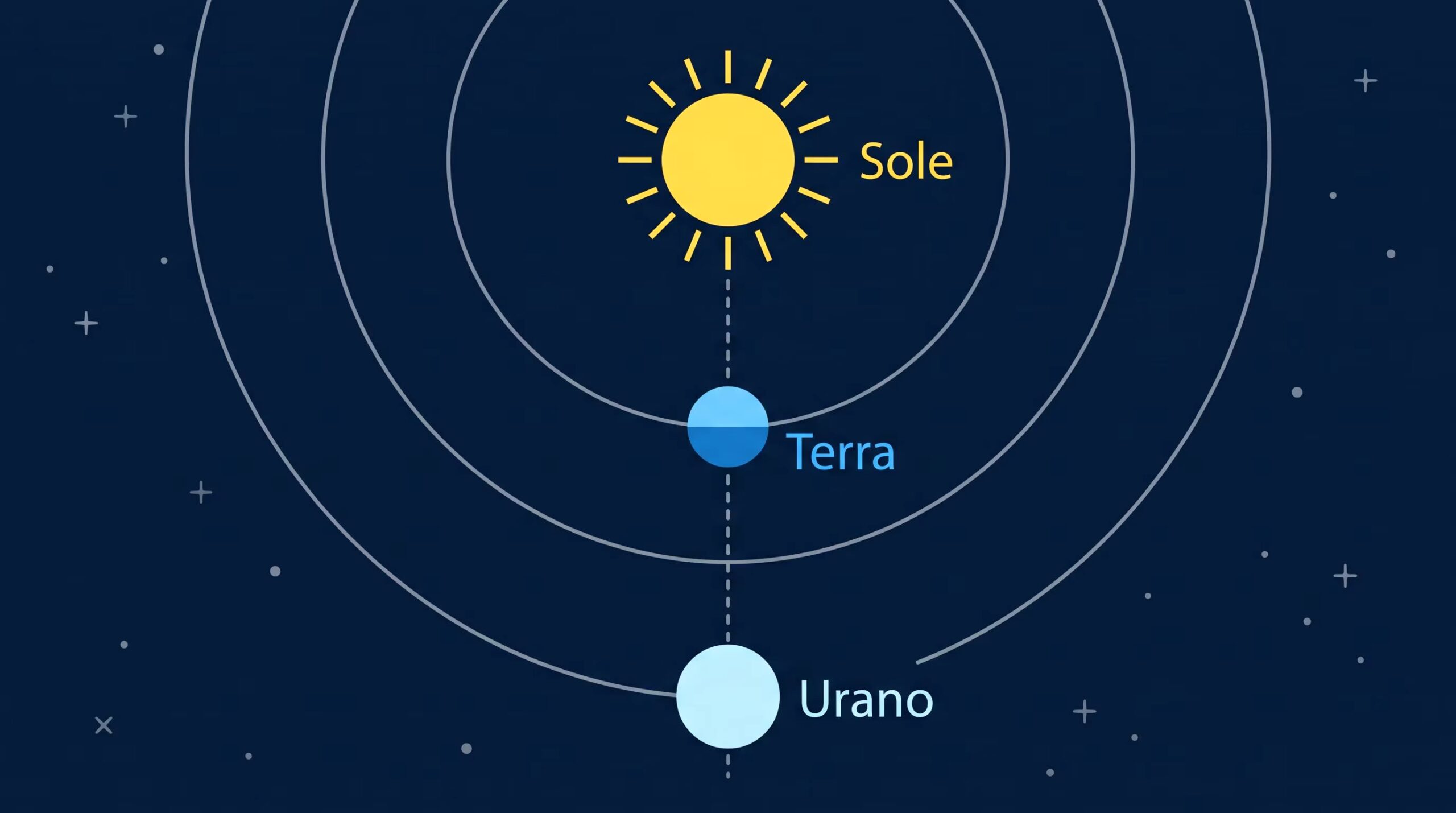
On November 25, 2026 Uranus will be in opposition to the Sun, also being at the minimum distance from the Earth. The planet will be observable throughout the night in the constellation of Taurus, near the Pleiades. The almost full Moon, however, will make it difficult to locate it with the naked eye: to observe it it will be preferable to use binoculars or a telescope.
Today, November 25, 2026around 11.40pm (Italian time), Uranus will reach the opposition al Sun. But what does it mean? The opposition of an outer planet occurs when the Sunthe Earth and the planet in question are almost found alignedwith the Earth in an intermediate position.
In this case, therefore, the Earth will be found aligned Between The Sun and the planetwhich will appear on the side opposite of the sky compared to our star and will remain observable for the entire night.
Uranus will rise around at sunsetwill reach its maximum height above the horizon in the central hours of the night and will set around dawn. At opposition, Uranus it will shine with an apparent magnitude of approximately +5.6 in the constellation of Taurus, its maximum brightness of the yearand will also be found at minimum distance from Earth for the entire year 2026, equal to approximately 18.4 astronomical units, or approximately 2 billion 759 million kilometers.
The period around the opposition is particularly favorable for the observation of Uranus: the planet is located at minimum distance from Earthappears slightly brighter and has the maximum apparent angular diameter of the year, as well as being observable for almost the entire night. The presence of Almost full moonHowever, it may make it more difficult to spot.
In any case, Uranus’ magnitude +5.6 is, in theory, a value just compatible with the visibility to the naked eye under exceptional skies dark and clearaway from any source of light pollution.
In practice, therefore, locate the planet without instruments will be very difficult and for observation it is recommended to use a binoculars or a telescope.
But how to find easily the “frozen giant” in the sky?
To locate Uranus, it will be useful to take as reference the Pleiadesone of the most recognizable star clusters in the autumn and winter sky. Watching towards the east in the early hours of the eveningapproximately 6/7 close stars will be distinguished: the Pleiades they are in fact easily recognizable as a small compact group of bright stars, of which six or seven can generally be distinguished with the naked eye (in favorable conditions).
The planet will be located at approx 5° south-east of the Pleiades, in the constellation of Taurus in the direction of the Hyades cluster, about halfway between the two clusters.
It must be said, however, that the Moon could complicate observation: the full moon happened on November 24 at 3.53pm (Italian time), just over a day before the opposition, and it will also be a so-called Supermoon. The intense brightness of the Moon, therefore, could hide faint objects such as Uranus and make its identification even more difficult.
For observe Uranus better it will therefore be preferable to wait for them last days of November or even the beginning of December, when the waning Moon will rise later and later, leaving the evening sky more free from its brightness.
Among other things, among the eight planets of the Solar System, only those with an orbit outside the Earth’s orbit (i.e Mars, Jupiter, Saturn, Uranus And Neptune) can reach opposition to the Sun. Mercury And Venusorbiting within Earth’s orbit, can never be on the opposite side of the sky from the Sun and never reach opposition.
For Jupiter, Saturn, Uranus and Neptune the opposition occurs approximately once a year, while for Mars the frequency is approximately 26 monthsbecause its orbit and orbital speed are quite similar to those of Earth: our planet therefore takes longer to reach and surpass it.