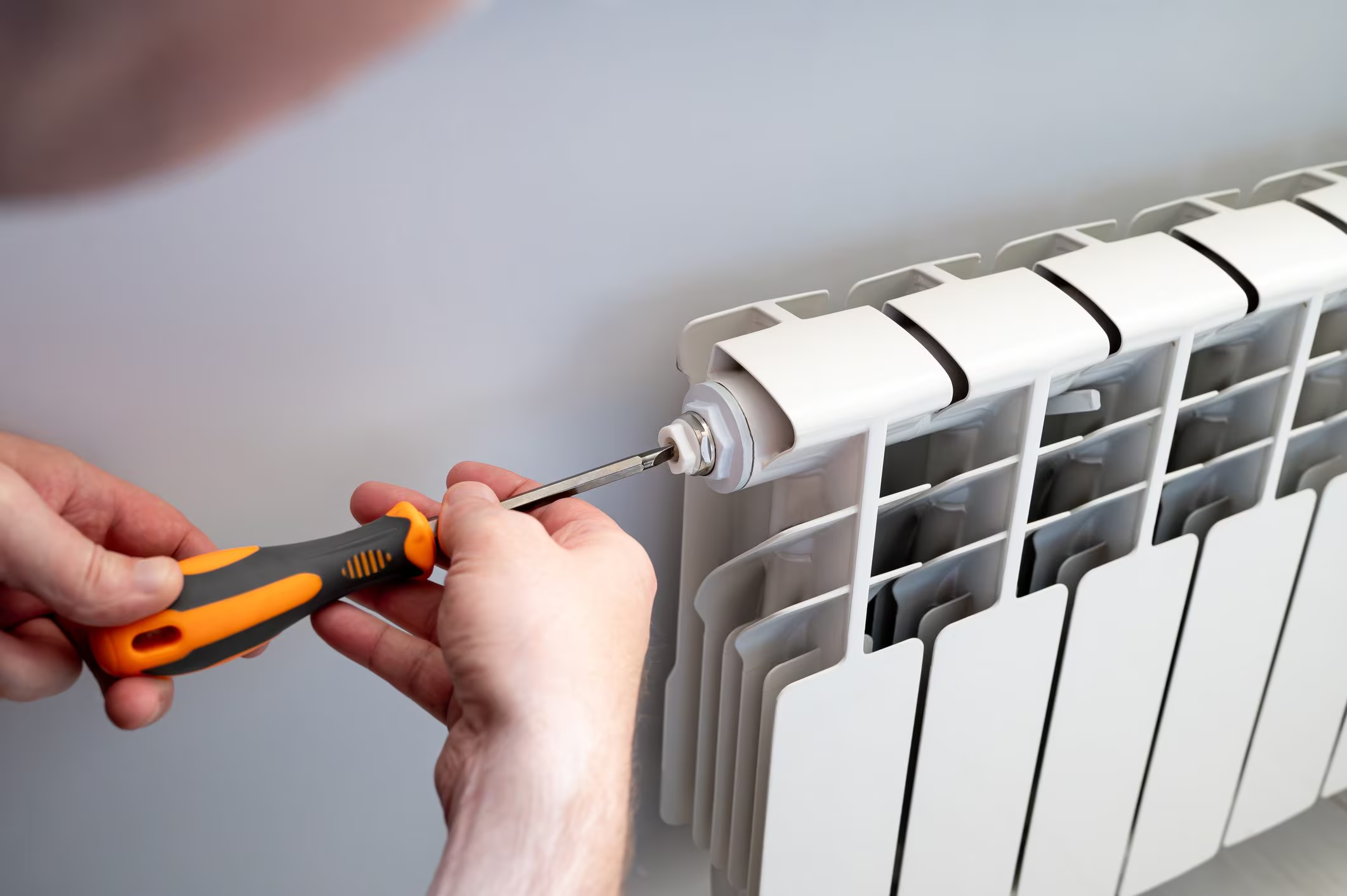
Venting the radiators allows you to eliminate the air accumulated in the radiators, improving heat distribution and reducing energy consumption by up to around 2%, according to ENEA. Let’s see how to carry out this operation correctly, by slowly opening the vent valve in an anti-clockwise direction. We will hear a hissing sound: we wait for the air to escape, until only water comes out constantly.
Winter is approaching and heating they can now be turned on in almost all Italian municipalities: sometimes, however, it can happen that i radiators are not working properly and this can lead, in addition to annoying sounds, to an increase in consumption and the cost of the bill.
This is why, among the behaviors recommended by ENEA (the National Agency for new technologies, energy and sustainable economic development) there is also that of vent regularly i radiators: this is a simple home maintenance operation, which consists of in eliminating the accumulated air inside the radiators of water heating systems.
The presence of air, in fact, can obstruct circulation of water warm, reducing there capacity of radiators to heat the rooms.
According to ENEA, venting radiators can cause a 2% annual energy saving. Assuming a consumption Of 1,000 cubic meters standard gas per year for heating only and considering the reference price of natural gas published by ARERA in October 2026 (1,768 euro/Smcincluding taxes), the economic savings would be approximately of the order of 30-35 euros per year.
As the Swiss Federal Office of Energy (SFOE) highlights, there are some signs that can indicate the presence of air inside the radiators and the need to vent them:
- The radiator Yes warms up in inhomogeneous mannerwith the upper part remaining cold while the lower part heats up;
- They warn each other abnormal noiseshow I gurgled And hiss;
- The environments they don’t reach there temperature desired even though the heating is on.
The directions to follow to vent radiators are contained in a document on energy efficiency developed by the Ministry of Defence. It is advisable to do this with the heating off hey cold radiatorsalso for avoid the risk of burns due to the leakage of hot water.
In particular, to vent radiators it is necessary:
- Locate the vent valvewhich is generally located in the upper part of the radiator – if it is not present, as happens in old cast iron radiators, it is necessary to slightly loosen the fitting that connects the tap to the body of the radiator, being very careful because it could cause leaks. If in doubt, better call a plumber!
- Place a container under the valve to collect any water that may escape, along with one rag, a cloth or absorbent paper to avoid wetting the floor;
- Open slowly there vent valveturning it anticlockwise without unscrewing it completely. Some valve types can be opened directly by hand, while for others it may be a special key is required for radiators or a flat tip screwdriver. At this point, if there is air in the radiator, we will hear a I hiss;
- Wait for the air to escape, until only water comes out constantly from the valve, making sure that only a little water comes out, from a few tens of ml to a maximum of a glass;
- At that point, close the valvewithout tightening it too much;
- Repeat the operation on the other radiators.
Attention: it’s important do not let out more water than necessary.
Once the venting is complete, it is still necessary check the water pressure inside the heating system.
In the municipalities autonomous heating systems in a closed circuit, the water pressure is generally between 1 and 1.5 bars with the system cold, but the correct value depends on the characteristics of the system and the manufacturer’s indications.
If the pressure is too low, it may be necessary to carry out a topping upi.e. add water to the heating circuit through the appropriate fill tap. For this operation, however, you must adhere strictly at manufacturer’s instructions.
These last considerations, however, apply only to autonomous boilers: in facilities of heating centralizedHowever, pressure control and any topping up are managed by the system manager and it is possible to vent domestic radiators only to release the air trapped in your radiator if it produces gurgling or uneven heat.
If, despite the venting, the problems persist, it is advisable to contact a specialized technician.
But How often do radiators need to be vented? The Ministry of Defense suggests carrying out the operation especially at the beginning of the cold season: in general, however, it is advisable to bleed the air from the radiators when the typical signs of the presence of air in the radiators, listed previously, emerge.