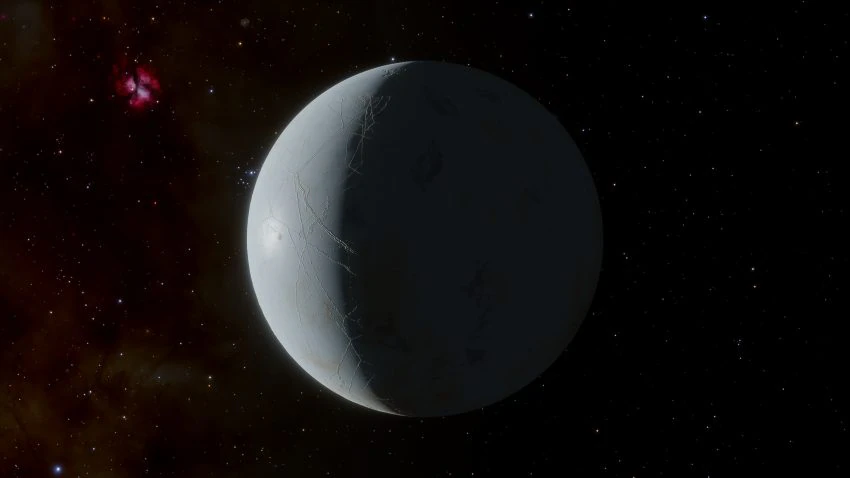
It’s called Planet X2 and it could hide beyond Neptune and explain the anomalous orbits of many trans-Neptunian icy bodies. In the simulations it manages to reproduce the architecture of the most remote regions of the solar system better than the famous Planet Nine.
A rocky planet similar to Earth by mass it could orbit the edge of the solar system at hundreds of times the distance that separates our planet from the Sun. Called Planet X2 (or briefly PX2), its existence was hypothesized in a study published on November 23, 2026 in the journal Monthly Notices of the Royal Astronomical Society entitled “Signatures of an Earth-class planet in the distant Solar system”.
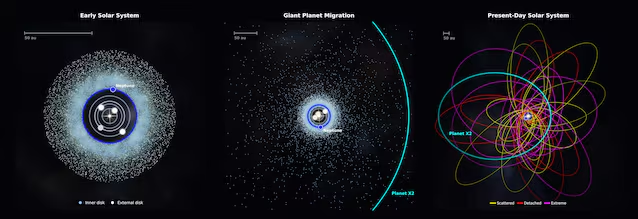
In the simulations done by the authors, a planet of approximately two land masses on a stable elliptical orbit, very elongated and of modest inclination, between 1° and 15° (practically the plane on which the Earth moves around the Sun). The semimajor axis of the orbit (i.e. half the major axis of an ellipse) would measure between 350 and 500 astronomical unitse (abbreviated in Italian with UA, is the average Earth-Sun distance), while the perihelionthe point of closest approach to the Sun, would be a 200 AU (over six times the distance of Neptune, the most distant planet in the solar system). At the farthest point (the aphelion) the planet would push between 500 and 800 AU. A revolution of PX2 around the Sun it would last between approximately 6,500 and 11,000 years.
PX2 could explain the anomalous orbits of trans-Neptunian objects
In the most remote regions of the solar system, beyond the orbit of Neptune, there is a very large population of icy bodies known as trans-Neptunian objects (in English TNO, Trans-Neptunian Objects). In addition to small icy bodies, they also include asteroids and dwarf planets, and are considered primordial remnants of the formation of the solar system. Most of them are located in the so-called Kuiper belta vast, disk-shaped region of the solar system that extends beyond the orbit of Neptune, between about 30 and 50 AU from the Sun.
However, by studying their orbits, astronomers have identified some of their characteristics that are difficult to explain with traditional models of the formation of the solar system. In particular some of these objects travel extremely elongated elliptical orbits and with the points of closest approach to the Sun (i.e. the perihelion) very distant from Neptune. Others move up strongly inclined orbital planes than that which most planets orbit, while some exhibit orbits so large that they number in the hundreds or even thousands of astronomical units from the Sun.
To find a solution, Patryk Sofia Lykawka and the co-authors of the study therefore carried out a series of numerical simulations that reconstruct the evolution of the trans-Neptunian region over 4.5 billion years (the mechanism hypothesized by the authors is in fact linked to gravitational perturbations exerted over billions of years) comparing different simulated scenarios: a solar system without planets additional, one in which in the early stages of its history some planetary embryos (celestial bodies of intermediate size that are formed during the birth of a planetary system starting from the aggregation of smaller bodies called planetesimals) are expelled towards the external regions and one in which it is present a stable and still unknown planet.
In the past, different types of models have been proposed to explain the presence of bodies such as TNOs very far from the Sun which maintain relatively low inclinations. This is precisely where PX2 differs from the more well-known scenario of Planet Nine, also known as Planet. The latter was proposed in 2016 by astronomers Konstantin Batygin and Michael Brown to mainly explain the apparent clustering of some orbits of extreme trans-Neptunian objects, which appear to share particular orientations in space. The classic model predicts a decidedly more massive planetsort of super-Earth with a mass generally estimated at approx 5-10 Earth masses on a very distant and eccentric orbit.
According to the study’s simulations, the scenario proposed with PX2 reproduces better overall the properties of the different TNO populationsespecially over 50 astronomical units. Its gravity can, in fact, generate objects with perihelions far from Neptune, create a TNO component with very inclined orbits and explain the characteristics of bodies such as Sedna and 2012 VP113, two TNOs with perihelion very distant from the Sun with extremely wide and eccentric orbits.
A new class of planets
The case of Pluto shows how much the classification of what a planet is has been redefined over time and with astronomical discoveries. Pluto was in fact downgraded in 2006 when theInternational Astronomical Union (UAI) set three criteria for an orbital body to be defined as a planet: it must orbit the Sun, it must have enough mass for its gravity to make it almost spherical and it must have cleared the area around its orbit. Pluto, which measures about 2,300 kilometers and is smaller than our Moon, meets the first two criteria but not the third, because it shares its space with many other Kuiper belt objects, and since then it is a dwarf planetsuch as Ceres and Eris.
The study’s first author, Lykawka, argues that if a world like PX2 were actually discovered the very definition of planet should be further refined or in any case a new class of orbital bodies should be defined.
To know if the planet exists we will have to wait for direct observations. To this end, the Vera C. Rubin observatory (located in Chile) launched the Legacy Survey of Space and Time (LSST), a ten-year census that intends to repeatedly photograph the entire southern sky every few nights and which will allow the discovery of many new bodies orbiting in our solar system. According to scientists’ estimates, LSST should lead to approx 37,000 trans-Neptunian objects (To date, approximately 8,300 TNO objects are known). For the authors who hypothesized PX2, the survey can directly detect the planet or verify the gravitational influences of PX2 on icy objects found in regions beyond 100 AU.