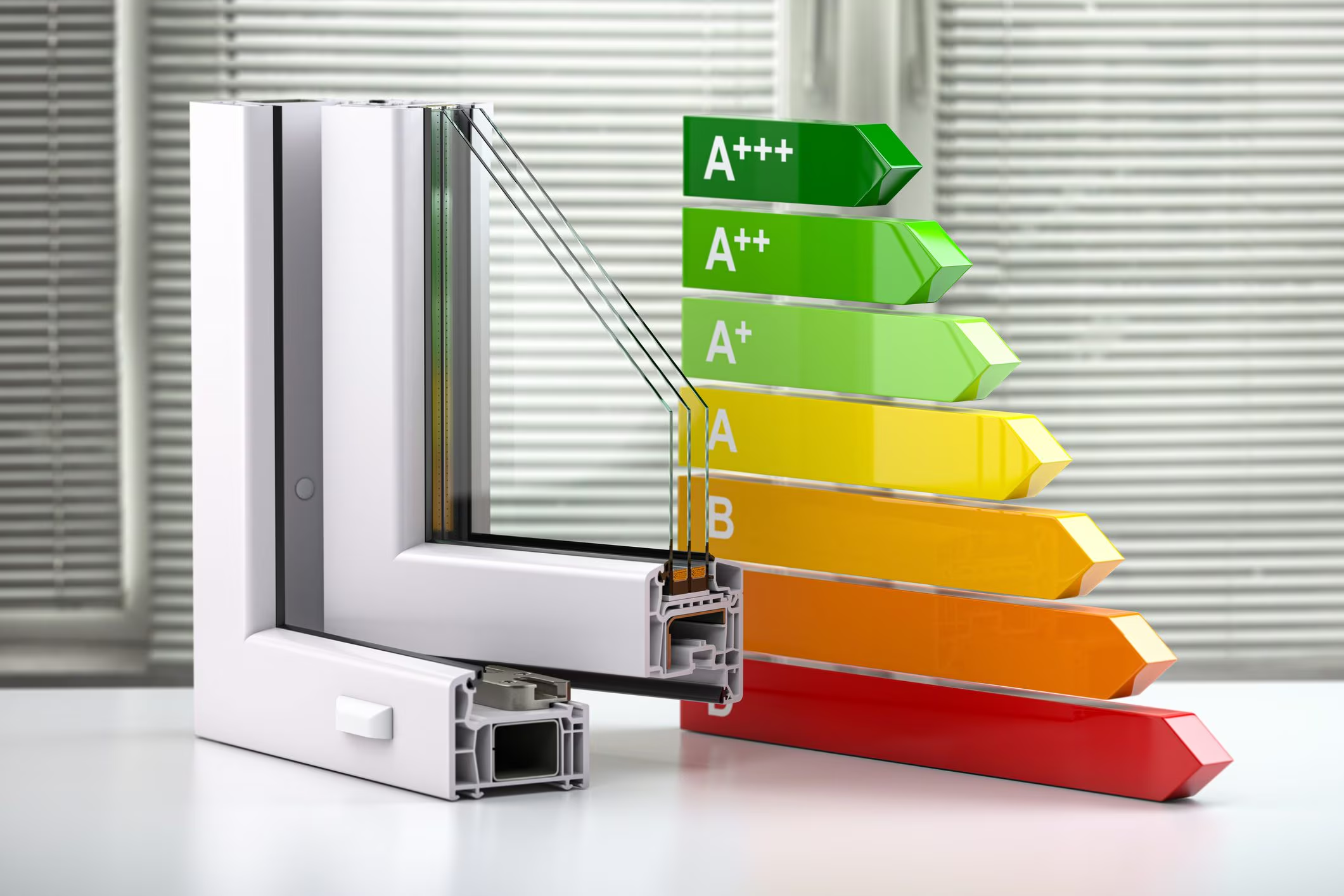
The choice of fixtures can significantly impact the energy consumption of a home. Replacing 20 m² of old windows with single glass can save, in the conditions assumed for a heating season, more than 200 euros. However, the actual saving on the bill depends on the thermal transmittance of the windows, the climate, the quality of the installation and the type of system.
Changing windows can reduce the energy needed to heat and cool your homebut how much do you have to spend and how much do you get back in your bill? For a home of 100 m²hypothesizing about 8–10 openings between windows and French windowsthe commercial indications of an operator in the sector place the replacement, including installation, in the order of 6,000–20,000 euroswith the possibility of exceeding this figure in the more expensive configurations. It is an indicative interval: the estimate is mainly determined by the number and dimensions of the windows, materials, glass, accessories and necessary workmanship, not the square meters of the home alone.
The following can contribute to reducing the cost of the operation incentives for replacing fixtures: for expenses incurred in 2026the Ecobonus provides for an ordinary deduction of 36%which rises to 50% for the main residence when the owner or holder of a real right of enjoyment, such as usufruct, bears the expense. The benefit is recovered in ten annual installmentswithin the limits of the tax due and the conditions envisaged: it is therefore not equivalent to an immediate discount on the estimate. The intervention must comply with specific technical and documentary requirements, including communication to ENEA.
The energy savinghowever, it depends above all on how much the new windows insulate compared to the existing ones, on the surface of the windows and on the climate. In the example we will develop, referring to a 100 m² house with 20 m² of windows in totalreplacing old windows with single glass allows us to estimate savings associated with lower dispersions of approximately 247 euros with double glazing And 273 euros with triplein the hypothesized conditions of use and price. The additional advantage of the triple is therefore of 26 euros: to understand where these amounts come from, and why they do not represent a forecast of the bill, we need to start from thermal transmittance Uw of the entire window.
What is thermal transmittance and how does it influence consumption
In winter, when it is warmer inside the house than outside, the windows let part of the heat pass towards the outside: in this case, the heating system must compensate this loss to maintain the desired temperature. The ability of the window to limit exchange can be understood from thermal transmittance Uw: the lower it is, the less heat passes through the window for the same surface area and temperature difference. This quantity is measured in W/(m2K): a value of 1 indicates the passage of one watt for each square meter and for each degree of difference between inside and outside.
However, you must pay attention to the acronym shown on the estimate: Ug it only concerns the glass, Uw instead theentire windowinclusive of chassis And edge of the glass. The latter is the useful value for comparing theoverall insulation of the windows and which ENEA recalls to evaluate the performance of the complete window in the technical documentation of the interventions.
PVC, wood or aluminum frames: which insulate better
The PVC and the wood they conduct less heat thanaluminum: in modern metal windows, the thermal breakan interruption made with insulating material That limits the passage of heat between the internal and external part of the frame. An old metal profile without this solution can represent a significant weak point.
Furthermore, the Wood requires periodic carewhile the PVC does not require painting. There are also mixed solutions, such as wood externally covered with aluminium, which reduce maintenance of the surface exposed to the elements. These are useful differences in choosing, but they do not by themselves allow you to assign a bill to each material.
Two windows with lo U himselfw and the same surface they disperse by transmission the same amount of heat in the same conditions, even if the frames are different. To compare overall consumption, it is necessary to consider air tightness, solar gains and installation. Therefore, a universal classification such as “PVC saves 30%, wood 20%” would be misleading.
How much do you save on your bill by replacing single glass with double or triple glass
Insulating glass slows down the passage of heat thanks to gaps between the sheets. For example, gases such as argon improve insulation, while low-e coatings reduce heat exchange by radiation: they are different technologies that can work together.
Let’s take an example by considering one house of 100 m² in which windows and French windows have a total surface area of 20 m², including frames. The two surfaces are distinct hypotheses: a house of the same size could have smaller or larger openings, and it is the surface of the windows that enters into the calculation of their dispersions. Let’s imagine a period of 2,000 hours during which the average temperature difference between inside and outside is 15 °C and we compare three windows, choosing the values of Uw indicated in the following table.
The calculation of waste heat is evaluated multiplying transmittance, surface area, temperature difference and duration. In the example, the transition from the old window to double glazing reduces dispersions by 74%. for transmission through windows, choosing triple the reduction reaches 82%.
To translate the result into euros, let’s assume that all this heat is supplied by a boiler with a seasonal efficiency of 90% and that the gas costs 0.10 euros per kWh, considering the applicable variable components. The least heat to be replenished would be equivalent to approx 247 euros with the double glass And 273 euro with the triplecompared to the old window. The additional advantage of the triple it would therefore be approximately 27 euro in the period considered. These amounts are one economic conversion of dispersions alone calculate, Not a prediction of the bill annual. The model does not consider free heat from the sun and household activities, changes in internal temperature or the reduction of drafts. However, the comparison highlights one point in particular: the “jump“ greater it can be the one from one window Very dispersive to a good modern window.
Because the savings are not proportional to the reduction in heat dispersion
Heat also passes through walls, roofs and floors, and is lost through air exchanges and infiltrations. Reduce just one of these items by 74%. does not mean reducing by 74% The requirement of the house. Furthermore, bills include other energy uses and fixed amounts that window replacement does not eliminate. We must also consider the operation of the system: to provide the same amount of heat, a boiler and a heat pump purchase different quantities and forms of energy. Consequently, it same improvement from the windows can produce various financial savings.
The benefit increases if the replaced surface is greater and if the temperature difference between inside and outside is high and persistent. A house heated all winter and a house used only on weekends will not offer the same economic return: convenience must be weighed against the investment and to the actual use of the property.
Why is the installation of fixtures important to consume less energy?
A good window and door must be connected correctly to the masonry, as poorly maintained joints air infiltrations And discontinuity of insulation can compromise the result. Furthermore, counter frames and roller shutter boxes must also be considered: the quality of installation it is therefore part of the intervention. More airtight windows also require managing air exchange: eliminating drafts does not eliminate the need for ventilation. In terms of comfort, less cold internal glass and fewer air currents could make staying near the window more pleasant even without increasing the thermostat.
How much do windows affect air conditioning consumption in summer
For cooling, taking into account only the Uw factor is insufficient, as a window can insulate well and still let in a lot solar radiation. In this case we must consider the solar factor gwhich describes the share Of incident solar energy that passes through the glass, directly or after being absorbed and released inside.
The choice should be coordinated with exposure And shielding: external curtains, shutters and sunshades can intercept solar radiation before it heats up the rooms. A useful solar contribution in winter can become an additional load for the air conditioner in summer: also for this reason, the solution suitable for a window that is very exposed to solar radiation may differ from that for a north-facing window.
To conclude, the useful comparison in choice of window to buy should consider together performance of the entire window, quality of installation And estimated savings for that house. A triple glass can be advantageous in cold climates or to improve comfort near large glass surfaces; elsewhere, a good double glazing with screens adequate may prove to be the most convenient solution. There additional expense must be compared with the additional benefit: it is this step that allows you to understand how much the best frame on the technical sheet is really worth in your bill.
Sources
ENEA: Ecobonus FAQ, section B. Reference for the transmittance of the complete window and the methods of determination. US Department of Energy, Building Science Education: Types of Windows. Frame materials, thermal breaks, gas in the cavities and low-emission treatments. US Department of Energy, FEMP: Purchasing Energy-Efficient Residential Windows, Doors, and Skylights. Relationship between climate, transmittance, solar gains and economic convenience. US Department of Energy: Consumer Guide to Energy-Efficient Windows (2021). Exposure, solar control and importance of installation. ENEA: Vademecum on windows and doors Revenue Agency: Energy requalification