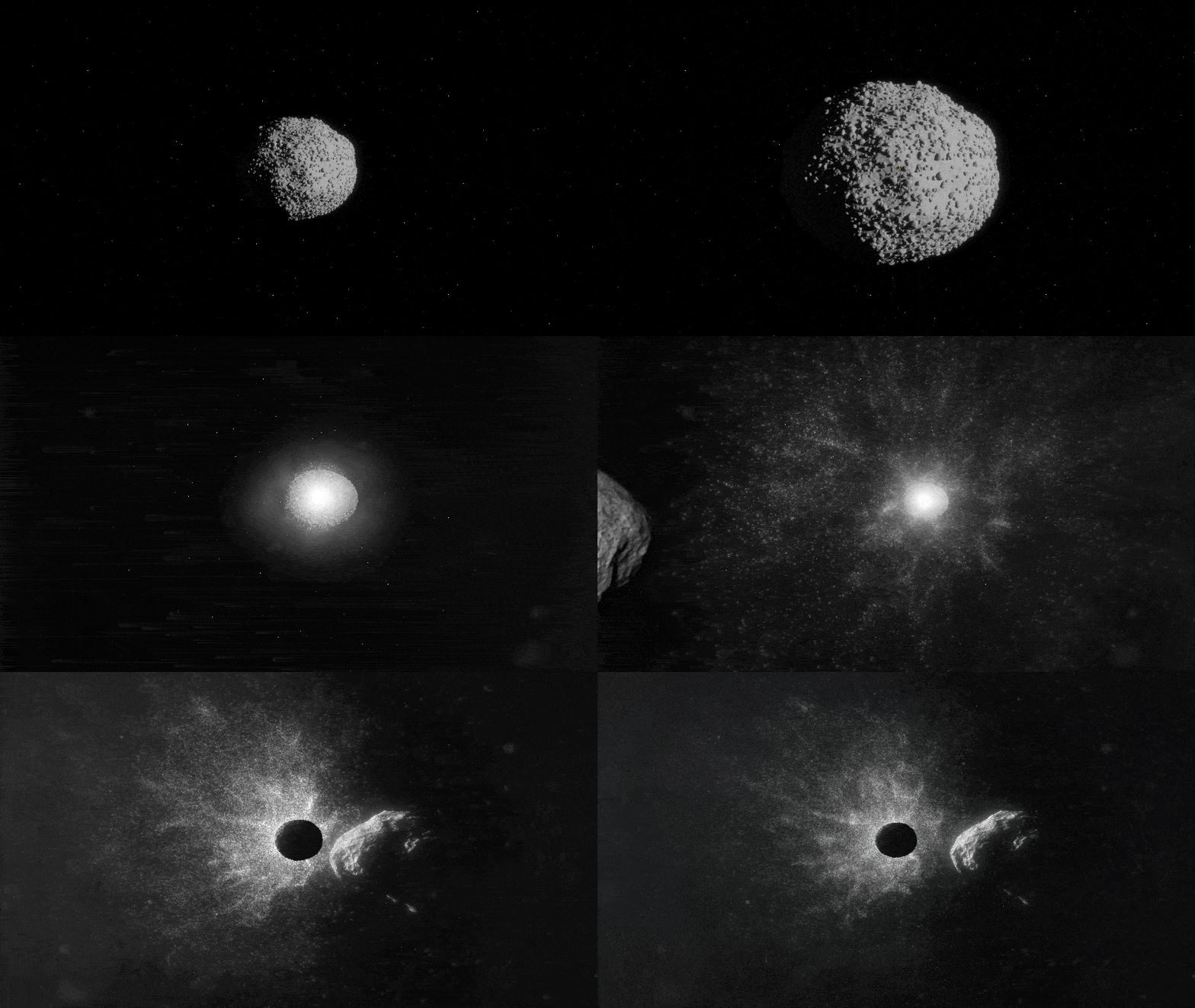
The first images from ESA’s Hera mission show a crater left by DART on Dimorphos. The impact altered its orbit and rotation: studying its effects will help improve planetary defense techniques in the future.
There mission from the NASA For deviate a asteroid generated a crater as big as one sports stadium on the celestial body: this is what emerged from the first images details of the asteroid Dimorphosrecently released by the European Space Agency (ESA) and obtained thanks to the Hera mission.
As visible in the simulation above, the asteroid was deflected by NASA hit intentionally on September 26, 2022 from DART probelaunched on November 24, 2021 from Vandenberg Space Base, California, aboard a Falcon 9 rocket by SpaceX. It was the first experiment of planetary defense of history.
The goal was to try something never tested until now: change the orbit of an asteroid through an impact. More than four years later, Hera’s observations are allowing scientists to understand what the physical consequences of the collision were and to collect fundamental information for any future missions to protect the Earth from potentially dangerous asteroids.
How Dimorphos changed after the impact of the DART spacecraft
Dimorphos is a small asteroid of 151 meters in diameter that orbits a largest asteroidcalled Didymosabout 730 meters in diameter: together, the two celestial bodies orbit around the Sun. The impact of the DART spacecraft in 2022 had reduced Of 33 minutes the time it took Dimorphos to complete an orbit around Didymos, an achievement that exceeded scientists’ expectations.
The observations made by ground-based telescopes had made it possible to measure the change in orbital periodbut not to establish precisely what changes the structure of the asteroid had undergone.
The Images before and after, visible below, show that the collision produced a crater which extends across the entire width of the asteroid, flattening the affected side, as visible in the photo below.
The rest of the surface, however, does not appear to have undergone significant changes: the boulders covering the other regions appear just like in the images taken by DART in 2022. The impact also altered the rotational movement of Dimorphoswhich appears today chaotic.
Another discovery concerns the presence of hundreds of rock fragments of different sizes orbiting the system of the two asteroids. According to INAF, much of the ejected material is still nearby: the rock fragments disrupted by the impact are still gravitationally linked to the system.
How the Hera mission works and why it is important for planetary defense
There Hera probe it left on 7 October 2024 to study the consequences of the impact. It is currently located at one distance between 25 and 30 km from the two asteroids, located approximately 193.5 million km from Earth: to study them it uses, among other instruments, a hyperspectral imager able to analyze there composition mineral of asteroids.
In December 2026 the probe should get closer until approximately 13km from the system, providing progressively higher resolution images. In January 2027, however, the release of is expected two small satellites cubesats, about the size of a shoebox, called Juventus And Milani.
The first will use low-frequency radar to probe for the first time the inside of an asteroid, then trying a landing on its surface. The secondunder Italian leadership, will study i asteroid materials and the dust surrounding.
Working together, Hera, Juventas and Milani will form a pioneering exploration system composed of three spacecraft around two asteroids, acquiring complementary measurements of their physical properties and the consequences of the impact.
One of the scientific objectives will be to determine the mass of Dimorphosa fundamental parameter for evaluating the effectiveness of the kinetic impact technique, which consists of modify The movement of a celestial body through collision with a spacecraft.