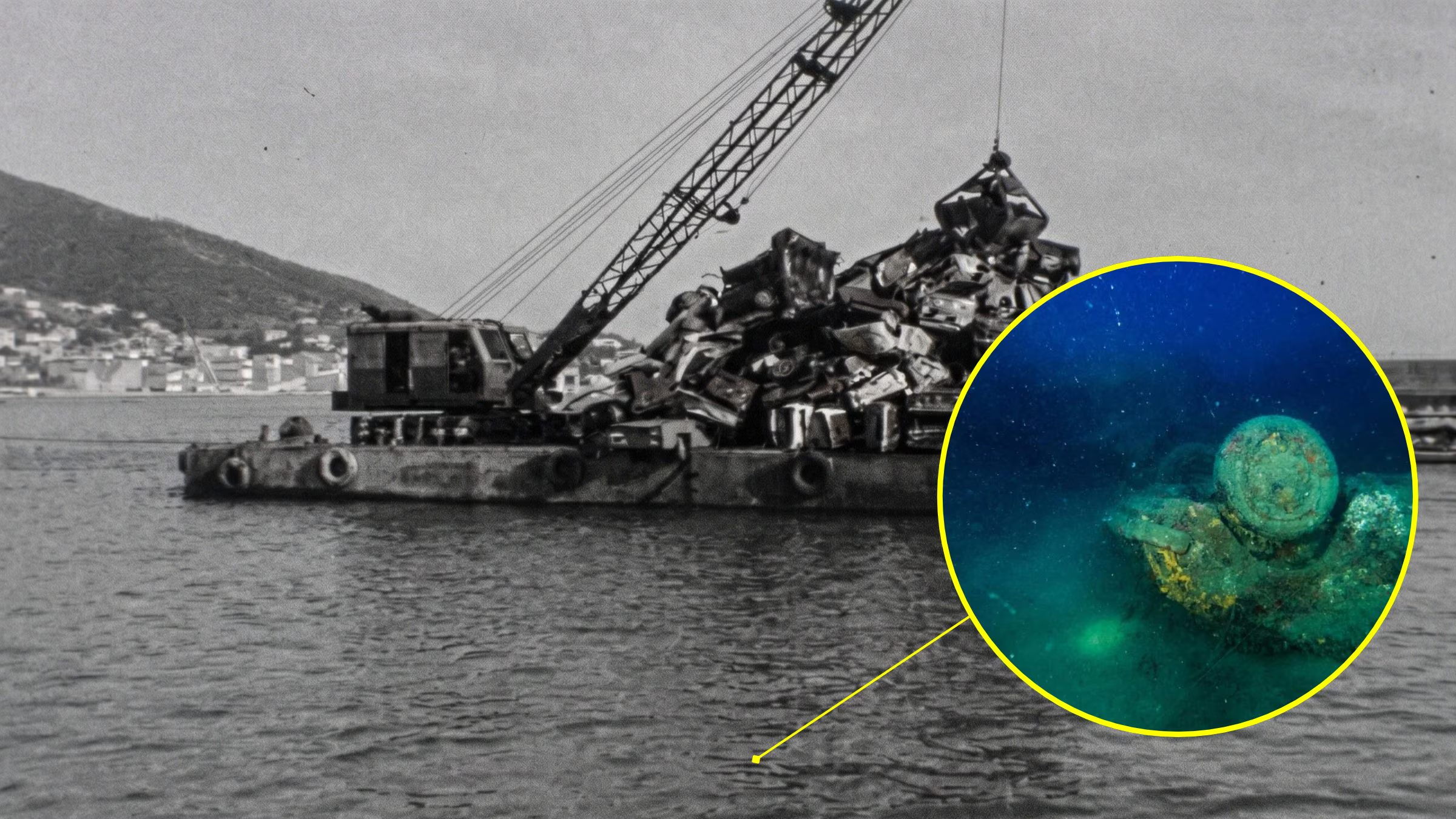
Off the coast of Varazze, in Liguria, about 40 meters deep, lie a thousand cars damaged by the Genoa flood of 1970. They were sunk to create the first artificial reef in Italy, but the operation immediately raised doubts about the environmental consequences.
In the sea ahead of Varazzein the province of Savona, on a sandy bottom about 40 meters deepthere is an unusual car cemetery: Fiat 500, 850 and 128 which have been there since December 1970. They didn’t end up in the sea due to an accident, but they were sink voluntarily after the devastating Genoa flood of 7 and 8 October 1970during which hundreds of cars were irremediably damaged.
To dispose of them it was decided to use them to create the first artificial reef in Italy (artificial reef), with the aim of promoting fish restocking and combating near-coast trawling. An operation which, however, was carried out without adequate preliminary scientific studies and without a complete reclamation of the cars. More than half a century later, tires, batteries and other waste are still found on the Ligurian seabed.
The Genoa flood of 1970 and the cars to be disposed of
Between 7 and 8 October 1970 Genoa was hit by one of the most devastating floods in its history. As reported by ARPAL (Regional Agency for the Protection of the Ligurian Environment), the rainfall continued for over 30 hours almost continuously, reaching intensity of 120 mm of rain per hour. In Genoa Bolzaneto, according to a 2021 ARPAL report, they fell 948 mm of rain in just 24 hoursequivalent to 948 liters of water for every square meter of surface.
The flooding of several streams, including the BisagnoThe Fereggiano and the Leiracaused very serious damage to the Ligurian capital and to 20 other municipalities in the province. For the Fire Brigade, the toll was 43 victims and over 2,000 displaced.
Once the water receded, hundreds of cars were left piled up and covered in mud on the streets of the city. Many of the damaged cars were returned to Fiat, which found itself having to quickly dispose of a large quantity of carcasses.
Because Fiat decided to sink the cars off the coast of Varazze
As reconstructed by Giovanni Modaffari, geographer of the University of Naples “L’Orientale”, in a study conducted as part of the GreenAtlas project and published in 2023, Fiat donated the carcasses to the Italian Naval League, also providing the technical assistance necessary for the operation.
On December 6, 1970, sinkings began off the coast of Punta dell’Olmonear Varazze. The cars, as visible in a historical video from the Archivio Nazionale Cinema Impresa, came transported on a pontoon and thrown into the sea with the aid of a cranein an area of approximately 15,000 square metres, distributed over seabeds between 35 and 50 meters deep.
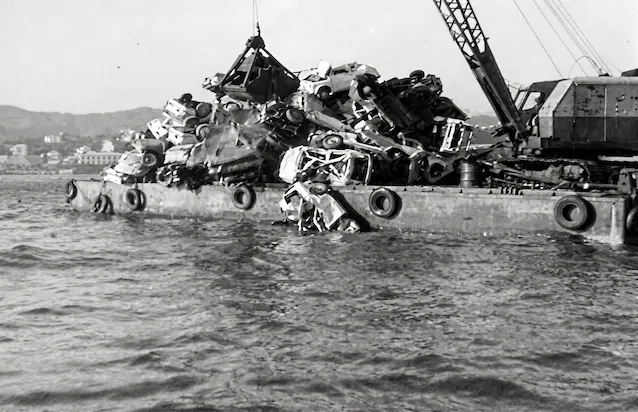
The idea was not entirely new: similar experiments had already been conducted in the United States, particularly in California, where car carcasses had been used to create artificial reefs in the late 1950s.
But why would sinking cars benefit marine life? On a predominantly sandy seabed, the introduction of rigid and three-dimensional structures offers new surfaces on which organisms such as molluscs, sponges and algae can settle, as well as cavities in which fish can find refuge. It is the same principle behind the transformation of old ships or industrial platforms into artificial reefs, as in the case of the platform wreck Hermit crab off the coast of Ravenna or the transatlantic SS United States in Florida.
The carcasses should also have constituted a physical obstacle for the nets used in trawling.
The consequences on the marine environment
Despite the declared aims, as explained by the aforementioned research, the operation immediately aroused criticism from the Italian scientific community. In 1971 the Italian Society of Marine Biology and the commission for the protection of nature of the Italian Zoological Union expressed their opinion opposition to the initiative.
One of the main problems concerned the failure to clean up cars. Despite the newsreels of the time ensuring that they had been removed from the cars fuels And lubricantssubsequent observations by marine biologists highlighted the presence of tyres, oils And components of electrical systems.
Furthermore, sea water promotes corrosion of metal car componentsprogressively compromising its structural integrity. An artificial reef, to be effective in the long term, must instead be made with durable, stable and compatible materials with the marine environment.
A similar case, albeit of much larger dimensions, is that ofOsborne ReefFlorida, where in the 1970s they were thrown into the sea until 2 million tires to create an artificial barrierwith serious consequences for the surrounding ecosystem.
What remains of the underwater cemetery today
The underwater images taken by the explorer Andrea Bada and broadcast by TGR Liguria in January 2026 show what remains of the approximately 1,300 cars sunk over 55 years ago. The carcasses, now difficult to recognise, were colonized by various marine organisms.
Studies conducted in the years following the sinking had actually documented a progressive increase in organisms such as molluscs, sponges, hydrozoans and marine worms. The presence of cars, however, it did not prevent the accumulation of fishing nets and other waste on the seabedwhile the long-term consequences of the release of pollutants remain uncertain.
The presence of marine flora and fauna on the carcasses is not in fact sufficient to determine the environmental success of the operation. Furthermore, the question ofpossible removal of polluting materials: intervening today could damage the organisms that have colonized the structures in the meantime.