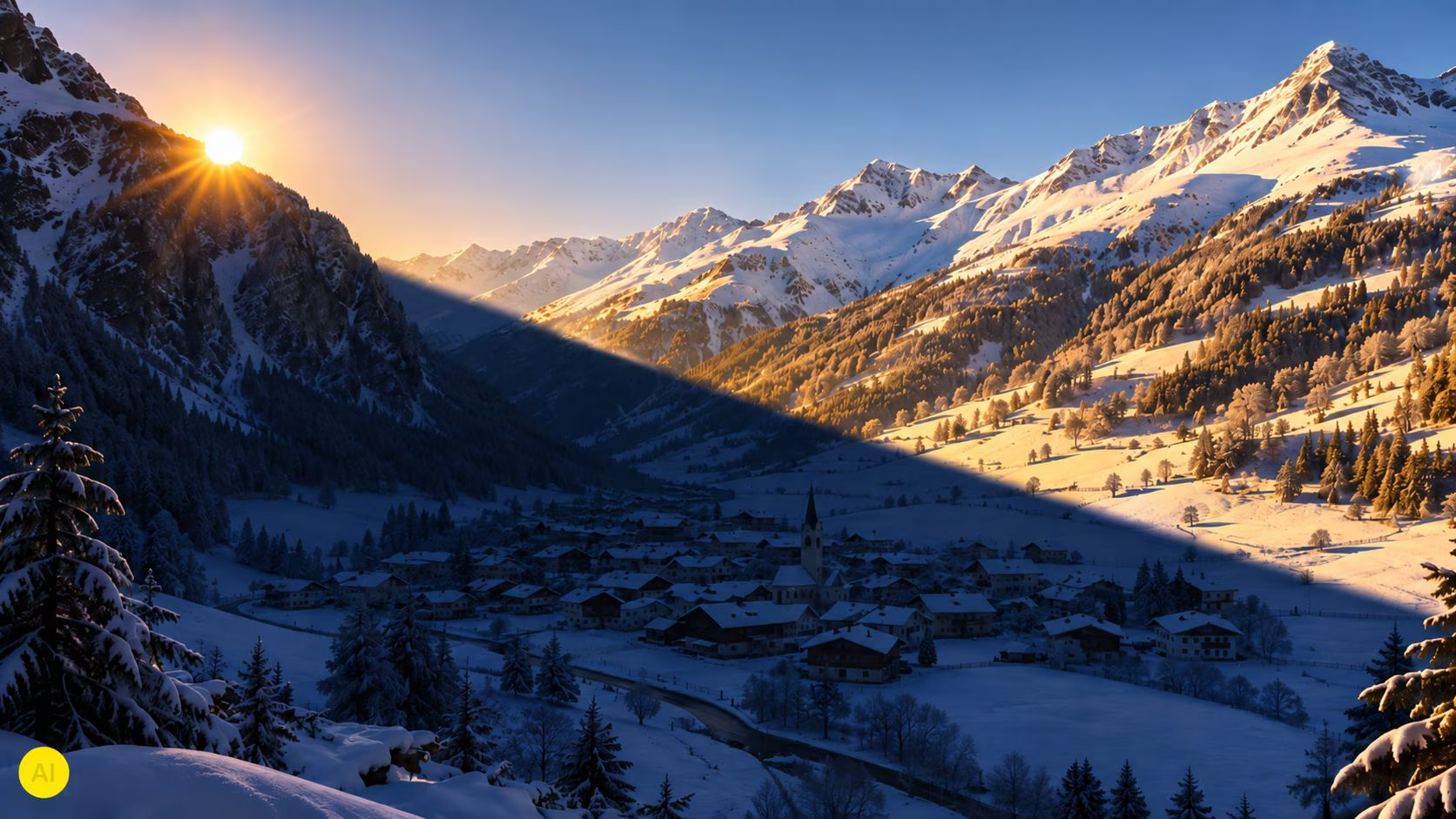
It is not a phenomenon linked to the polar night, but to the conformation of the valleys: the surrounding mountains, together with the low position of the Sun with respect to the horizon in the winter months, prevent the rays from reaching the inhabited areas. This is also the case of Viganella, in Piedmont, where there is no direct sun for 83 days a year, but also of other Alpine villages in Italy, France and Switzerland.
There are towns and villages in the Alpine valleys between Italy, France and Switzerland that pass entire months without seeing direct sunlight. This happens because in winter the sun is lower on the horizon and is unable, for astronomical and orographic reasons, to “climb” the mountains and reach some valleys. Be careful, these places are not completely dark: during the day they still receive sunlight diffused by the atmosphere, but during more or less long periods of the year they do not enjoy completely, or in some portions of the town, direct sunlighttherefore remaining in the shade.
In Italy there is one of the best known cases Viganellain Piedmont, a hamlet of Borgomezzavalle in the Antrola Valley, where the sun does not shine for 83 days a year and where the “artificial sun” was restored a few days ago after a fault: installed for the first time in 2006, it is a 40 m² computerized mirror that moves to bring reflected light to its inhabitants during the winter months.
Why in some Alpine countries the sun disappears in winter: topographical factors
This phenomenon is defined topographic shading (topographic shading or terrain shading) and depends on the combination of several factors. First of all astronomical:
- the inclination of the earth’s axis of approximately 23.4° (with respect to the perpendicular to the plane of the Earth’s orbit) – which, together with the revolution motion of the Earth around the Sun, determines the alternation of the seasons;
- the lowest apparent elevation of the Sun on the horizon during winter in the Earth’s northern hemisphere, particularly in the northernmost latitudes, caused by the previous factor. The altitude of the Sun at midday towards the winter solstice decreases as the latitude of the location increases and the orbit of the Sun is generally lower in winter: thus, at a latitude of around 46° N, representative of many Alpine locations, the altitude of the Sun at solar noon changes considerably during the year and in winter it causes it to remain low and is unable to rise.
Then there are the factors orographicthat is, the conformation of the mountain ranges and valleys:
- the height and distance of the mountains surrounding the localities and population centers taken into consideration;
- the orientation of the valleys and the position of the town itself, which may be more or less subject to shaded areas.
If during the summer season the sun reaches a very high position in the sky and its rays therefore more easily overcome the natural obstacles such as mountainswith the arrival of autumn and winter on the contrary, the apparent path of the sun becomes lower and lower compared to the horizon line, causing a lengthening of the shadows and therefore an extension of the shaded areas.
If, observing the sky from a town, the profile of the surrounding mountains reaches an angular height higher than that of the Sun in the same direction, the reliefs intercept direct solar raysleaving the town in the shade, as in the image below. If this condition occurs throughout the Sun’s daily path, the location remains in shadow for the entire day.
The countries with the most days of shade in the Alps
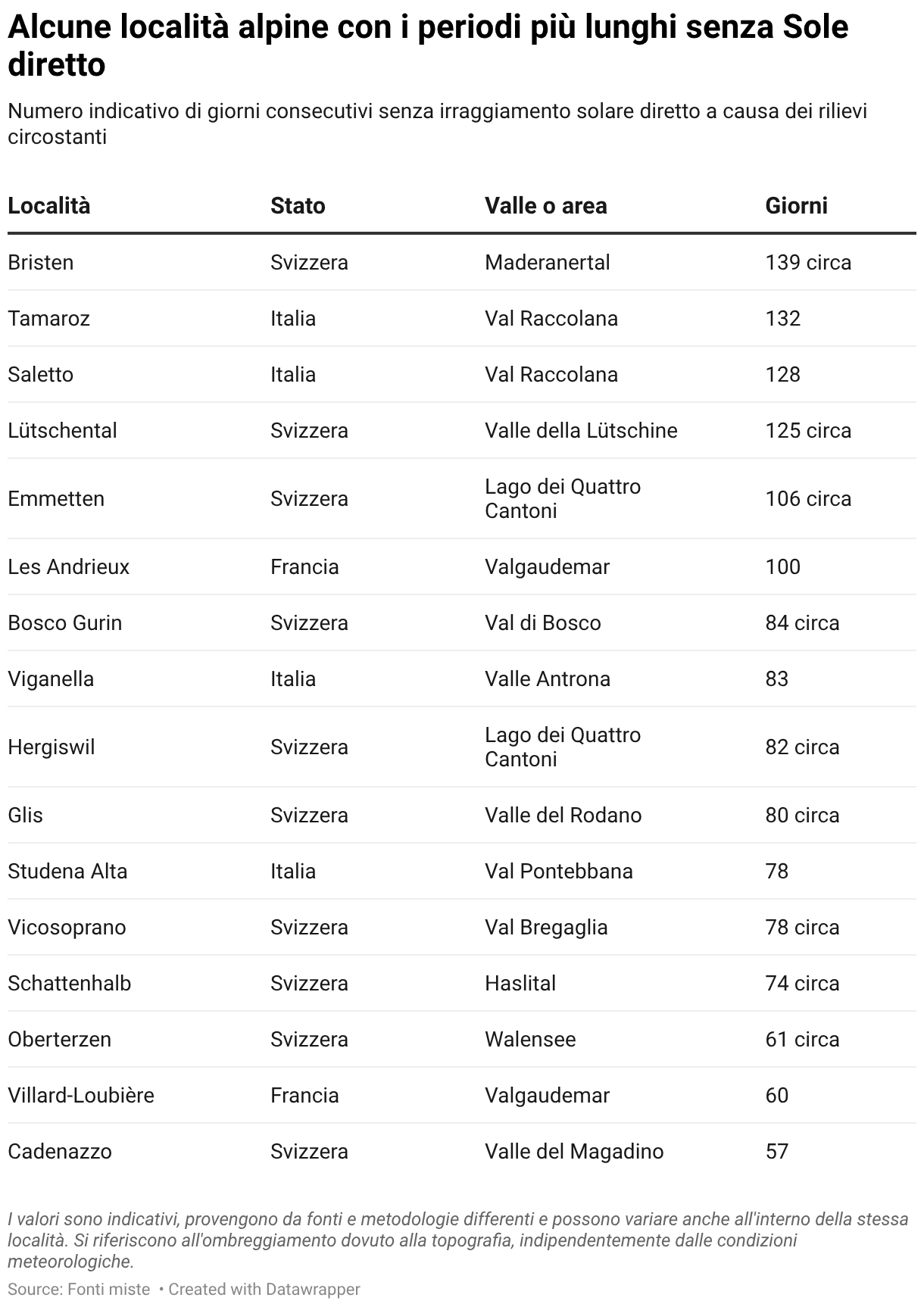
In Swissthe phenomenon of lack of direct solar radiation occurs for example in the Bergell valley, in Canton of Grisonswhere in Vicosoprano the sun is not visible from mid-November to the end of January. At the foot of Mount Bristen, in Canton of Uri, stands the village of the same name, where in some places, such as the town square, direct sunlight does not reach over four and a half monthsfrom October until the end of winter.
In Canton of Ticinohowever, there is the case of Bosco Gurin, which remains without sun for more than two and a half months, and the best-known one of Cadenazzo (the most populous shaded area in Switzerland according to the Corriere del Ticino, with around 3,200 inhabitants): here the shading due to the surrounding mountains can prevent the arrival of direct sunlight for 57 days a year, from the beginning of December to the end of January.
In Italy among the most extreme cases documented there are Tamaroz And Hallboth locations in Val Raccolana, in Friuli Venezia Giulia, which count respectively with 132 and 128 days without receiving direct sun, with a record in the region according to an analysis published by FriuliVillas, which examined 1,140 hamlets of 102 mountain and hilly municipalities in Friuli Venezia Giulia, using a digital terrain model.
Below is a non-exhaustive table of the most famous locations in the Alps affected by the phenomenon.
Viganella’s mirror: how the “artificial sun” works
One of the most famous cases in Italy is Viganellaa hamlet of Borgomezzavalle with around 200 inhabitants located in the Antrona Valley, in the province of Verbanio-Cusio-Ossola, in Piedmont, where for 83 days a year, from 11 November to 2 February, the sun doesn’t shine. For this reason, it was built and installed on the upper part of the mountain slope on the opposite side, a mirror, called heliostat, which changes its orientation during the day to reflect the sun’s rays towards the central square of the village, illuminating part of the town for around 6 hours a day.
The 8 × 5 meter reflective panel was inaugurated on December 17, 2006. Already in January 2007 a delegation of technicians and administrators from the Norwegian town of Rjukan (80 km from Oslo) visited Viganella to study its functioning: in 2013 the Norwegian town also equipped itself with a similar system, consisting of three mobile mirrors.
In 2023, a fault rendered the Piedmontese «Artificial Sun» unusable, which returned to operation in November 2026 thanks to a repair.