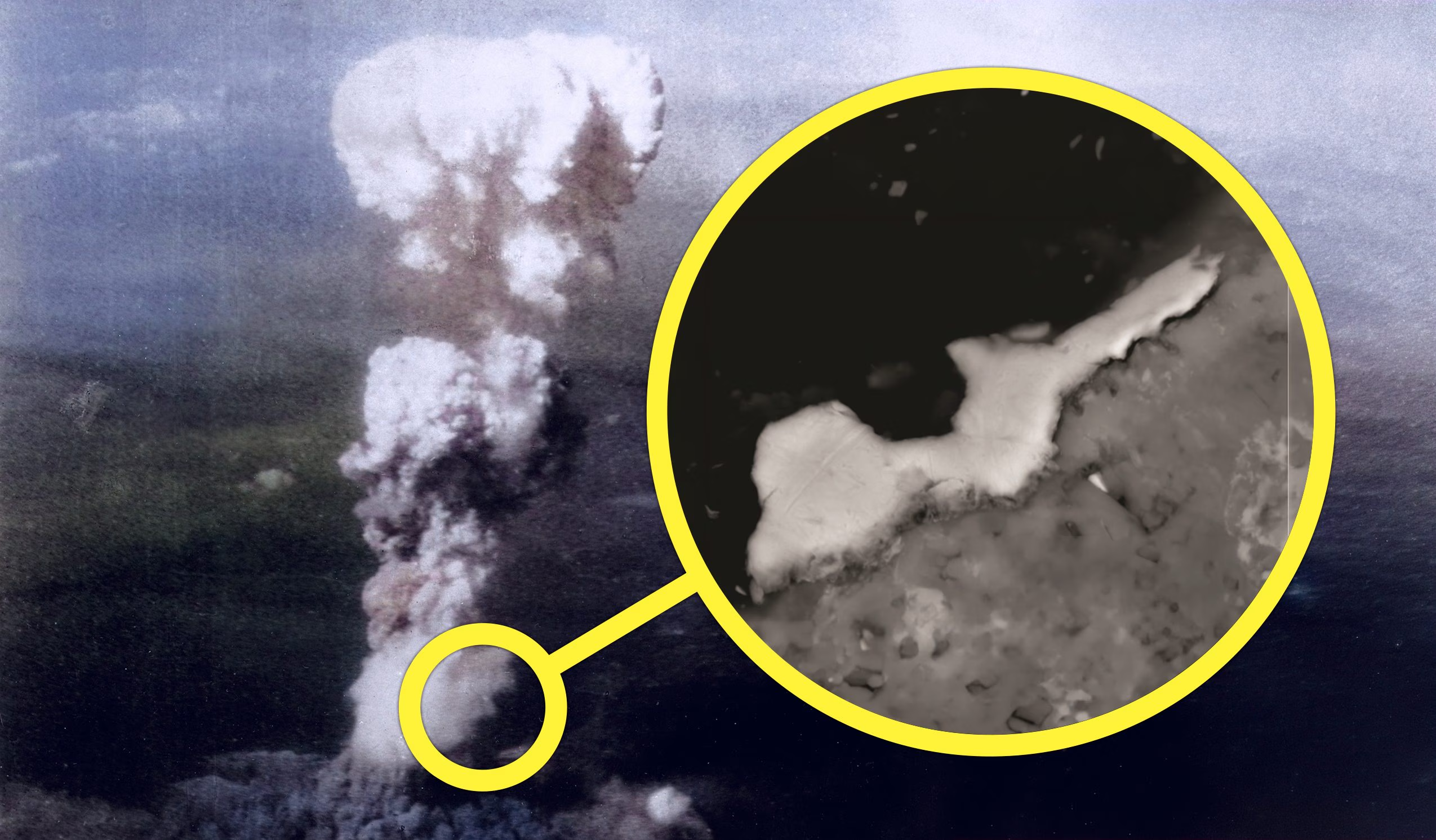
The August 6, 1945 the United States dropped out Hiroshima the first atomic device in history used in a conflict. Among the tragic consequences of that day, which we all know, there is one that we discovered only a few months ago: the explosion gave life, for an instant, to a material which had never existed on Earth. A phase seven-component intermetallicremained hidden in the sand for almost eighty years. It was found by a team led by the Italian geologist Luca Bindi (University of Florence), in a study published in Science Advances. But why is this discovery so relevant?
How the metal alloy was formed at temperatures above 7000°C
At the moment of detonation, the fireball in contact with the ground reached peak temperatures above 7000°C: more than the photosphere of the Sun, which is around the 5500°C. Everything on the ground – such as concrete, glass and steel of the structures – was instantly vaporized or melted, transforming into a dense metallic vapor mixed with molten material, raised into the mushroom cloud. Then, in a matter of seconds, that vapor cooled at a breakneck speed, falling back to the ground in the form of tiny glassy spherules.
Everything is fine spherulein a certain sense, was an involuntary micro-laboratory. Conditions that no industrial plant in the world could replicate – extreme heating followed by lightning-fast tempering – “frozen” atoms into configurations that do not form naturally. Inside one of these spherules, the researchers found a tiny crystalline speck rich in silicon and containing six metals: iron (about 62.7%), chrome (14.7%), nickel (8.9%), molybdenum (3.7%), manganese (2.1%) e aluminum in traces.
The numbers alone, however, don’t say much. The real strangeness is in the way these atoms arranged themselves. Normally, when such a complex mix of metals cools the atoms have time to “get together” and separate into structures more simple and tidy. Here, however, the opposite happened: the cooling was so rapid that the atoms did not have time to separate. They remained “frozen” all together, in one interlocking geometric regular never seen before. Conceptually, it’s a bit as if hundreds of people were suddenly stopped and stuck exactly where they were, forming a perfectly orderly figure by chance.
What is hiroshimaite
It all begins in 2019, when the geologist Mario Wannier He scours the beaches of Hiroshima Bay and finds the glassy spherules that we now call hiroshimaite. Bindi’s team analyzes 34 of these spherules, ranging from a few hundred micrometers to a few millimeters wide: practically grains of sand. Under the electron microscope, several trapped metal fragments emerge in one of them. One in particular catches your attention: barely 10 micrometers long – one tenth the thickness of a hair – with an anomalous chemical signature and very rich in silicon. With very thin needles under a reflected light microscope, the researchers they extract that grain microscopic and bombard it with X-rays to reconstruct its three-dimensional atomic structure. The result confirms: it is a phase never documented before, neither in nature nor in the laboratory.
This discovery is not just an anecdote for crystallographers. These grains are, in fact, a archive physicist frozen: They recorded the extreme thermodynamic conditions experienced in the fireball for a fraction of a second, in 1945, and preserved them for eighty years. They also tell us something concrete: such complex alloys they can exist and be stable, even if they require conditions that are almost impossible to replicate in the laboratory today. Knowing this, however, opens up new paths for metallurgy – understanding how structures with this combination of hardness, corrosion resistance and thermal stability are created – and offers an additional tool for nuclear forensics, the discipline that analyzes the residues of an explosion to reconstruct the original materials and dynamics.
