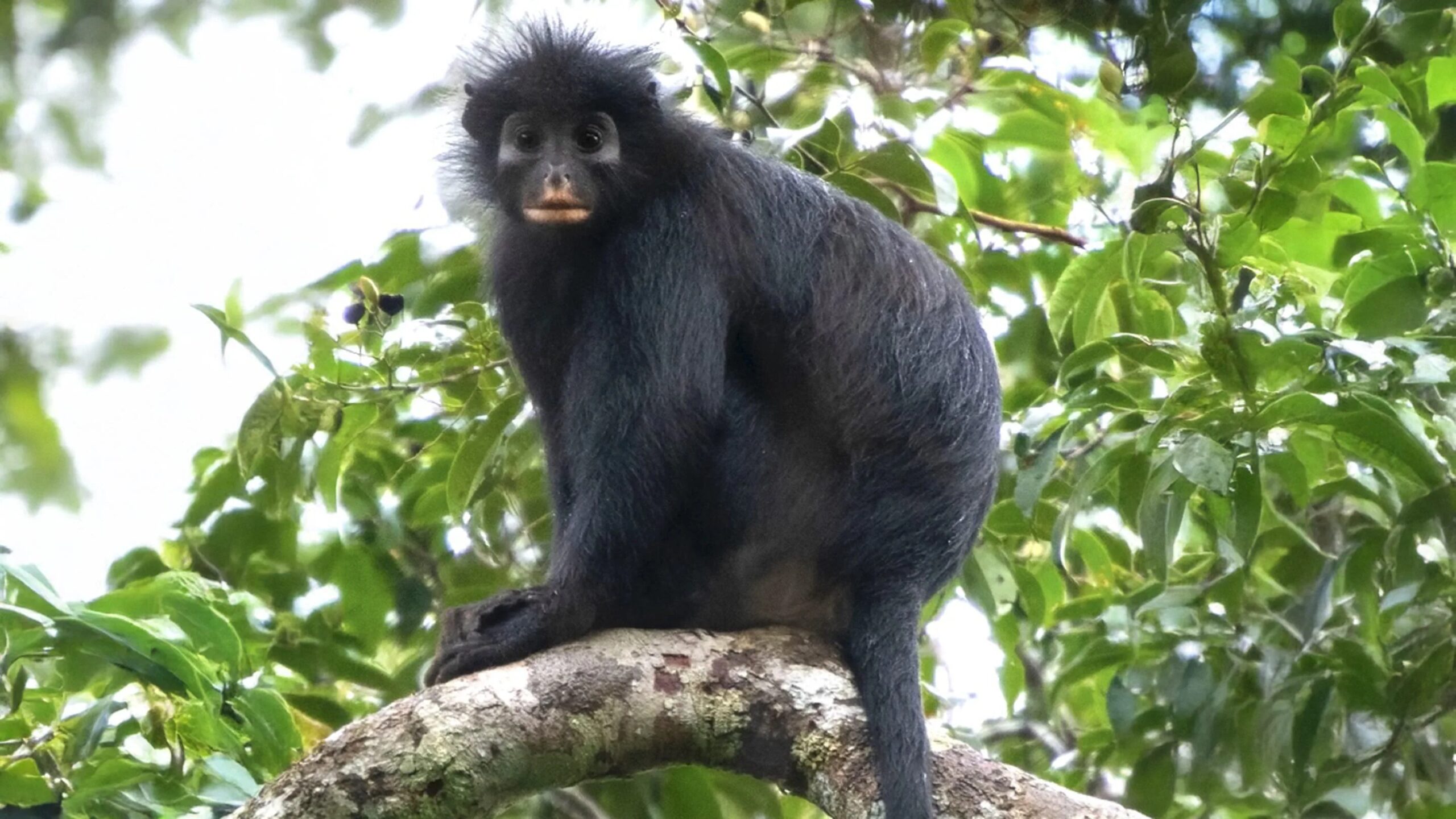
In the dense rainforests of Democratic Republic of the Congobetween the Lomami River and the Lualaba River, the discovery of a new species of primate has been confirmed: the Colobus congoensisknown to local populations as “Likweli“. Featured in the magazine PLOS One after a series of elusive sightings in the Lomami National Park that began in 2008, this small monkey stands out for its thick black coat, a peculiar facial “mask” in cream-orange tones and a conspicuous white perianal spot. Morphological, acoustic and DNA analyzes have shown that it is a separate species, a distant “cousin” of the black colobus (C. satanas). It is only the fifth new African monkey discovered in the last 75 years, but it risks disappearing before it is even fully known: scientists are calling for its immediate inclusion among the “Endangered” species (Endangered) due to its very small range (approx 1,700 km²), threatened daily by rapid deforestation and poaching.
Colobus congoensis: appearance and differences with other species
The Likweli is a small colobus monkey, with a long tail and completely black fur that almost forms a shiny coat on the shoulders. Around the mouth, on the upper lip and on the nasal filter stands out a patch of glabrous colored skin cream-orangeframed by dark gray cheekbones and a black circle around the eyes, which gives the muzzle an almost masked appearance. To complete the picture, a showy white perianal patch (hairier in males, glabrous in females) which in nature is not found with this extension in any other species of the genus Colobus.
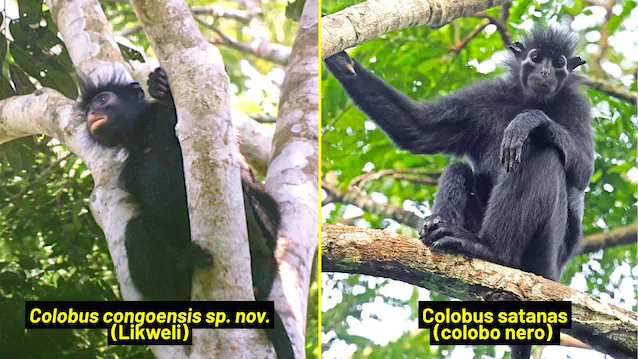
The work of the researchers – led by John Hart of Lukuru Wildlife Research Foundation and Kate Detwiler of Florida Atlantic University – he didn’t stop at the external appearance. By comparing the skull, teeth and mitochondrial DNA of three specimens with those of 13 other species of African colobins, the team was able to precisely place the Likweli on the primate family tree: its closest relative is the Colobus satanas (the black colobus, endemic to central-western Africa). Their evolutionary line split between 4 to 5 million years agoand today the territories in which the two species live are separated by more 1,200 km.
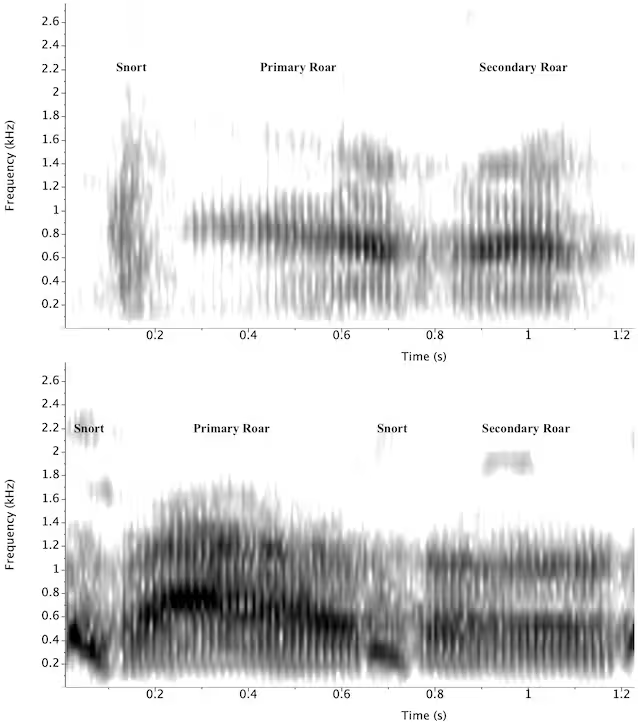
Also the voice call refers to this species: the roars of the Likweli share those of the C. satanas a rapid pulse rate and frequency modulation, traits absent in all other colobus species. But in acoustic detail (duration, timbre, sequence of secondary calls) they still remain distinguishable.
The habitat of the “Likweli” and the first sightings in the Lomami park in Congo
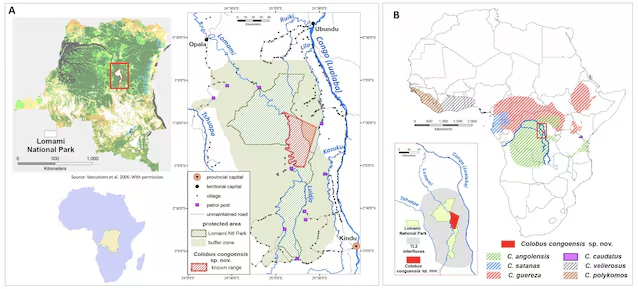
The Likweli lives exclusively in the rainforest belt between the Lomami River and the Lualaba River (the upper reaches of the DRC), in the province of Tshopo, in and around the Lomami National Park. It particularly prefers tall, closed forests on clayey soils, while it avoids sandy savannah areas or areas subject to seasonal flooding.
The first clue of their existence dates back to 2008, when conservationists of Lukuru Wildlife Research Foundation by chance they photographed, among the highest branches of the forest, a monkey that did not correspond to any known species in the area. We had to wait until November 2018 for Jean Pierre Kapale, during a surveillance patrol, to photograph the animal again. In the following ten months his team documented it seven more times, and comparing the photos from 2008 and 2018 confirmed that it was the same species, never described before.
Between 2018 and 2022 researchers total 114 field observations in an area of approximately 1,700 km². The animals are mostly spotted in small groups (on average 6 individuals) and often in association with other monkey species, a mixed social behavior quite common among the primates in the area. Curiously, the species is almost unknown even to the local communities living on the borders of its range. The two names by which it is called reflect precisely this elusiveness: Likweligiven to him by the Balanga people, and kasaba nkoni (“the branch shaker”), used by Mituku communities.
Why the new African monkey species is in danger
The Colobus congoensis it’s just there fifth new species of African monkey described over the last 75 years, a rare event at a time when much of the biodiversity of large mammals was considered already mapped.
But the good news of discovery brings with it bad news about conservation. The researchers propose to classify the species as “Endangered” (in danger) in the IUCN Red List, due to a combination of factors all documented in the study: an extremely restricted range (about 1,700 km², compared to the 60,000 km² typical of other species of Colobus), numerically scarce and dispersed populations, and growing threats linked to deforestation and hunting pressure. Only in the province of Tshopo, which hosts a large part of its territory, the loss of primary forest is estimated at 4% per annumwhile the human population of the Democratic Republic of Congo is growing at a rate of 3.2% per year resulting in the expansion of hunting, fishing and itinerant agriculture right in the park’s buffer zones. Precisely for this reason, according to the authors of the study, the effective protection of Lomami National Park represents today the most urgent measure to guarantee the survival of the Likweli.
The discovery of Colobus congoensis is both a scientific triumph and a warning that some of Earth’s rarest creatures may disappear before the world even knows they exist.
Kate Detwiler (Ph.D. and senior author of the study)
