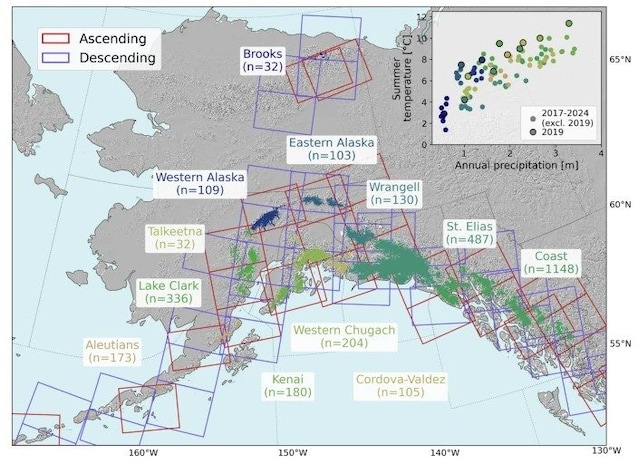
The fusion period of glaciers in Alaska it lasts longer and longer due to global warming. This was revealed by radar analyzes carried out starting from data collected between 2016 and 2024 with European satellites Sentinel-1from which it emerges that every 1 °C increase in the average summer temperature causes these they found for three more weeks per year. Furthermore, studies show how aheat wave in the past caused the glaciers to lose almost 28% more of their snow cover compared to normal years. The collected radar data was analyzed by researchers from Carnegie Mellon University, Pennsylvania, and the University of Alaska Fairbanks. The new study, published in the journal Natureit is also important because it shows the potential of synthetic aperture radar (HRH), which can monitor glaciers constantly and automatically all year round.
The use of data provided by satellite radars
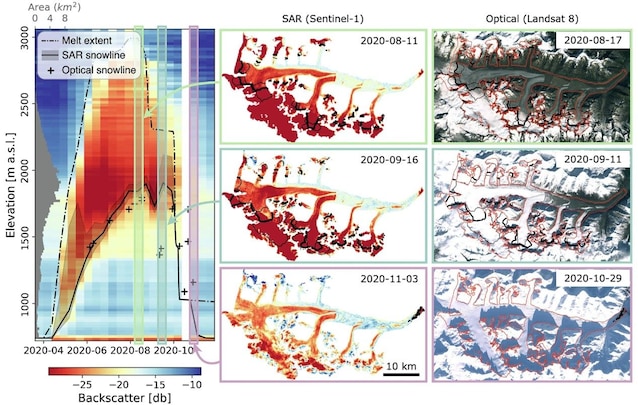
The planet’s glaciers are melting at a very high rate due to global warming, but our understanding of their changes is limited when using traditional optical instruments. THE synthetic aperture radar of the Sentinel-1 satellites, which provided the data on which this study is based, can instead monitor constantly glaciers all year round. Their technology is based onsending microwave pulses towards the ground from a moving aircraft or satellite and on recording of re-emitted signals from the earth’s surface. Their operation, unlike that of optical sensors, is independent of sunlight and meteorological conditions such as cloud cover and precipitation. The result is high resolution images of the Earth’s surface. The European Sentinel-1 satellites pass over the same point on the surface every 12 days and, between 2016 and 2024, have constantly monitored almost all of Alaska’s glaciers (about 3000) with dimensions greater than about 1.3 km. These radars also recorded the change in the persistent snow linethe line that separates the area of a glacier where snow accumulates and turns into ice, from that where the ice is lost through melting. This line moves in response to seasonal variations and climate change and with optical instruments it was only possible to detect it at the end of the melting season, in late summer or early autumn.
What radar images revealed about Alaska’s glaciers
The researchers used radar data to pinpoint the number of glacier melt days per year. It turned out that every 1 °C increase in average summer temperature causes these they found for three more weeks per year. The study also focused on the effects ofheat wave that from June 23rd to July 10th 2019 hit Alaska, during which temperatures exceeded the seasonal average by about 20°C for about two weeks. According to radar data, the glaciers reacted with a notable retreat of the snow line, of more than 100 m in altitude. On this occasion the glaciers of Alaska lost almost their 28% more of their snow cover compared to normal years. This phenomenon demonstrates how glaciers are extremely sensitive to short-term climate variability. Thanks to technological advances, in the future it will be possible to improve predictions on the evolution of glaciers in response to global warming.