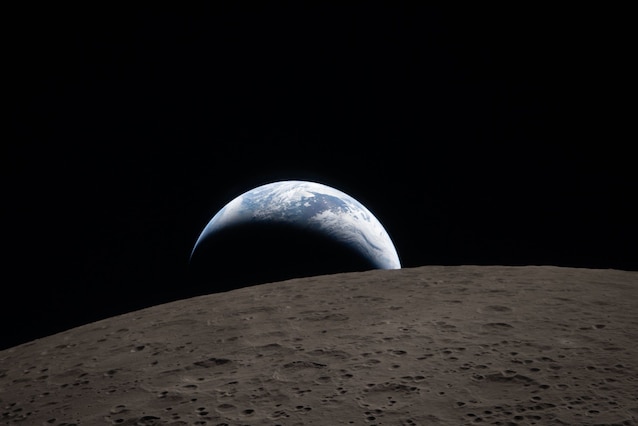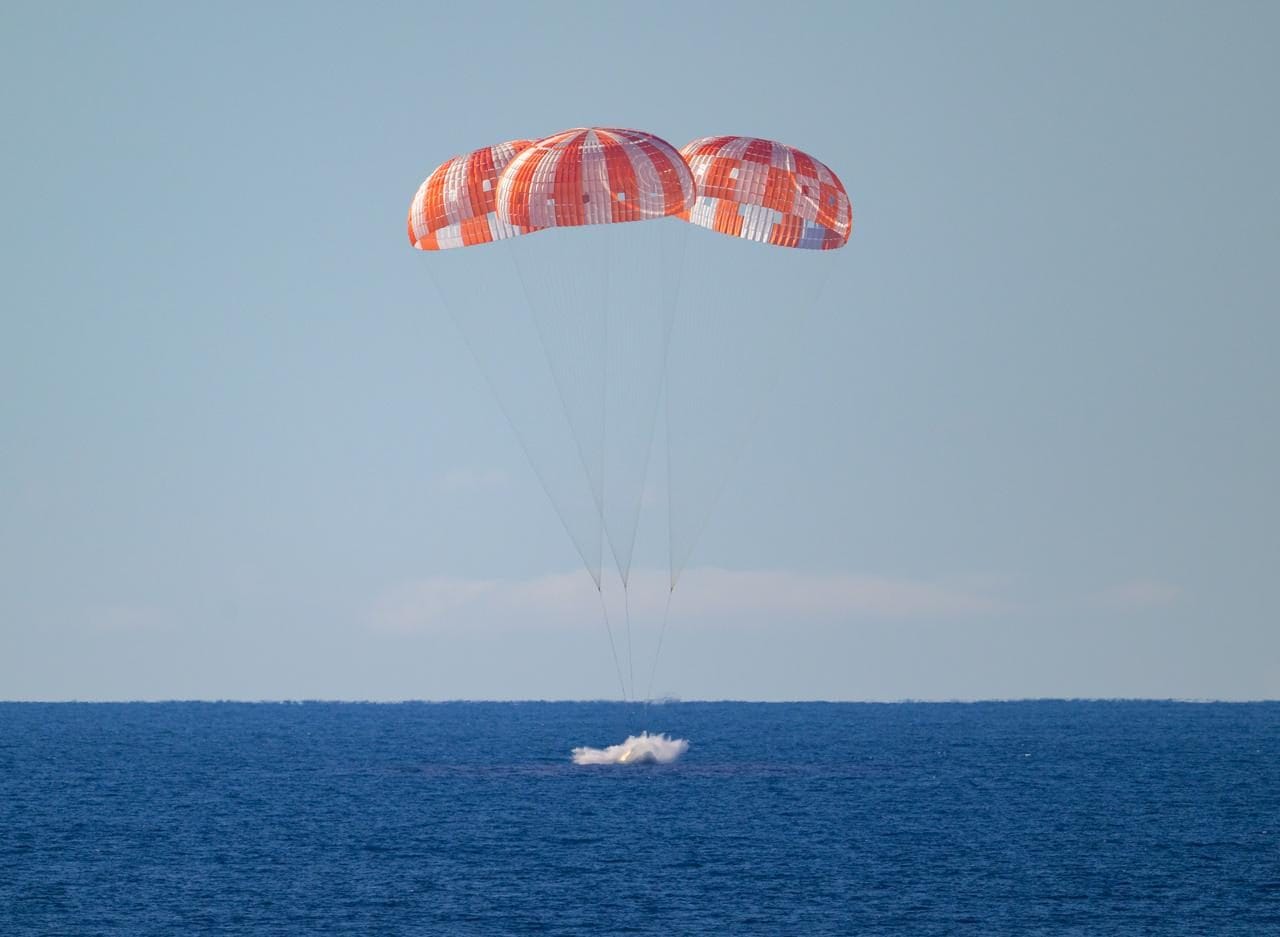
On the night between Friday 10 and Saturday 11 April 2026, the capsule Orion of NASA landed in the Pacific Ocean off San Diego, California, concluding the Artemis II mission after nine days, 1 hour, 32 minutes and 15 seconds. They were the 2.07 Italian time when Reid Wiseman, Victor Glover, Christina Koch and Jeremy Hansen landed off the coast of San Diego, California, after a dizzying descent into the Earth’s atmosphere at a speed of about 40,000 km/h. It was the first human flight beyond low Earth orbit since Apollo 17, way back 1972. The return, which occurred with a maneuver skip reentry like Artemis I, it was one of the most delicate moments of a journey that took the four astronauts up to 406.771 kilometers from Earth – the furthest point ever reached by humans in history – and also made them fly over the far side of the Moon.
How did the reentry into the atmosphere and the landing go?
After the lunar flyby, Orion used the Moon’s gravitational pull to automatically head towards Earth, with almost no need to turn on its engines. The return was not a simple fall but a precise and complex maneuver that began at 01.33 Italian time with the separation between the crew module and the European service modulewhich guaranteed energy and propulsion for the entire journey, leaving the habitation module to crash with the four astronauts on board.
The peculiarity of this critical phase lasting approximately 8 minutes was the adoption of the maneuver called skip reentry (“bouncing re-entry”), the same used for Artemis I. Instead of entering the atmosphere directly, the Orion capsule impacted “edged” at very high speed into the upper layers of the atmosphere, so much so that it bounced like a stone thrown onto a pond, before regaining altitude and re-entering a second time for the final descent. This double maneuver was fundamental for reduce there deceleration suffered by astronauts e improve there precision of the trajectory towards the planned ditching area.
During the final descent, in which the crew had to break off all contact with land, the heat shield it protected the passenger compartment from high temperatures (2,800 °C) caused by friction with the air. There was one technical question in particular that had NASA engineers on the edge of their seats. After Artemis I, in 2022, an unexpected degradation of the heat shield was found Avcoatthe material designed to absorb (melt) the heat of friction and thus protect the housing module. For this mission, instead of redesigning the shield, NASA chose a modified reentry trajectory, calibrated to expose the shield to temperatures higher for a shorter time. A decision not without debate among experts, with some engineers having expressed public concerns.
However, with this solution the shield held up perfectly, protecting the cockpit and the astronauts. Finally, the opening of the 3 parachutes of 35 meters in diameter slowed Orion down to a safe speed (about 27 km/h) to have a soft impact with the ocean.
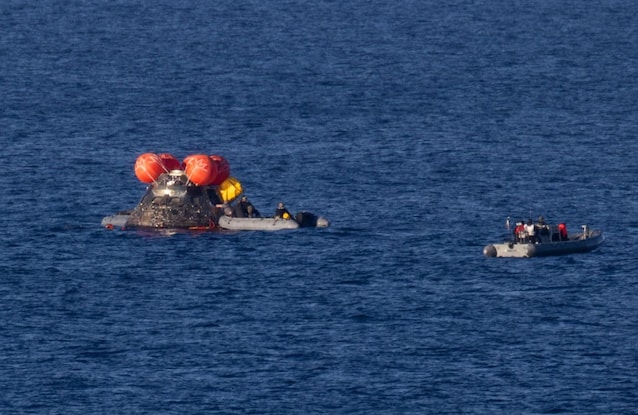
At this point a US Navy ship and specialized teams recovered the crew after the splashdown. The astronauts, all 4 in excellent condition, were first transferred to an inflatable boat, then recovered by a MH-60 Seahawk helicopter and finally transported to USS John P. Murthaper the former controls doctors.

Although it was initially thought that Orion could cross the threshold of 39,938 km/hthe all-time speed record for a manned flight of the mission Apollo 10 of 1969, the final data confirmed that the capsule reached a maximum speed of 38,367 km/h failing to establish a new record.
Artemis II was the first crewed mission to the Moon of the 21st century
Artemis II it was the second mission of NASA’s Artemis program and the first with astronauts on board. Its goal was not to land on the Moon (it will be the goal of Artemis IV not before 2028), but test in real conditions all the systems of the Orion capsule, from navigation to life support, which will be used to take a crew to the moon.
Aboard Orion during i ten days There were four astronauts on the mission: Reid Wiseman as commander, Victor Glover as a pilot, Christina Koch And Jeremy Hansen as mission specialists.
From a technical point of view, the mission had several objectives. In addition to certifying Orion’s life support systems for long-duration missions, the presence of astronauts made it possible to collect data on cosmic radiation into deep space and verify the maneuverability of the capsule. Everything tested in this mission will be used to make a human walk on the Moon again in the continuation of NASA’s lunar program.
Launching on April 1st
The journey began in the night between 1st and 2nd April 2026. At 00:35 Italian time, lo Space Launch System (SLS) lifted off Ramp 39B at the Kennedy Space Center in Florida. A launch which, after some postponements, managed to be completed successfully.
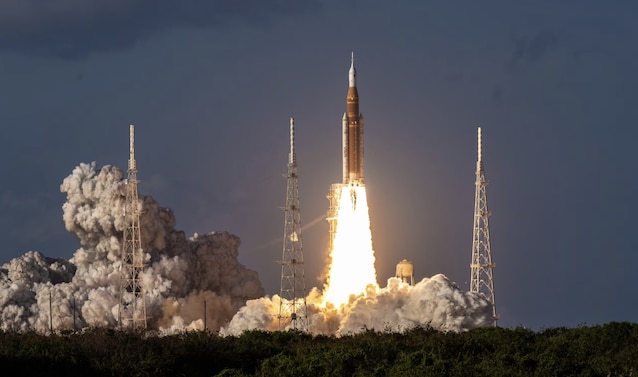
After approximately 8 minutes of flight, the SLS separated the boosters lateral solid fuel from the rocket’s main stage, leaving the Orion capsule – renamed Integrity by the crew – initially accompanied by the SLS upper stage. A few hours later, pilot Victor Glover successfully performed proximity maneuvers in Earth orbit, separating from the upper stage and simulating approach maneuvers.
In the following hours, Orion reached a distance from Earth of approximately 70,000 km before starting the engines for the translunar injection maneuver (TLI) and point towards the Moon. The journey to the satellite had begun.
The flyover on April 6th
The most symbolic moment of the mission came when Orion began his mission lunar flyby at 8.45pm Italian time on April 6th, ending at 3.20am on April 7th. Orion circumnavigated our satellite, coming as close as possible 6,550 km from the surface of the Moongiving the crew a view no human has had in over half a century. For about 40 minutes, as the capsule passed behind the Moon compared to Earth, communications with the control center in Houston were completely interrupted.
It was in those minutes, at 01:07 Italian time on April 7, that Orion reached its point of maximum distance from Earth: 406.771 kilometresbeating the record held by the Apollo 13 mission since 1970 (400,171 km). During the passage behind the Moon, the astronauts were able to observe asolar eclipse (the Moon that obscures the Sun), in addition to sunset of the Earth seen from the other side of the Moon (Earthset).