
When we are in queue at the supermarket generally we tend to choose the shortest queue, however, it often seems to us that the other queues, the longer ones, proceed faster. But is it really like that? Not always, but it is no coincidence that we have this feeling so often: it has in fact been demonstrated that, having to choose between 2 queues, the chance that that longer is faster of the short one can be rather high even when it is twice as long.
First of all, in general, if there are more than two queues all more or less the same length, the probability that we will be able to choose the fastest one is not very high. For example, if there are 4 queues, we only have a 1 in 4 chance of guessing the fastest queue and a 3 out of four chance of ending up in one of the slowest queues. In practice we have the 75% chance Of Don’t end up in the fastest queue: most of the time it is therefore very likely that we actually find ourselves in one of the slow queues, a bit like what happens with queues on the motorway.
However, if the queues are only two, plus minus the same length, the probability of randomly choosing the fastest queue is 50%, so it’s just a matter of fortune. Things change if one queue is obviously longer than the other because in this case we generally opt for the shorter tailbut it is not at all certain that this is the fastest one. In fact, if all the customers in the queue have more or less the same quantity of products in the cart then the shortest queue is usually also the fastest, but if the number of products in the carts varies a lot from customer to customer then this is no longer necessarily true.
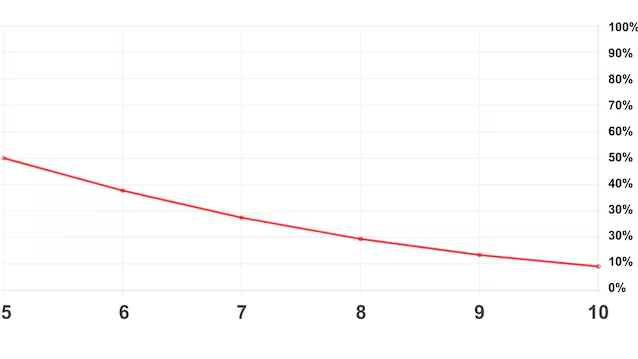
From a mathematical point of view the problem was approached using the probability calculationfor example the mathematician Alexander Herzog calculated that if we are in a queue of 5 people, and the other queue has 8 people, the probability that the other queue is faster is around 19.4%, in practice almost 1 out of 5 times there long tail will be faster. Even if the other queue was made up of 10 people, double ours, the probability would decrease but would still be high, around 9%: almost one time in ten a queue of 10 people could be faster than a queue of 5 people.
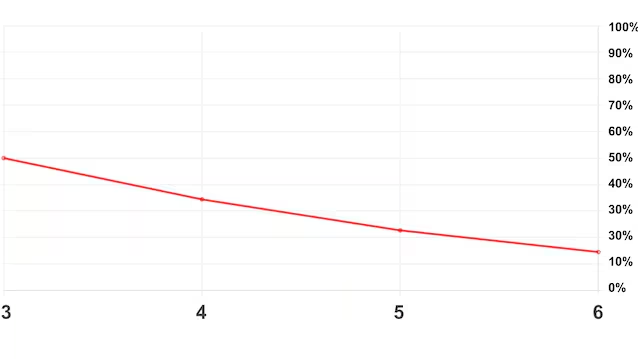
In the case of a queue of 3 people the probability that a queue twice as long, 6 people, will be faster is even higher, i.e. about 14.5%.
In essence, it is true that generally the shorter tail is faster, but the chances of the opposite happening are quite high, enough to make us think that it is precisely the longest queue that is most often the fastest, perhaps precisely when we are in the other queue. The good news is that, unlike what happens for thenext row effect on the motorway, there is a simple trick that can eliminate the disparity between the different rows: just organize the checkouts with a single queue and the first of the rows gradually heads towards the first free checkout.
